
Key takeaways
- The median price of a priced product on Amazon UK is £16.99, across 193,782 priced products.
- Toys & Games has the highest category median price at £28.49 and Beauty & Personal Care the lowest at £12.68.
- For priced products overall, the dearest tenth starts 10.6x above where the cheapest tenth ends.
The typical price on Amazon UK is a median of £16.99 across 193,782 priced products in our sample, and category medians run from £12.68 in Beauty to £28.49 in Toys. To get there, we sorted the 868 searches we ran on amazon.co.uk on 23 to 24 September 2026 into 16 categories and took each category's median.
The Data
People search for the "average price on amazon uk", but a plain average (the mean) is a poor answer here. A handful of listings at thousands of pounds, some of them likely placeholder prices, would pull it well away from what a shopper actually pays. The median does not care about those outliers: it is the middle price, with as many priced products below it as above it.
Across all 193,782 priced products, the median is £16.99. The cheapest tenth of priced products sells for £6.59 or less, and the dearest tenth for £69.99 or more. Here is the median by category, over 16 categories.
| Category | Median price |
|---|---|
| Toys & Games | £28.49 |
| Baby | £22.99 |
| Garden & Outdoor | £22.65 |
| Tools & DIY | £21.35 |
| Sports & Fitness | £20.99 |
| Electronics & Computing | £19.99 |
| Camping & Fishing | £19.99 |
| Automotive | £18.64 |
| Fashion & Travel | £17.95 |
| Pets | £16.99 |
| Health & Supplements | £16.69 |
| Home & Cleaning | £16.00 |
| Kitchen & Dining | £15.49 |
| Office & Stationery | £13.95 |
| Arts, Crafts & Music | £12.99 |
| Beauty & Personal Care | £12.68 |
| All priced products | £16.99 |
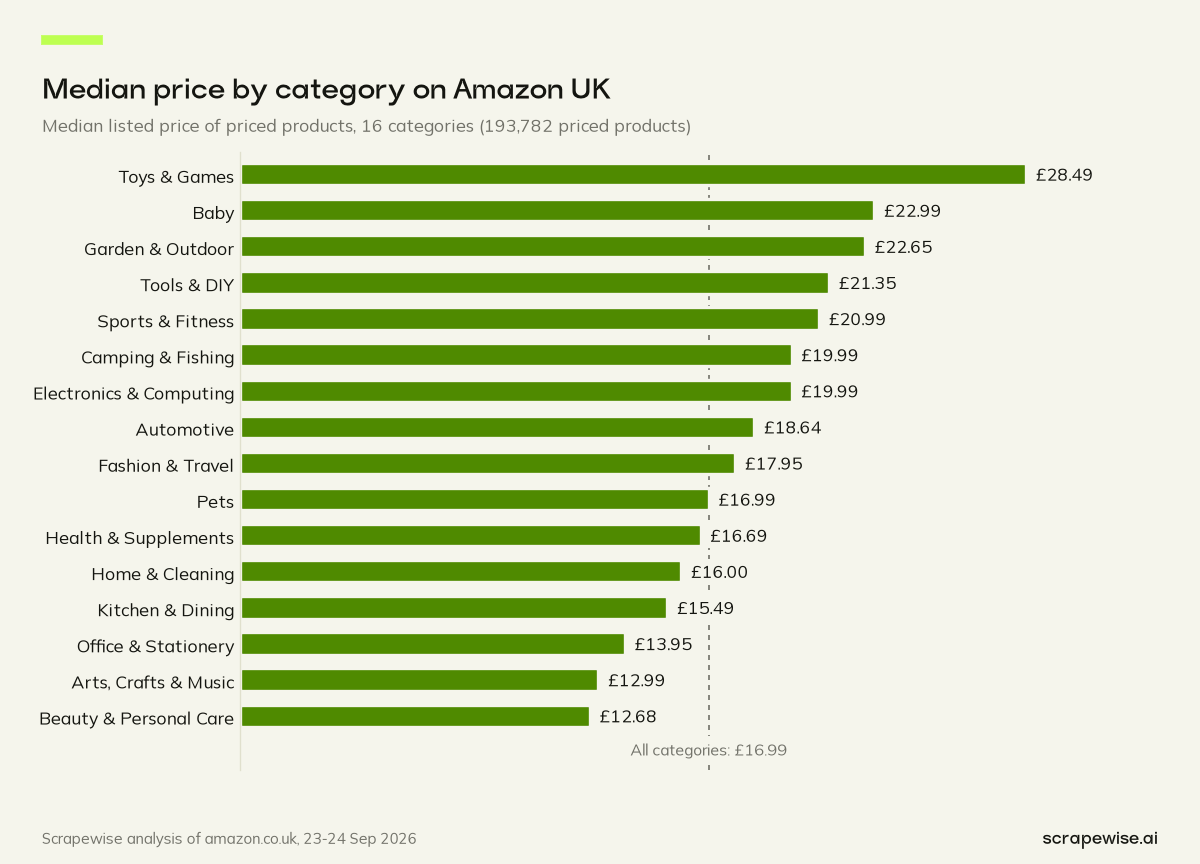
The whole table of priced products fits between £12.68 and £28.49. For a shop that sells both nail files and turbo trainers, that is a remarkably polite range. In every category we grouped, the typical product costs tens of pounds, not hundreds.
Which Categories Cost the Most and the Least
Toys & Games leads at £28.49. Our toy searches include LEGO sets and model kits. Baby (£22.99) and Garden & Outdoor (£22.65) follow, then Tools & DIY (£21.35) and Sports & Fitness (£20.99). These are categories where a lot of products are equipment rather than refills.
At the other end, Beauty & Personal Care has the lowest median at £12.68, just under Arts, Crafts & Music at £12.99 and Office & Stationery at £13.95. These categories include many small consumables: a lip balm, a pack of pens, a tube of paint. Pets sits exactly on the overall median at £16.99.
Keep the sampling caveat in mind. A category median depends on which searches we put in the group. If we had searched for more espresso machines and fewer peelers, Kitchen & Dining would look dearer. Treat the table as a picture of these 868 searches, not a census of Amazon.
How Wide Prices Spread Within One Search
A median tells you where the middle is. It says nothing about how far apart the cheap and dear ends are, and for pricing that often matters more. We measure spread inside a single search: the price where the dearest tenth begins, divided by the price where the cheapest tenth ends.
Measured across all priced products at once, the spread is 10.6x. Inside single searches with enough products to measure, it runs from 2.0x to 28.3x. A few smaller searches spread even wider, so we leave them out of the table.
| Search | Price spread |
|---|---|
| turbo trainer | 28.3x |
| drone | 27.8x |
| sewing machine | 22.9x |
| OBD2 scanner | 22.1x |
| IPL hair removal | 22.1x |
| chess set | 21.3x |
| cushion covers | 2.2x |
| boot liner | 2.1x |
| jigsaw 1000 | 2.0x |
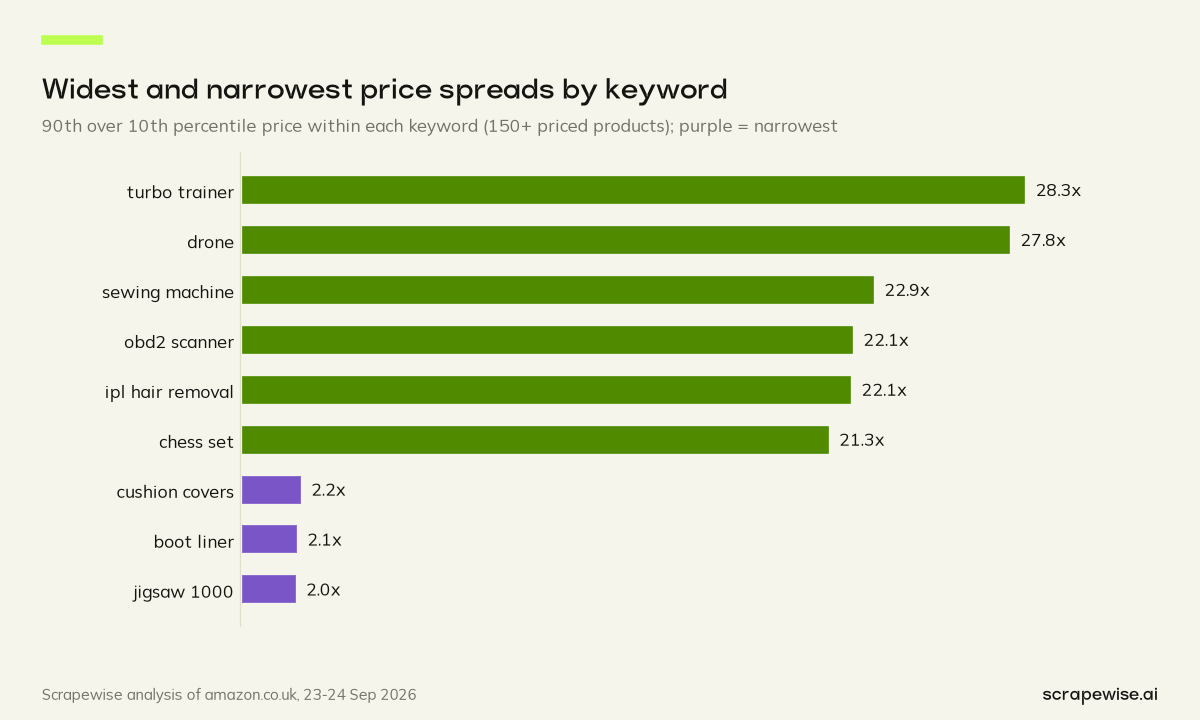
The wide searches have one thing in common: a single search term can cover very different products. "Turbo trainer" can mean a basic resistance stand or a full smart trainer. "Drone" can mean a small toy or a camera drone. "Sewing machine" can mean a mini hand-held unit or a serious machine. The narrow ones, like cushion covers or a 1,000-piece jigsaw, describe a product that barely changes from one listing to the next.
What It Means for Sellers and Brands
If you are pricing a new product, the category median is a starting point, not a target. The spread tells you how much room there is around it. In a narrow search such as cushion covers, your price has to sit close to everyone else's, because shoppers can compare like for like. In a wide one such as drones, price is less of a signal and features carry more weight, so the question is which part of the range you belong in.
This connects to what sells at each price level. Our post on the best price point to sell on Amazon shows that cheaper products carry a sales label far more often, and our list of the cheapest things on Amazon UK looks at the bottom end of the range.
A category is really a set of searches, and each search has its own middle and its own spread. One price list per category hides both, which is why the search is the better unit for pricing work.
What It Means for Analysts
Three practical rules follow from this data. Report medians for price levels, because a mean on Amazon data is hostage to placeholder listings. Compare prices within a search, not across a category, because the category mix drives most of the difference. And set outlier rules per search, using the spread: a price far above the median is normal in a turbo trainer search and more likely a data error in a cushion cover one.
For a longer guide to collecting and cleaning price data, see our price scraping guide for ecommerce, and for turning it into a routine, how to track competitor pricing. The complete Amazon UK marketplace report puts these price levels next to seller, rating and search data.
How We Collected This Data
For this post we used the Amazon Search API on its own. It read results pages 1 to 7 on amazon.co.uk for 868 keywords and captured the listed price of every product, tagged with the keyword that found it. The keyword tag is what let us group products into categories and measure the spread inside each search. Pricing is €0.00015 per call, or €0.15 per 1,000 calls, with one results page per call. You can schedule it daily, every few days, weekly or monthly, or run it on demand, and take the rows through the REST API or a CSV/Excel export. Make an account to work out the median and spread for your own searches.
What does the typical product cost in the searches you sell in, and how wide is the range? Measure it with 5 free requests, then pay as you go. Begin here, or see pricing for the per-call rates.
Paste a marketplace URL — get structured market data
Size categories, track assortments, monitor trends. Clean feeds ready for your BI stack.
97% accuracy on Amazon benchmarks · no credit card · book a 15-min call →