
Key takeaways
- Within the same keyword, median prices of China and Hong Kong based sellers were 3% below UK-based sellers across 641 keywords.
- Same-keyword star ratings were equal, with a median ratio of 1.00x.
- On 939 products with both a mainland China-based and a UK-based new offer, the cheapest offers had a median price ratio of 1.00.
Sellers based in China and Hong Kong are a little cheaper on Amazon UK when you compare like with like: within the same keyword, their median price was 3% below that of UK-based sellers, across 641 keywords. We ran the test on amazon.co.uk search results and offer pages from 23 to 24 September 2026, using the business address each seller declares.
The Data
In the keyword test, "China and Hong Kong based" means a seller whose Amazon profile declares a business address in mainland China or Hong Kong, and "UK-based" means a declared UK address. The same-product test further down uses mainland China addresses only. An address says where the business is registered, not where its stock sits or who runs it.
For each keyword with enough products from both groups, we took the median price, star rating and review count of each group and divided one by the other. The table shows the median of those ratios across keywords.
| Measure, same keyword | China and Hong Kong based vs UK-based | What it means |
|---|---|---|
| Price | 0.97x | 3% lower; lower in 52.3% of keywords |
| Star rating | 1.00x | equal |
| Review count | 0.79x | 21% fewer reviews |
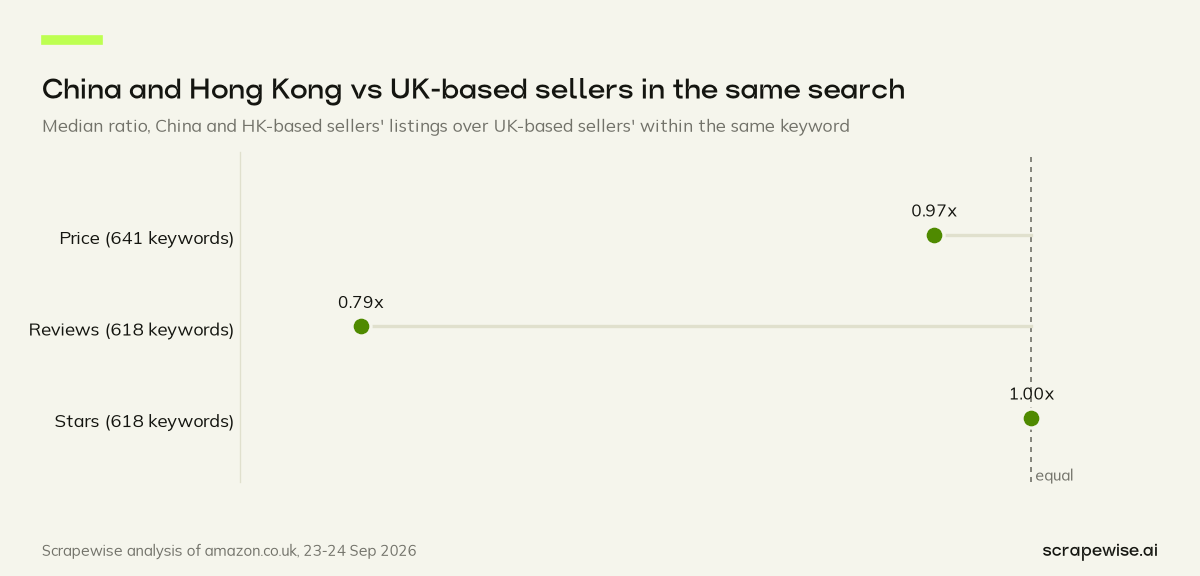
Price was close to an even split. The China and Hong Kong group had the lower median price in 52.3% of the 641 keywords.
Why a Like-for-Like Test Matters
Raw averages mislead here. Sellers from different countries list different mixes of products, and a group that lists more small accessories will look cheaper than a group that lists more furniture, even if both price each item the same. Across the whole site, a price comparison would mostly measure what each group sells, so each comparison here stays within one search.
Keeping to the same keyword removes most of the product-mix effect. It does not remove all of it. Two products in the same search can still differ in size, quality or pack count, which is why we also ran a stricter test on identical products.
Our post on Amazon UK sellers by country shows how many sellers declare each country, and where UK and overseas sellers lead by category shows the category mix that a raw comparison would blur.
The Same Product, Two Sellers
The strictest test is one product with an offer from both groups. We found 939 products in our sample with at least one new-condition offer from a seller declaring a mainland China address and one from a UK-based seller. For each, we compared the cheapest offer from each side.
- The median ratio of the two cheapest prices was 1.00. On the typical product, there was no gap at all.
- The mainland China-based offer was cheaper on 37.2% of these products.
- The UK-based offer was cheaper on 48.9%.
- The two tied on 14.8%.
On identical products, the UK-based seller was cheaper slightly more often. This is a small, special sample: products where both groups sell the same item are a narrow slice of the market, likely including branded goods that several resellers stock. Read it as a check on the keyword result, not as a verdict on its own.
Stars and Reviews
Stars were level. Within the same keyword, the median star rating of the two groups had a ratio of 1.00x.
Review counts were not level. China and Hong Kong based sellers' products had 21% fewer reviews in the same search. That fits newer listings more than weaker products, but our data cannot prove which.
Amazon's own listings sat in between on price. In the same search, their median price was 1.06x the China and Hong Kong median and 0.96x the UK median. Our study of whether Amazon competes with its sellers covers Amazon's side.
What This Test Cannot Tell You
A price test answers one question. It leaves several open.
- Total cost. We compared listed prices. Delivery charges, delivery speed and returns can change which offer is the better deal, and they differ by seller.
- Where the stock is. A declared address says where a business is registered. Some sellers with an overseas address ship from UK warehouses, and some UK-registered businesses import everything they sell.
- Why the prices match. Similar prices may come from similar costs, from sellers watching each other, or from repricing tools. Our snapshot shows the outcome, not the cause.
- Every category. The median hides variation. In some keywords one group is clearly cheaper; in others the opposite holds.
For those questions, the answer is to track the same offers over time rather than to rely on one snapshot, which is what most price monitoring comes down to.
What It Means for Sellers and Brands
For UK-based sellers: the price gap is smaller than a raw comparison suggests. Where overseas sellers lead a search, price is unlikely to be the whole reason, so look at reviews, listing quality and delivery before cutting prices.
For overseas sellers: star ratings already match UK-based sellers in the same search. Review counts are where the difference lies.
For brands and analysts: seller country is a weak predictor of price. Track the actual offers on the products that matter to you instead. Our guide on how to track competitor pricing sets out the method, and our look at price intelligence under tariffs covers why cross-border prices are worth watching over time.
Every other headline from this snapshot is in our Amazon UK marketplace statistics for 2026.
How We Collected This Data
This test needed all three Scrapewise Amazon APIs. The Amazon Search API covered results pages 1 to 7 on amazon.co.uk for 868 keywords and supplied each product's price, star rating and review count. For the same-product test, the Amazon Offers API listed every offer on each product's offer page with its seller, price and condition. The Amazon Seller API then supplied each seller's declared business address, which set the country groups. We publish aggregates only, never seller names. All three share one rate: €0.00015 per call, or €0.15 per 1,000 calls. Register here to compare seller prices on the products you care about.
Who is cheaper on the listings you compete on? You can find out with 5 free requests and pay as you go from there. Get started or look at pricing before you decide.
Paste a marketplace URL — get structured market data
Size categories, track assortments, monitor trends. Clean feeds ready for your BI stack.
97% accuracy on Amazon benchmarks · no credit card · book a 15-min call →