
Key takeaways
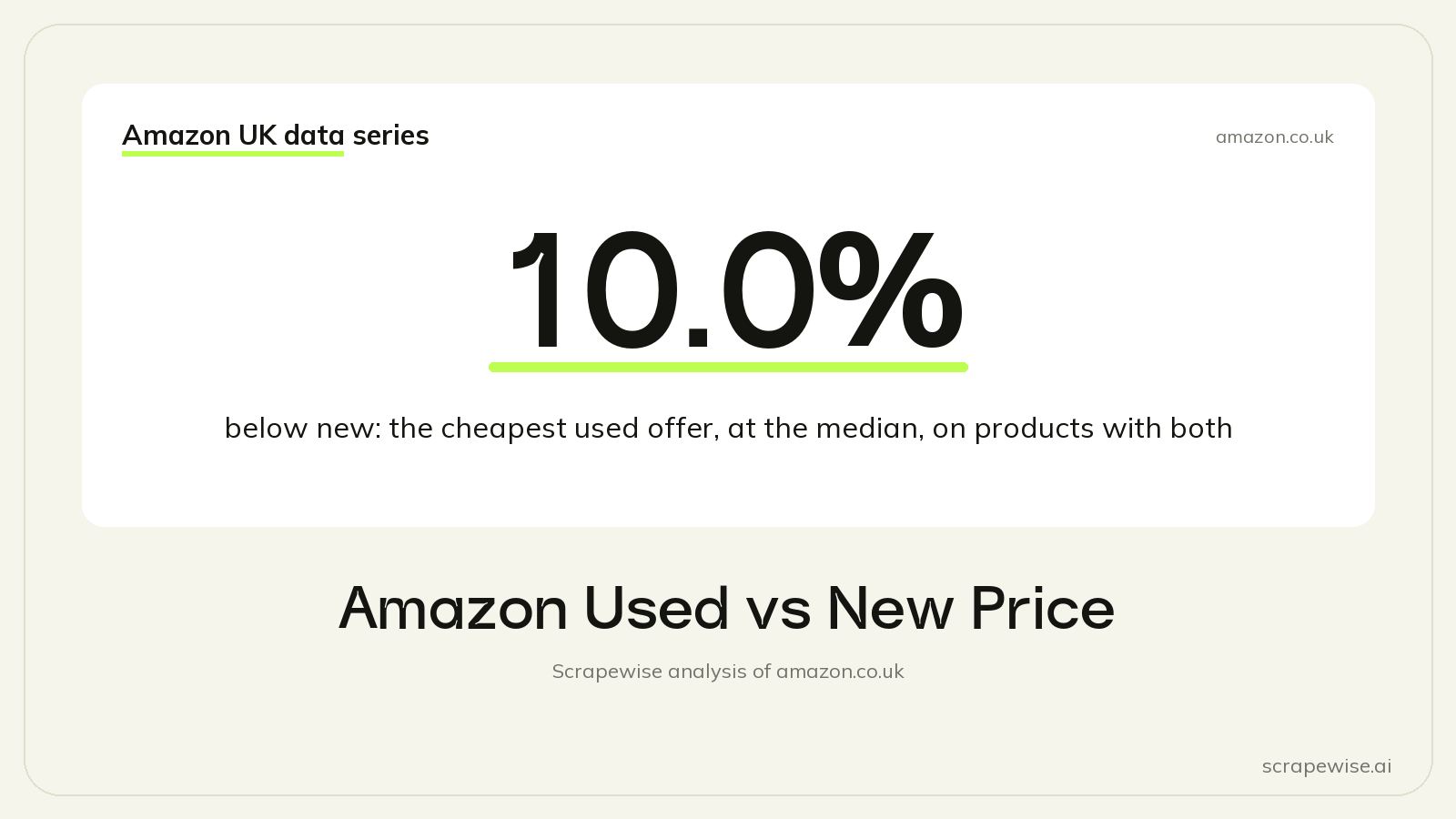
- On 14,671 products with both, the cheapest used offer is a median 10.0% below the cheapest new offer.
- Like New copies are a median 7.5% below new, and Acceptable copies 25.7%.
- On 15.6% of products with both, the cheapest used offer costs more than the cheapest new one.
Buying used on Amazon UK usually saves a modest amount: on products with both kinds of offer, the cheapest used offer is a median 10.0% below the cheapest new one, item plus shipping. We checked 14,671 products with a used and a new offer in a snapshot of amazon.co.uk taken on 23 to 24 September 2026.
The Data
The discount depends on the grade. The table shows the median gap between the cheapest used offer in each grade and the cheapest new offer on the same product.
| Used grade | Median discount vs cheapest new offer |
|---|---|
| Like New | 7.5% |
| Very Good | 10.0% |
| Good | 13.8% |
| Acceptable | 25.7% |
| Any used grade | 10.0% |
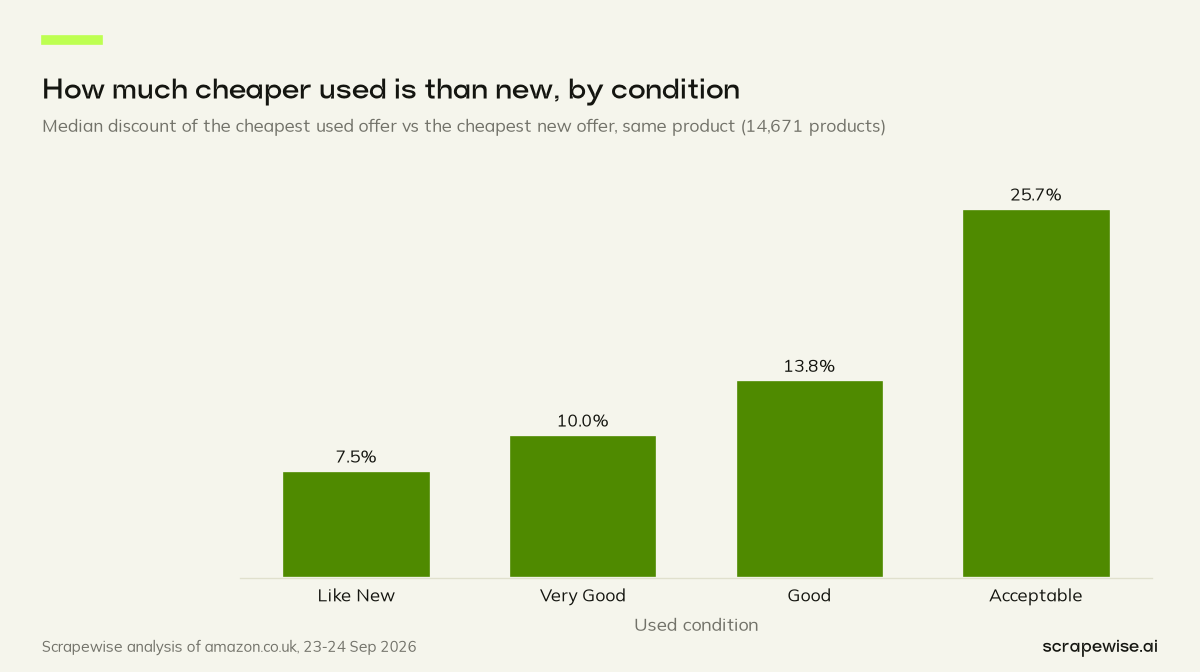
Like New is by far the most common grade: 7,630 products had a Like New offer to compare with new. It also saves the least, a median 7.5%. The discount grows as the grade drops, and Acceptable copies are a median 25.7% below new. Acceptable is the lowest of the four grades, and the price suggests sellers are being honest about it.
Used Is Not Always Cheaper
The median hides a surprising tail. On 15.6% of products with both, the cheapest used offer cost more than the cheapest new one. On those products, used is the premium option.
At the other end, 13.5% of those products had a used offer at 30% or more below new. So the used market holds real bargains, but they are the minority, and a shopper who assumes used is cheaper without checking will sometimes pay more for a worse copy.
Several things can put a used price above new. A new offer may be a short-lived low price from a seller clearing stock. A used offer may carry an old price that nobody updated after the new price fell. The offer page does not tell us which, only that it happens often enough to check every time.
Where Used Offers Show Up
Used offers are a small part of the marketplace. They make up 5.7% of all offers we read, and 15,117 products (7.7% of those with offer data) had a used offer.
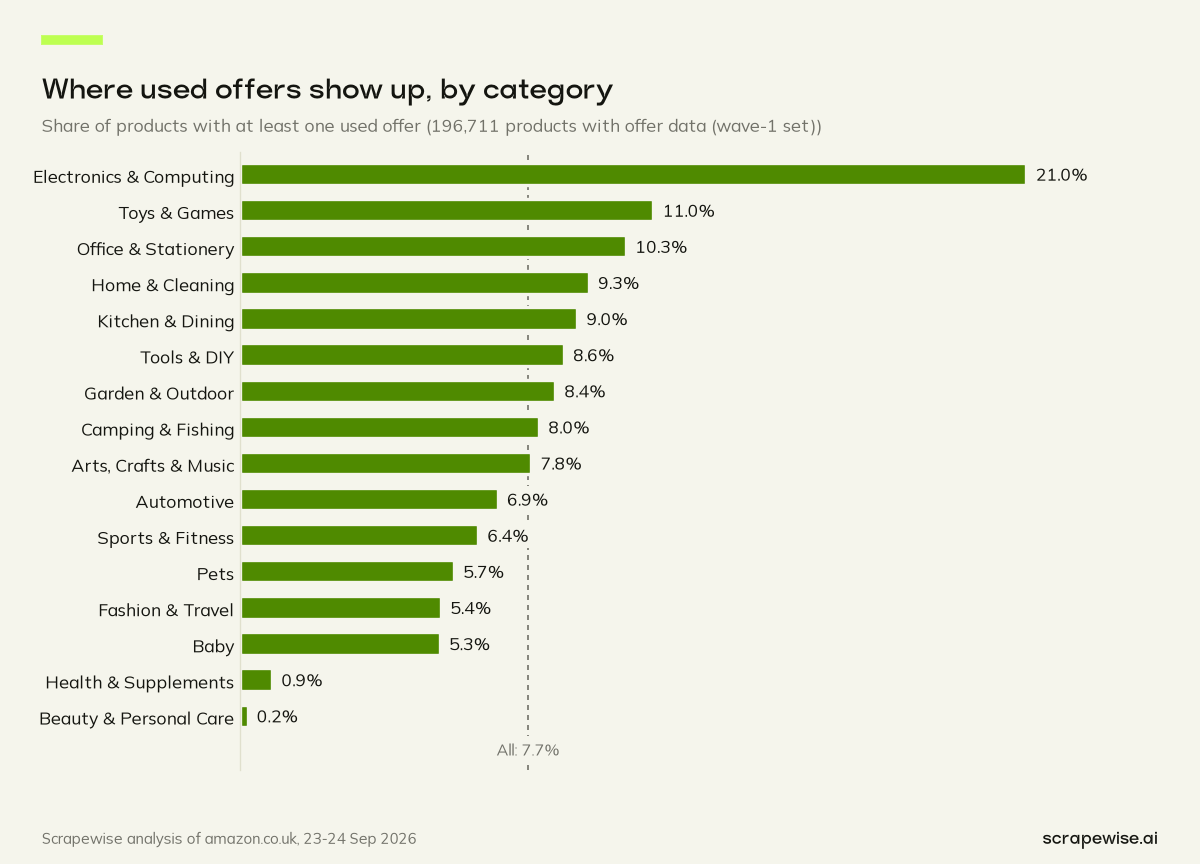
Electronics & Computing leads by a distance: 21.0% of products in that category had a used offer. At the bottom, Health & Supplements had used offers on 0.9% of products, and Beauty & Personal Care on 0.2%. Used beauty products, thankfully, have not caught on.
One likely reason: electronics can be tested and graded after a return, while opened personal care products are hard to resell. Category here comes from the search keyword that found the product. If you sell in Electronics & Computing, expect a used alternative next to your new offer on a real share of listings.
Who Sells Used Offers
The used market on Amazon UK leans heavily on Amazon itself. Of the used offers we read, 37.6% were sold by Amazon (any Amazon account), and 88.3% shipped from Amazon's warehouses. A plausible reading is that a large part of the used supply is returned or repackaged stock handled inside Amazon's own network. That is our interpretation; the offer page records who sells and who ships, not where the item came from.
For third-party sellers of used goods, that means the main competitor on many listings is an Amazon account, with Amazon's delivery promise behind it.
What It Means for Shoppers, Sellers and Pricing Teams
- For shoppers, the grade matters more than the word "used". Like New saves a median 7.5%; Acceptable saves 25.7%. Check the cheapest new offer first, because on 15.6% of products with both, the used offer is the dearer one.
- For sellers of used stock, price against the cheapest new offer on the same listing, not against other used offers alone. A used offer priced above new competes with a better product at a lower price.
- For brands, used offers on your own listings are worth watching. A cheap Acceptable copy sits in the same offer list as your new stock, and a shopper comparing prices sees both at once.
- For pricing teams, keep used and new offers apart. A price file that mixes them will report a false floor on products with a cheap Acceptable copy, and a false ceiling on products where a used copy is dearer than new.
How to Compare Used and New Prices Yourself
The same check works for any list of products, whether you are buying, selling or tracking a market:
- Pull the full offer list for each product, including the offers below the top one, with the condition grade, item price and shipping cost of every offer.
- Split the offers into new and used, and keep the used grade.
- Take the cheapest new offer and the cheapest offer in each used grade, item plus shipping, and work out the gap as a share of the new price.
- Flag products where a used offer costs the same as or more than new. On those, the used offer is unlikely to sell unless the new one disappears.
- Watch the flagged products over time. When the cheapest new offer sells out, a used copy at a similar price can suddenly become the cheapest option on the page.
Two cautions apply. Used offers often sit near the bottom of the offer page, so on a crowded listing the cheapest used copy may be beyond the offers you can see. And a grade is the seller's own description of the item. Two Very Good copies from different sellers are not guaranteed to be in the same state, which is part of why their prices vary.
For the gaps between new offers on the same listing, see our post on the price difference between sellers on Amazon. For electronics, where used offers are most common, see electronics price tracking, and for a wider method, how to track competitor pricing strategies. The full Amazon UK market study covers every other angle on this snapshot.
How We Collected This Data
We fed the Amazon Offers API the products from our amazon.co.uk search sample. For each one it read the offer page and returned one row per offer, with the condition grade, item price, shipping cost, who sells it and where it ships from. Those fields are everything the used versus new comparison above is built on. Used or new, each offer page costs €0.00015 per call, or €0.15 per 1,000 calls, and the rows arrive together through the REST API or a CSV/Excel export. Create an account to see used and new offers side by side on your own products.
Are used copies undercutting the new price on your listings? Spend your 5 free requests finding out, then pay as you go. Sign up or compare pricing.
Paste a marketplace URL — get structured market data
Size categories, track assortments, monitor trends. Clean feeds ready for your BI stack.
97% accuracy on Amazon benchmarks · no credit card · book a 15-min call →