
Key takeaways
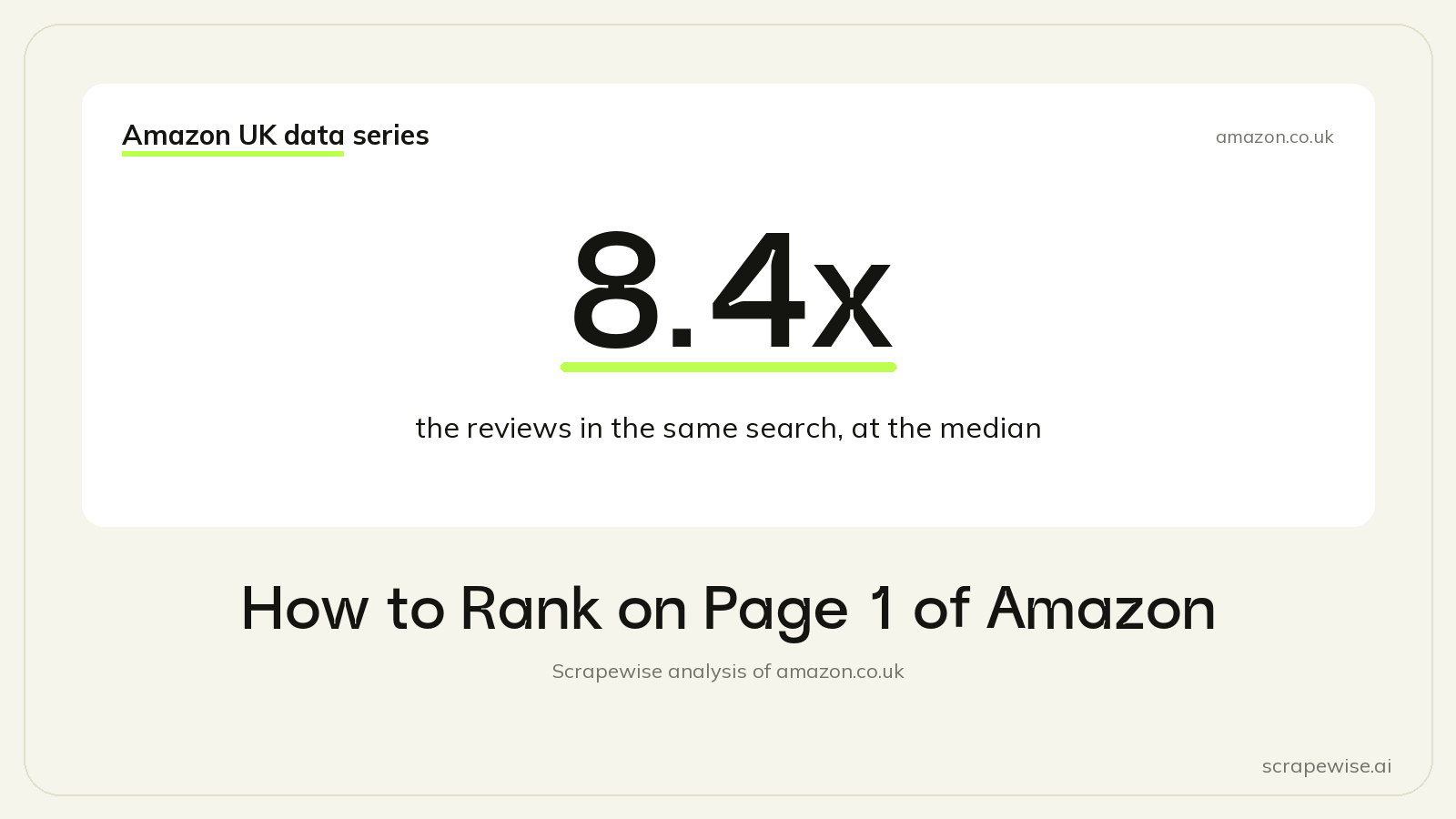
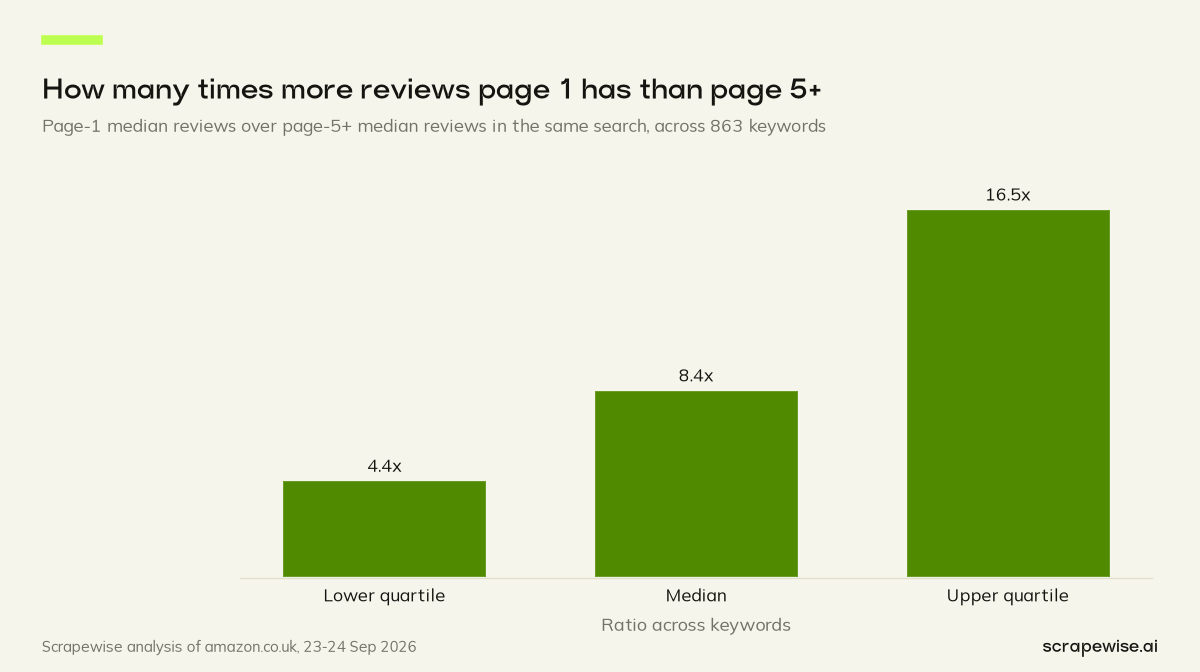
- In the same search, page-1 products have a median 8.4x the reviews of products on page 5 and beyond.
- 68.5% of page-1 products show a bought in past month label, against 19.9% on page 6.
- The median rated product on page 1 has 589 reviews; by page 6 the median is 63.
To rank on page 1 of Amazon, the numbers point to reviews and sales: in the same search, page-1 products have a median 8.4x the reviews of products on page 5 and beyond. We measured 863 searches in a snapshot of amazon.co.uk taken on 23 to 24 September 2026. Sales labels fall page by page in the same way, and prices rise a little.
What Separates Page 1 From Page 5
For each keyword we took the median review count of page-1 products and the median review count of products on page 5 and later, then divided one by the other. Across 863 keywords, the median of that ratio is 8.4x. Page 1 had more reviews than page 5+ in 842 of the 863 keywords.
The table shows the same slope for the whole sample, page by page.
| Search page | Median reviews (rated products) | Share with a sales label | Median price (priced products) |
|---|---|---|---|
| Page 1 | 589 | 68.5% | £15.00 |
| Page 2 | 230 | 47.6% | £15.99 |
| Page 3 | 152 | 36.8% | £16.99 |
| Page 4 | 118 | 31.8% | £17.99 |
| Page 5 | 82 | 25.4% | £18.99 |
| Page 6 | 63 | 19.9% | £17.95 |
| Page 7 | - | 20.1% | £18.65 |
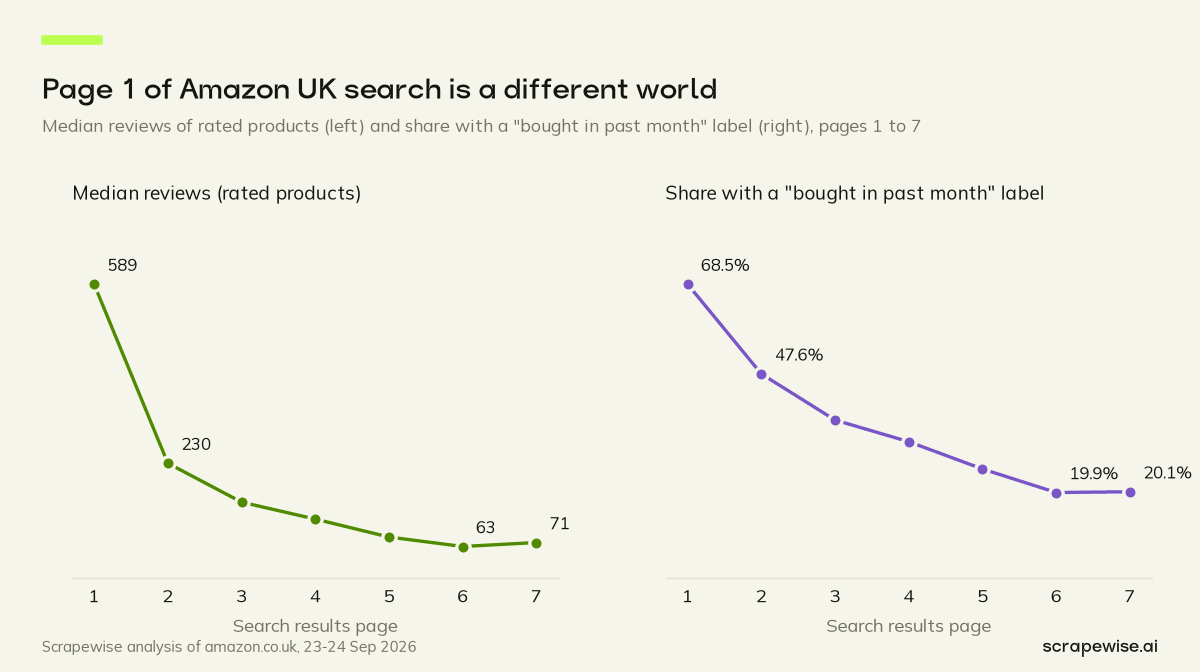
Reviews drop fastest between page 1 and page 2, where the median falls from 589 to 230. After page 3 the fall slows, but it keeps going.
Reviews: The Clearest Page-1 Signal
The biggest gap between page 1 and the rest is in reviews. The median rated product on page 1 has 589 reviews. By page 6 the median is 63.
Products with no reviews at all are rare near the top. Only 1.8% of page-1 products have none. By page six, 12.1% of listings have yet to collect a single review. It is a quiet neighbourhood.
Be careful with cause and effect here. Reviews may help a product rank, and a high rank brings sales, which bring more reviews. A snapshot cannot separate the two. It does show the level you are up against: in a typical search, a new product with a handful of reviews competes with page-1 listings that have hundreds.
Sales Labels Fall Page by Page
Amazon shows a "bought in past month" label on products that pass its sales thresholds. 68.5% of page-1 products carry one. The share drops to 47.6% on page 2, 31.8% on page 4 and 19.9% on page 6.
The high-volume label is even more concentrated. 13.1% of page-1 products show 1K+ bought in past month. On page 6 that share is 0.9%.
Amazon's own retail offer also thins out. Amazon is among the sellers on 23.8% of page-1 products and on 12.8% of page-7 products. We cover what that means for marketplace sellers in does Amazon compete with its sellers.
Price: Page 1 Is Slightly Cheaper
The median price rises from £15.00 on page 1 to £18.99 on page 5, then settles at £17.95 on page 6 and £18.65 on page 7.
The gap is small. Cheaper products may simply sell more and collect reviews faster, which would put them higher for other reasons. So a lower price may help, but the data does not show that a price cut alone lifts a product's rank.
Sponsored results follow a different pattern: in the same search they tend to cost more than organic results. We cover that in Amazon sponsored products price, and the badge that only turned up on page 1 in how to get Amazon's Choice badge.
What the Snapshot Cannot See
Amazon does not publish its ranking formula, and a search results page shows only some of the inputs. Conversion rate, returns, stock levels and delivery promises are all likely to matter, and none of them is visible in a search result. Results can also differ by device, location and whether a shopper is signed in. We collected one view of amazon.co.uk over one day.
So read the numbers as a description of what page 1 looks like, not as a recipe. They tell you the review count, label share and price level that page-1 products have in common. They do not tell you which of those things caused the ranking.
Run the Same Check on Your Own Keywords
The page-by-page view above is easy to rebuild for the searches that matter to you. A simple routine:
- Pick your keywords. Start with the searches that bring you sales today, plus the ones where you want to appear.
- Collect pages 1 to 7 for each. Record page, position, price, rating, review count and the sales label for every product.
- Compare medians per page. For each keyword, find the median review count on page 1 and on your own page. That gap is your target.
- Repeat on a schedule. A weekly run is a sensible start, and the direction over several weeks tells you more than any single day.
What It Means for Sellers and Brands
There is no single switch for page 1, but the snapshot points to a few practical steps.
- Compare reviews search by search. The gap is measured inside each keyword, so set your review count against the page-1 products for the searches you care about.
- Build early reviews the legitimate way. Amazon's own programmes and good after-sale service are the safe routes. Buying reviews breaks Amazon's rules.
- Treat the sales label as a target. 69% of page-1 products show one, so a product without it starts behind most of the page.
- Do not rely on price cuts alone. Page 1 is only slightly cheaper, and the gap may have other causes.
- Check your position again later. Rank moves with sales and reviews, so repeated checks show whether your changes work.
If you are mapping what competitors stock on those page-1 slots, our guide to competitor assortment gap analysis shows how to turn search results into a gap list. Our guide to scraping Amazon and eBay marketplace data covers collection at a wider scale.
How We Collected This Data
Everything in this post came from one Scrapewise data API, the Amazon Search API. Each call reads one search results page. We ran it on pages 1 to 7 of each keyword, and for every product the API returned the page and position, the price, the star rating, the review count, the sponsored flag and the "bought in past month" label. That is all you need to rebuild the table above for your own keywords. It is billed at €0.00015 per call, or €0.15 per 1,000 calls, and runs can repeat daily, every few days, weekly or monthly, or on demand. To watch page 1 for your own searches, create an account.
The rest of the findings, from sellers to price endings, are in the Amazon UK Marketplace Report 2026.
Who holds page 1 for your main search, and how many reviews do they have? The 5 free requests you get at sign-up are enough for a first look at one keyword. Try it on your own keyword, and look at pricing for bigger runs.
Paste a marketplace URL — get structured market data
Size categories, track assortments, monitor trends. Clean feeds ready for your BI stack.
97% accuracy on Amazon benchmarks · no credit card · book a 15-min call →