
Key takeaways
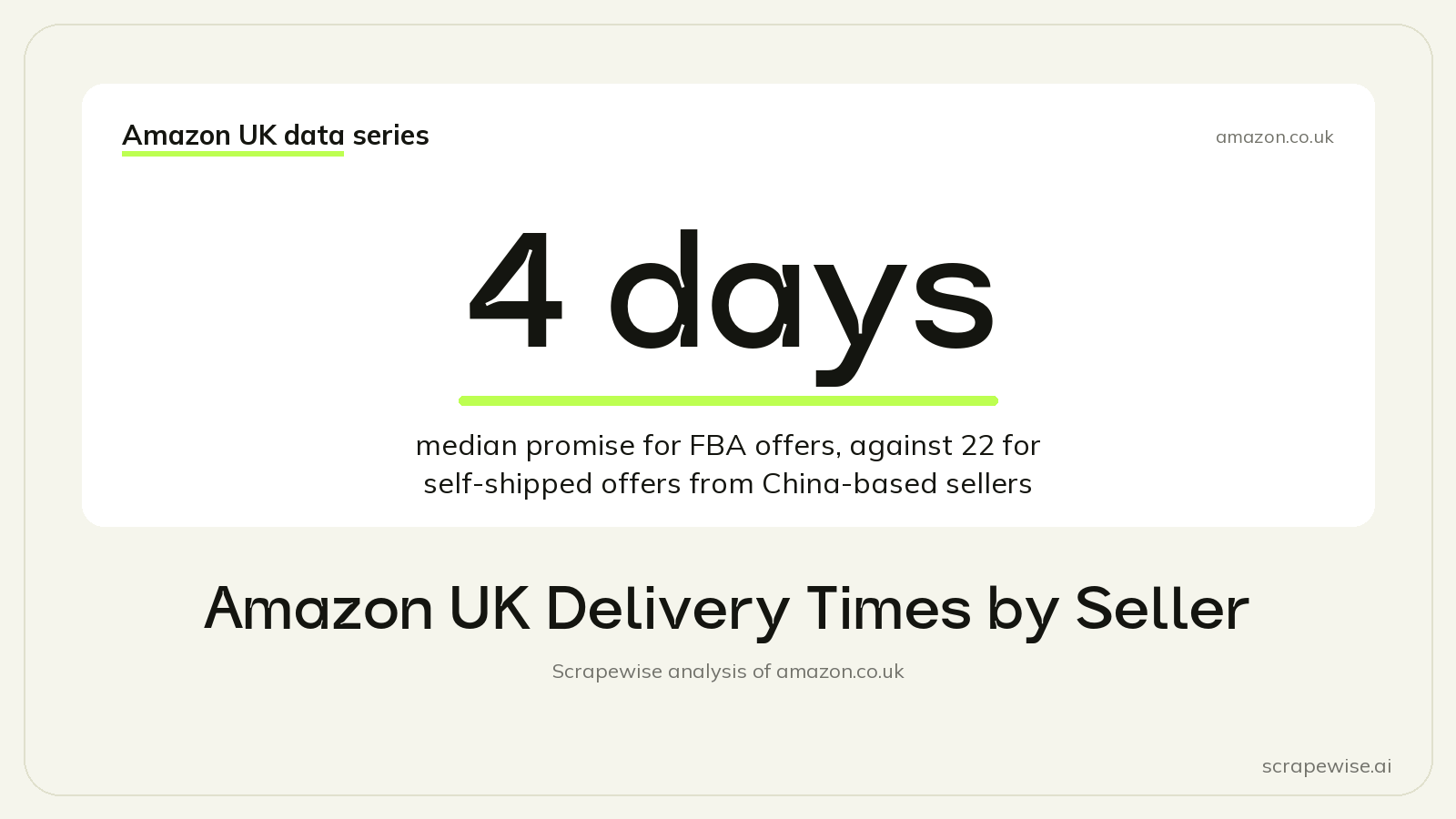
- Offers shipped by Amazon (FBA) promise a median 4 days for China-based, UK-based and US-based sellers alike.
- Self-shipped offers promise a median 5 days from UK-based sellers and 22 days from China-based sellers; 76.6% of the China-based ones promise more than 14 days.
- On multi-offer products where delivery dates differ, the fastest offer is also the cheapest in 59.4% of cases.
Amazon UK delivery times depend more on who ships the order than on where the seller is based: offers shipped by Amazon (FBA) promise a median 4 days for China-based, UK-based and US-based sellers alike. We checked promised delivery dates on the offers for 196,711 products in a snapshot of amazon.co.uk taken on 23 to 24 September 2026.
The Data
The table shows the median promised delivery time for new third-party offers, split by the seller's declared country and by who ships the order. Countries appear where we had enough offers to give a stable median; "not shown" means we do not publish a figure for that group.
| Declared seller country | Shipped by Amazon (FBA), median days | Self-shipped, median days |
|---|---|---|
| United Kingdom | 4 | 5 |
| Netherlands | not shown | 7 |
| Poland | not shown | 12 |
| Spain | not shown | 14 |
| Germany | 4 | 15 |
| France | not shown | 16 |
| Hong Kong | 4 | 19 |
| United States | 4 | 19 |
| Bulgaria | not shown | 20 |
| China | 4 | 22 |
| India | not shown | 26 |
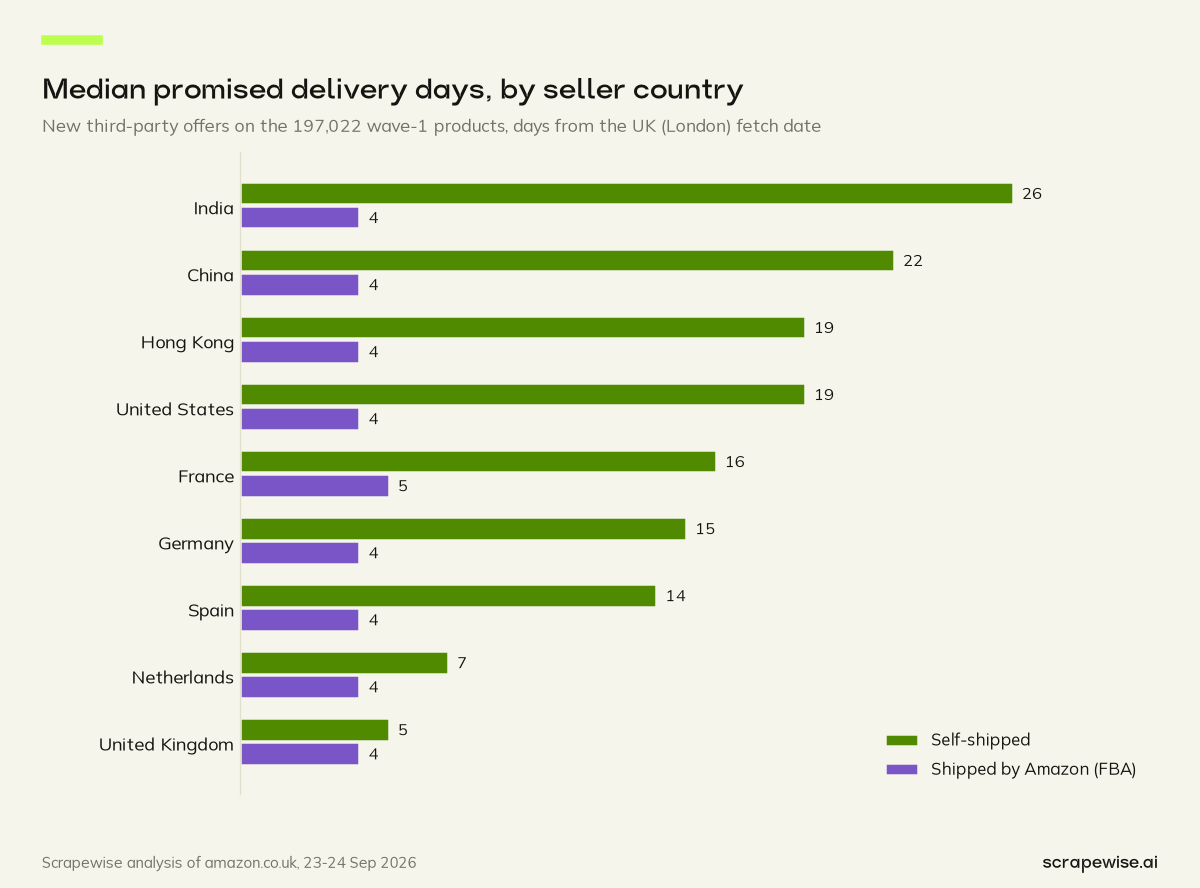
An offer shipped by Amazon promises a median 4 days whether the seller's declared address is in China, the UK or the US. Once the stock sits in an Amazon warehouse, the address on the profile makes no difference to the median promise.
Self-Shipped Offers: Where Distance Shows
Once the seller ships the order, distance comes back. UK-based sellers who post their own orders promise a median 5 days, just one day behind FBA. Sellers based elsewhere in Europe sit in between: 7 days for the Netherlands, 12 for Poland, 14 for Spain, 15 for Germany and 16 for France.
Further away, the medians stretch. Self-shipped offers from Hong Kong-based and US-based sellers promise 19 days, Bulgaria 20, China 22 and India 26.
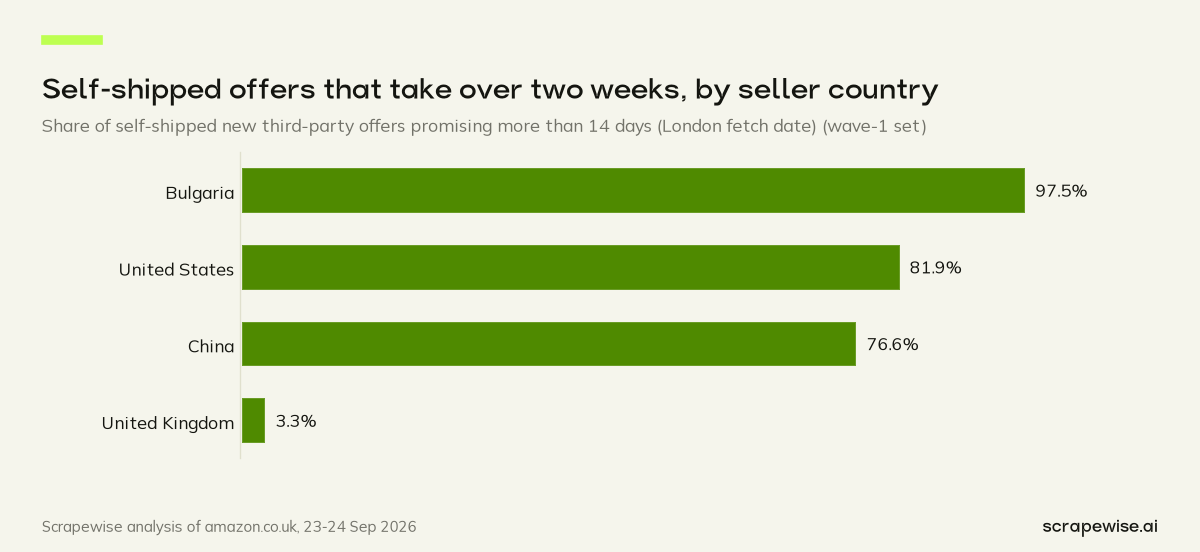
The share of self-shipped offers promising more than 14 days shows the same split:
- UK-based sellers: 3.3% of self-shipped offers.
- China-based sellers: 76.6%.
- US-based sellers: 81.9%.
- Bulgaria-based sellers: 97.5%.
Keep the volumes in mind. We counted 155,842 self-shipped offers from UK-based sellers, but only 15,818 from China-based sellers, against 68,450 FBA offers from China-based sellers. Most China-based sellers ship through Amazon, as our post on FBA vs FBM statistics for Amazon UK shows, so the 22-day median describes a minority of their offers.
Is the Faster Offer Dearer?
On products with competing offers, speed and price often point the same way. We looked at 61,060 multi-offer products where the offers promised different delivery dates.
- The fastest offer was also the cheapest in 59.4% of cases.
- Where it was not, the fastest offer cost a median 15.7% more, £3 at the median, and arrived a median 2 days sooner.
- Featured offers, our stand-in for the Buy Box, promised a median 4 days, against 6 for the other new offers on the same multi-offer products.
So on multi-offer products, a shopper who pays for speed pays a median 15.7% extra to get the item 2 days sooner. Whether that is good value depends mostly on whose birthday it is.
Who Charges for Postage
Free delivery is the norm. Only 3.5% of new offers charged for postage, as seen by a logged-out visitor. Where there was a fee, the median was £7, and on 11.9% of those offers the fee was higher than the item price. Items under £5 carried a fee 8.4% of the time.
The share charging for postage depends heavily on the seller's declared country:
| Declared seller country | New offers that charge postage |
|---|---|
| Czech Republic | 76.6% |
| Italy | 56.4% |
| France | 54.4% |
| Germany | 26.6% |
| Poland | 18.5% |
| Spain | 17.2% |
| Hong Kong | 2.9% |
| China | 2.1% |
| United Kingdom | 1.0% |
We did not capture basket thresholds, so a seller may waive the fee above a certain order value. The figures describe the price on a single item.
The pattern lines up with the delivery table. Several of the EU seller groups that often charge postage are also the ones that mostly ship their own orders, from outside the UK. For a shopper, that combination means a longer wait and a delivery fee on the same offer, which is a hard sell next to a free, four-day FBA offer on the same listing.
Reading Delivery Dates With Care
Three limits apply to every number above. First, these are promises, not deliveries. We saw the date the offer page quoted, not the date the parcel arrived. Second, we visited logged out, from the UK, so the dates are what a shopper without a membership sees for standard delivery. A signed-in shopper may be offered faster options. Third, this is one snapshot. A seller who restocks an Amazon warehouse can move from weeks to days overnight, and a delivery promise made on a Wednesday can differ from one made on a Saturday.
These limits matter less than they might seem. The gap between FBA and self-shipped offers from far away is measured in weeks, and none of these effects is likely to close it.
What It Means for Sellers and Pricing Teams
For sellers based outside the UK, FBA is what closes the delivery gap. The data shows the same median of 4 days for FBA offers from China-based, Hong Kong-based, UK-based, US-based and Germany-based sellers, while self-shipped offers from far away promise weeks.
For UK-based self-shippers, the gap to FBA is small at the median, 5 days against 4. Postage is the bigger lever: UK-based sellers almost never charge for it, and several EU seller groups often do.
For pricing teams, compare the delivered offer, not the item price. Record the promised delivery date and the shipping fee next to every competitor price. A cheap offer that arrives in three weeks, or that adds £7 of postage, is not really the cheapest one. For seller countries across the whole marketplace, see Amazon UK sellers by country, and for the margin side of cross-border selling, see price intelligence in the tariff era. Our full Amazon UK market study covers the rest of the snapshot.
How We Collected This Data
Two scrapers built this post. The Amazon Offers API went through the offer page of every product in our amazon.co.uk sample and returned one row per offer, with the item price, shipping cost, condition, where it ships from, the promised delivery date and whether it was featured. The Amazon Seller API returned the declared business address from each seller's public profile, which gave us the seller country; we publish only aggregates. Offer pages and seller profiles are each €0.00015 per call, or €0.15 per 1,000 calls, and a weekly run is enough to see which sellers speed up or slow down. Create an account to see the delivery promise of every seller on your listings.
How fast do your competitors promise to deliver, and what do they charge for it? The 5 free requests on a new account will show you on a few listings, and then you pay as you go. Sign up or compare pricing.
Paste a marketplace URL — get structured market data
Size categories, track assortments, monitor trends. Clean feeds ready for your BI stack.
97% accuracy on Amazon benchmarks · no credit card · book a 15-min call →