

Key takeaways
- A real-time web search API runs a query at call time and returns the live result as structured fields — now including generated AI answers and the sources they cite.
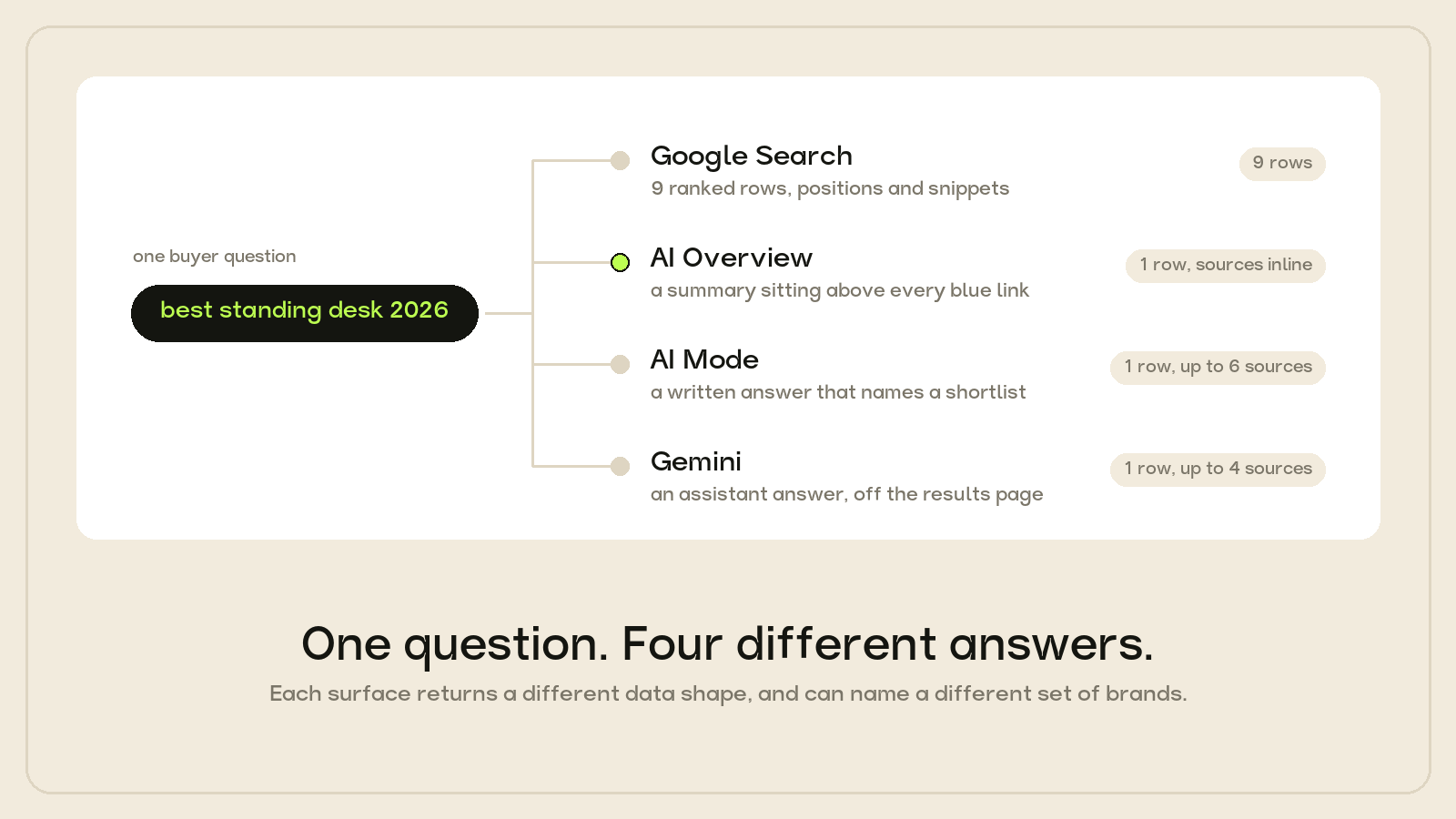
- Google answers the same query on four surfaces: Search, AI Overviews, AI Mode and Gemini. Each returns a different data shape and can name a different set of companies.
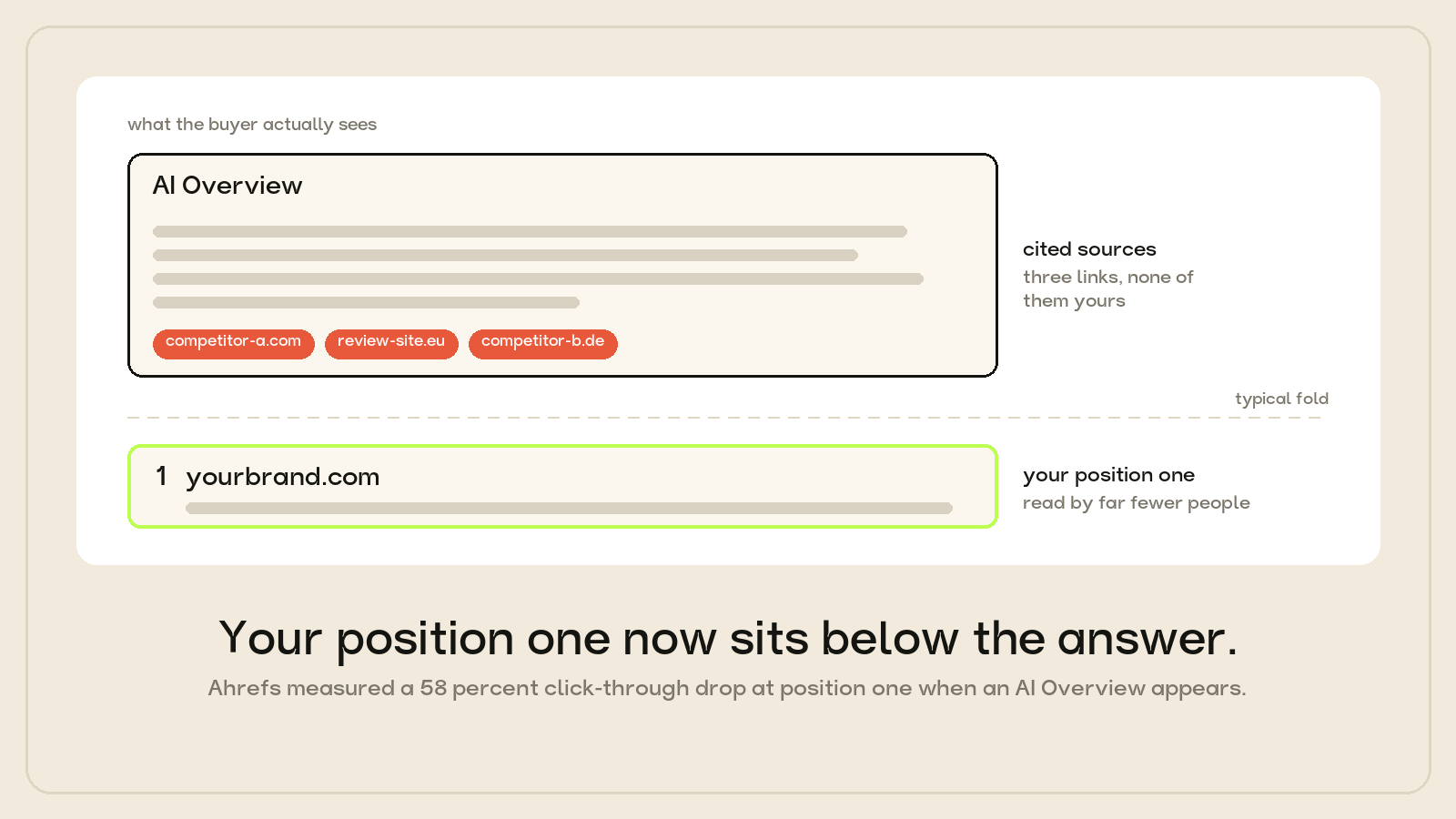
- Ahrefs measured a 58% drop in position-one click-through rate when an AI Overview is present; Pew found only 1% of visits to a page with an AI summary produced a click on a cited source.
- 1,000 calls cost €0.75 on AI Overview, €1.50 on Search and AI Mode, €3.75 on Gemini. Monitoring 200 questions weekly across all four is about €6 a month.
- Generated answers are non-deterministic. Sample each question repeatedly and score the trend, never a single snapshot.
Real-time web search APIs are no longer only a way to give AI applications access to fresh information. They are also how you find out what Google and other AI assistants are telling buyers about your brand.
Google now answers the same query on four distinct surfaces: traditional Search, AI Overviews, AI Mode and Gemini. Each returns a different data shape, and each can name a different set of companies for one commercial question.
This guide covers what a real-time web search API is, how those four surfaces differ, what 1,000 calls cost on each, and how to build a repeatable AI visibility monitoring workflow.
What is a real-time web search API?
A real-time web search API is an endpoint that runs a search query at the moment you call it and returns the live result as structured fields instead of HTML. You send a query at runtime and get back positions, titles, links and snippets — and, on AI surfaces, the generated answer plus the sources it cites.
Three properties separate a real-time web search API from a cached index or a crawler, and vendors quietly differ on all three.
- Live, not cached. A result fetched when you ask, not replayed from an index built last week.
- Structured, not HTML. Positions, titles, links, snippets and sources as fields. Handing an LLM a raw HTML blob wastes tokens and invites hallucination.
- On demand, not scheduled. The query is an input at runtime, not a job you configured yesterday.
A crawler gives you pages. A real-time web search API gives you the answer layer that sits on top of those pages. That distinction matters more every quarter, because the answer layer is increasingly where the buying decision happens. It is the same architectural shift we described in AI-powered web scraping, moved one level up the stack: from extracting fields off a page to extracting claims out of an answer.
If you need the page itself rather than the answer layer — product pages, stock, full catalogues — that is a different tool, and we compared nine real-time scraping APIs by cost per usable record separately.
Why AI applications need live web search
A language model without live web search answers from its training cut-off. Prices, stock levels, regulations and newer brands are all stale or missing — and the failure mode is not "the model says I don't know". It answers fluently and wrongly, and your user has no way to tell.
| Model alone | Model with real-time web search | |
|---|---|---|
| Freshness | Frozen at the training cut-off | Current at request time |
| Sourcing | No citations, or invented ones | Real URLs you can verify |
| Changing facts | Prices, stock, laws, staff — all stale | Read live at the moment of the answer |
| Long-tail entities | Small brands often absent entirely | Present if the web has them |
| Failure style | Confident and wrong | Wrong only if the source is wrong |
The last row is the important one. Grounding does not make a model correct. It makes a model auditable. When the answer cites a source, a human can check it, and a pipeline can score it.
That is also why the sources array matters more than the prose in most production systems. The text is what the user reads. The sources are what your evaluation harness can actually measure. If you are assembling a grounding corpus rather than a one-off lookup, the same structured-output rule applies to everything you extract as training and retrieval data for AI and LLMs.
Google has four search surfaces to monitor
For twenty years, "what does Google say about us" had a single answer: your ranked position. That is no longer true. The same query can now produce four materially different answers, and a buyer may only ever see one of them.
| Surface | What it returns | Rows per call | Best used for |
|---|---|---|---|
| Google Search | Ranked results with position, title, link and snippet, plus People also ask | ~9 | Traditional rank tracking |
| AI Overview | Generated summary as ordered text blocks, plus cited sources | 1 | Citation and AI visibility monitoring |
| AI Mode | Conversational answer as ordered text blocks, plus up to 6 sources | 1 | Recommendation-shaped queries |
| Gemini | Assistant answer from off the results page, plus up to 4 sources | 1 | Off-SERP AI visibility |
Google Search — the ranked results
Still the backbone. One call to the Google search API runs a keyword and returns roughly nine rows, each with position, title, link, source, displayed link and snippet. Every row also carries the People also ask questions and up to eight related searches for that keyword.
Country, language, device and a city-level location are inputs on each call. This is not a detail. Rankings for "best standing desk" in Chicago on a phone differ from what you see at a desk in Berlin, and rank tracking only means something once you fix those settings and keep them fixed.
Use it for: classic rank tracking, share of results, harvesting the question space around a keyword.
AI Overview — the summary above the links
The block Google puts above the blue links. The Google AI Overview API returns it as ordered text blocks — paragraphs, headings, list items, with the links inline — plus the cited sources with title, site name, link and the snippet Google pulled from each.
One implementation detail decides whether your data is any good: Google typically loads the complete AI Overview a moment after the results page renders. Scrape the page alone and you capture a fragment. The API expands the full version in the same run.
It does not return ranked results. Those come from the search call. Budget for both if you want the whole picture.
Use it for: the closest thing that exists to rank tracking for AI answers. Which sources get cited, week over week.
AI Mode — Google's chat-style search
The Google AI Mode API takes an AI Mode link and returns the answer as ordered text blocks — about thirteen on average across our test queries (ScrapeWise test, 16 September 2026). When AI Mode lists sources, the API saves up to six, with title, link, snippet and site name.
This is where the answer stops summarising the page and starts replacing it. Ask for "best shopify apps for dropshipping" and you get a written recommendation that names products — DSers first and Zendrop next in our sample (ScrapeWise test, 16 September 2026). A shopper reading that may never scroll to a place where your product appears.
Country and language come from the link itself, so you can hold two links side by side and compare what AI Mode tells a US buyer against what it tells a UK one.
Use it for: recommendation-shaped queries, where the answer names a shortlist and the shortlist is the decision.
Gemini — the assistant, off-SERP
The Gemini answers API sends a question straight to Google's assistant and saves the full answer as one row. When Gemini gives sources, up to four are saved alongside.
Two findings from our own test run set expectations for anyone planning to measure this.
First, the answers are specific. Asked which budget blenders have the best reviews in 2026, Gemini named nine blenders by full model name: five Hamilton Beach, two Magic Bullet, one Oster, one Mainstays (ScrapeWise test, 16 September 2026). If you sell a sub-$100 blender and you are not on that list, you now know exactly where you stand with anyone who asks Gemini first.
Second, sourcing is inconsistent. Three of our six test answers carried source links, and all three were research questions — "what is a good Amazon FBA profit margin", that shape. The blender answer had none. Neither did two one-line fact questions.
Use it for: off-SERP assistant visibility. Pair it with the ChatGPT answers API if you want the same question asked of both assistants.
How we tested
Every response shape, row count and price in this article comes from live API calls, not from documentation. The Gemini and AI Mode figures come from a single small run, and we report them as such.
| Test date | 16 September 2026 |
| Surfaces tested | Google Search, AI Overview, AI Mode, Gemini |
| Sample size | 6 questions on Gemini, 1 run each |
| Question mix | 2 product-recommendation, 2 research, 2 single-fact |
| Market settings | English, US, desktop |
| Citation counted as | a source object returned in the response, not a link inside the answer text |
| Normalisation | none — answers recorded verbatim, no deduplication across runs |
Six questions on one day is an illustration, not a study, and we have not repeated it across markets. Where this article cites click-through and behavioural data, the samples are far larger and the source is linked inline — Ahrefs and Pew Research below, not us.
Why AI visibility monitoring matters
Most writing on real-time web search stops at grounding — feeding live data into your own product. That is one job. AI visibility monitoring is the other, and the numbers behind it are ugly.
Ahrefs measured the effect directly and found that AI Overviews cut click-through rate on the number-one organic result by 58%, revising an earlier study across 300,000 keywords that put the drop at 34.5%. The European picture is softer but moving the same way: a separate Ahrefs analysis found AI Overviews reduced CTR by 23.1% in France.
The Pew Research Center went further and watched actual behaviour. Across a sample of US adults in March 2025, users clicked a traditional search result 8% of the time when an AI summary was present, versus 15% when it was not. More pointedly: only 1% of visits to a page carrying an AI Overview produced a click on one of the sources that summary cited.
Being cited, in other words, is not the same as being visited. Search Engine Land reached the same conclusion reviewing the citation data — AI Overview citations largely do not drive clicks — and separately found that AI Overviews appear below position one in only 12.4% of cases, meaning the summary is usually the first thing on the page.
Your rank-one listing can therefore sit underneath an answer that never mentions you, read by someone who will never scroll. The only way to know is to read the answers — the same discipline that makes competitive price monitoring work, applied to text instead of prices.
SERP API vs real-time web search API
These two terms get used interchangeably, and they are not the same thing. A SERP API reads the results page. A real-time web search API reads the results page and the generated answers that now sit on top of it.
| Capability | SERP API | Real-time web search API |
|---|---|---|
| Ranked organic results | Yes | Yes |
| People also ask, related searches | Usually | Yes |
| AI Overview, fully expanded | Rarely | Yes |
| AI Mode answers | No | Yes |
| Assistant answers (Gemini, ChatGPT) | No | Yes |
| Cited sources per answer | Limited | Title, link, snippet, site name |
| Traditional rank tracking | Yes | Yes |
| AI visibility monitoring | Limited | Yes |
| Typical pricing model | Monthly subscription | Per call |
If all you need is position tracking, a SERP API is enough and always has been. The gap opens the moment a buyer's question gets answered above the results, because a SERP-only tool cannot see the thing that answered it.
How much does a real-time web search API cost?
Here is where the per-call model separates from the subscription model. All four Google surfaces, priced per call, in euros:
| Surface | Per call | Rows per call | 1,000 queries |
|---|---|---|---|
| Google AI Overview | €0.00075 | 1 | €0.75 |
| Google Search | €0.0015 | ~9 | €1.50 |
| Google AI Mode | €0.0015 | 1 | €1.50 |
| Gemini | €0.00375 | 1 | €3.75 |
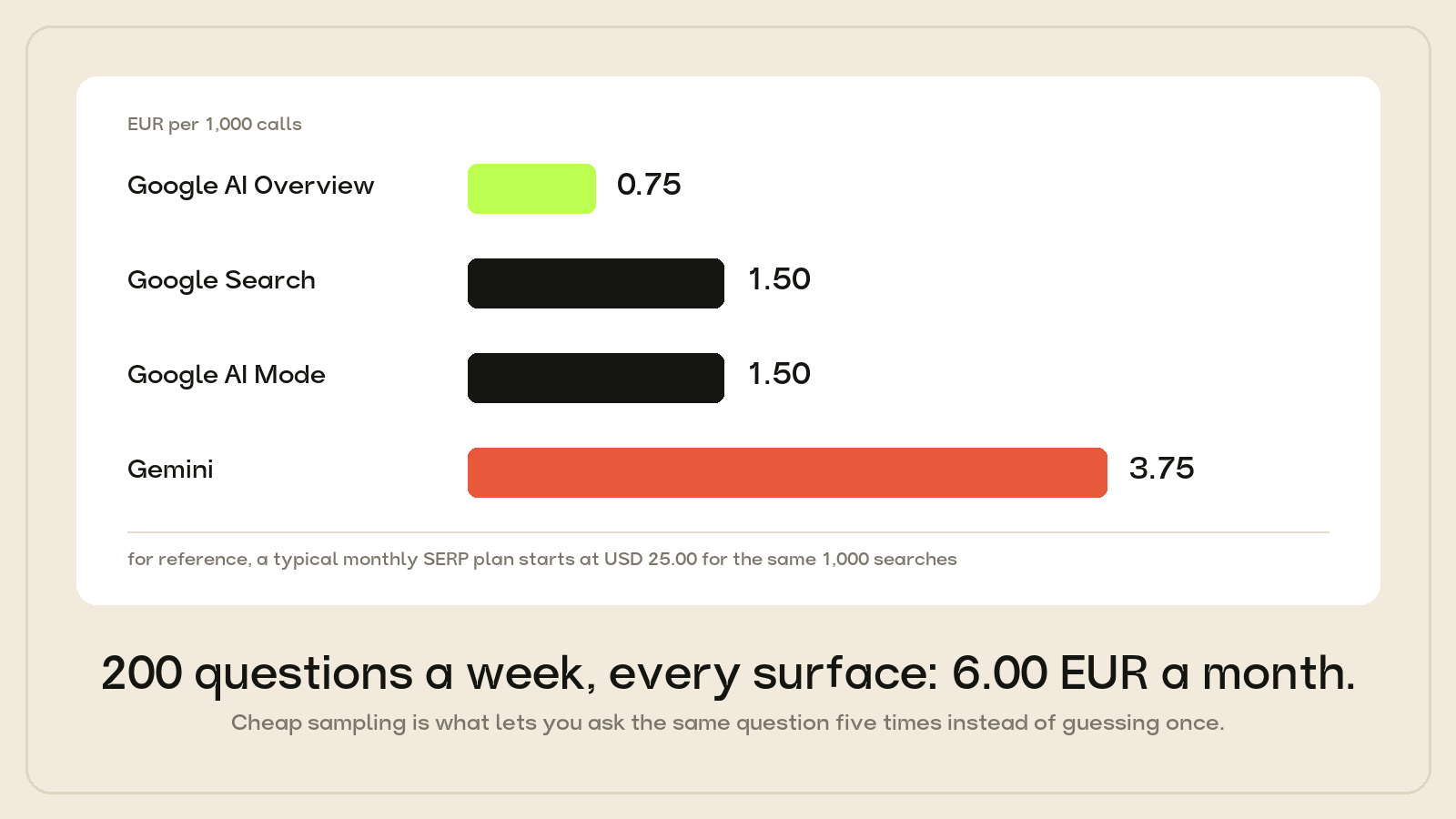
Now the number that matters in practice. Take a serious monitoring programme: 200 commercially important questions, run weekly, across all four surfaces. That is 800 calls per surface per month.
- Google AI Overview — 800 calls: €0.60
- Google Search — 800 calls: €1.20
- Google AI Mode — 800 calls: €1.20
- Gemini — 800 calls: €3.00
- Total: €6.00 per month
For context, the same 1,000 Google searches on a typical monthly SERP subscription start at $25, before anyone has looked at an AI answer. The full price list for every source sits on the data APIs and prices page.
The reason to care about the unit price is not the invoice. It is that cheap sampling changes what you can measure. At €6 a month you can afford to ask the same question five times to see how much the answer moves. At subscription pricing you ask once and pretend that is the truth.
How to monitor AI search visibility
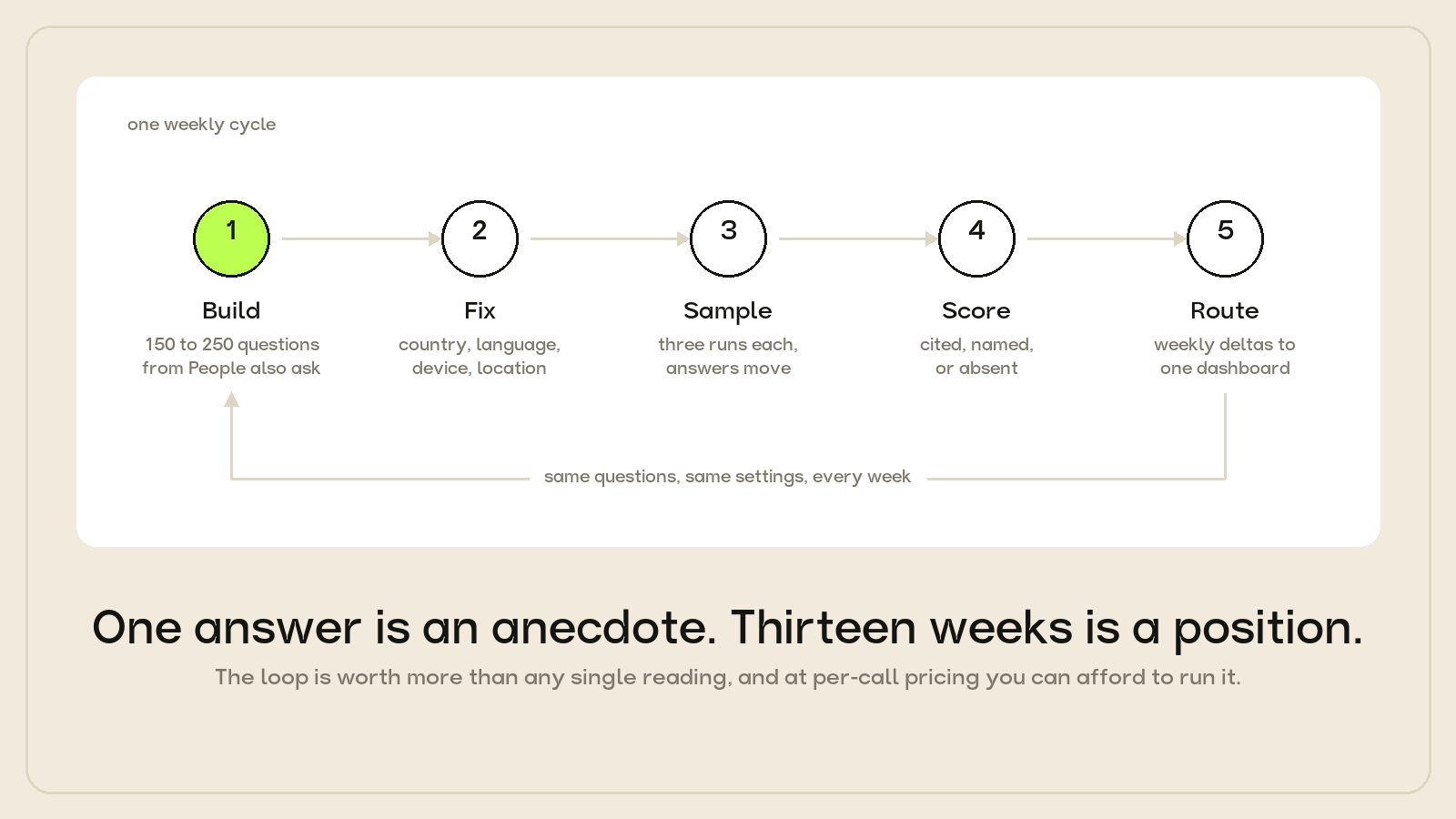
Five steps. None of them require an AI visibility subscription.
Build your query set
Run your head keywords through the search API and harvest the People also ask questions and related searches that come back on every row. Those are phrasings Google has actually observed, not ones you guessed. Keep 150–250. Then freeze the list, because a changing query set makes every trend line meaningless.
Fix location and device variables
Country, language, device, location. Write them down and keep them. A "ranking change" caused by silently switching from desktop-Berlin to mobile-Chicago is the most common false alarm in this work, and it is the one that survives longest before anyone notices.
Repeat your measurements
Generated answers move. Three runs of the same question in the same week gives you a stability signal, not just a value. Questions where the answer swings wildly are questions where you can still influence the outcome — that volatility is the opportunity list.
Measure brand and citation visibility
For each question, record three things: whether your domain appears in the cited sources, whether your brand is named in the body text, and which competitors are named. Brand-named-without-citation is a real and common state, and it is worth tracking on its own.
Track changes over time
An answer set nobody reads is a cost centre. Route weekly deltas into the same dashboard your pricing and merchandising teams already open. The same reporting rhythm that works for competitive price monitoring works here.
Limitations of AI search monitoring
No honest version of this article ends without the limits.
Generated answers are non-deterministic. Two identical calls can return different text. Anything built on a single sample is noise dressed as a metric.
Sourcing is inconsistent. Half our Gemini test answers had no sources at all (ScrapeWise test, 16 September 2026). If your metric is "citations", you will silently under-count on exactly the commercial, list-shaped questions you care most about.
Surfaces disagree. AI Mode, AI Overview and the ranked results can name three different sets of companies for one query. There is no single "Google answer" to track.
Attribution stays hard. A buyer who reads a Gemini answer and types your brand into the address bar an hour later shows up as direct traffic. You will see the visibility, not the conversion.
Coverage is uneven by market. AI surfaces roll out at different speeds across the EU, and a question that triggers an AI Overview in the US may return plain results in the Nordics. Compare like with like, or don't compare.
What to look for in a real-time web search API
Cut through the marketing with six questions.
- Does it return structured fields or an HTML blob? Positions, titles, links, snippets and sources as fields, or you will pay a second time in parsing and tokens.
- Does it expand the full AI Overview? Fetching the results page alone captures a fragment, because Google loads the complete overview after render.
- Can you pin country, language, device and location per call? Without that, comparisons across weeks are not comparisons.
- Does it cover generated answers, not just the SERP? A SERP-only API misses the surface that is replacing the SERP.
- What is the unit, honestly? Calls, credits, rows, successful requests. Convert everything to cost per usable record before comparing. We walked through that arithmetic in the scraping API pricing comparison.
- Do you keep the raw answers? Text you cannot re-query later is a report, not a dataset. Storing the full answer means next quarter's question can be asked of this quarter's data.
That last point is the quiet one. Subscription AI-visibility tools give you their chart. Per-call APIs give you the rows, and the rows are what let you do your own product and entity matching across answers, competitors and time.
Conclusion
Real-time web search APIs now serve two distinct purposes: grounding AI applications with current information, and monitoring how AI search represents your brand.
Traditional rankings remain useful, but they no longer describe the complete search experience. Google Search, AI Overviews, AI Mode and Gemini can each produce a different answer to the same commercial query, and a buyer may only ever see one of them.
For teams monitoring AI visibility, the practical response is straightforward: define a fixed query set, control location and device variables, sample repeatedly, record brand mentions and citations, and measure the change over time.
Start with the surface closest to your buyers. If they find you through Google Search, Shopping or Maps, expand the AI Overview first — it is half the price of a search call and it sits above every blue link. If your category is recommendation-shaped, start with AI Mode or Gemini instead.
A single AI answer is a snapshot. Repeated measurements turn it into a dataset.
Paste a marketplace URL — get structured market data
Size categories, track assortments, monitor trends. Clean feeds ready for your BI stack.
97% accuracy on Amazon benchmarks · no credit card · book a 15-min call →