
Key takeaways
- 41.3% of 51,374 rated Amazon UK sellers show exactly 100% positive feedback.
- Among sellers with a 100% score, the median is 33 ratings and 32.3% have fewer than 10 ratings.
- 3.8% of rated sellers, one in 26, are under 50% positive feedback.
A 100% positive feedback score on Amazon is good, but it is common rather than rare: 41.3% of 51,374 rated sellers on Amazon UK show exactly 100%, and 32.3% of those perfect scores rest on fewer than 10 ratings. Those scores come from the public profiles of 55,660 sellers, read on amazon.co.uk on 23 to 24 September 2026.
The Data
Of the 55,660 seller profiles we read, 51,374 showed a feedback score and a rating count. This is how their positive feedback splits.
| Positive feedback | Share of rated sellers |
|---|---|
| 100% | 41.3% |
| 95 to 99% | 19.1% |
| 90 to 94% | 12.4% |
| 80 to 89% | 12.2% |
| 50 to 79% | 11.2% |
| under 50% | 3.8% |
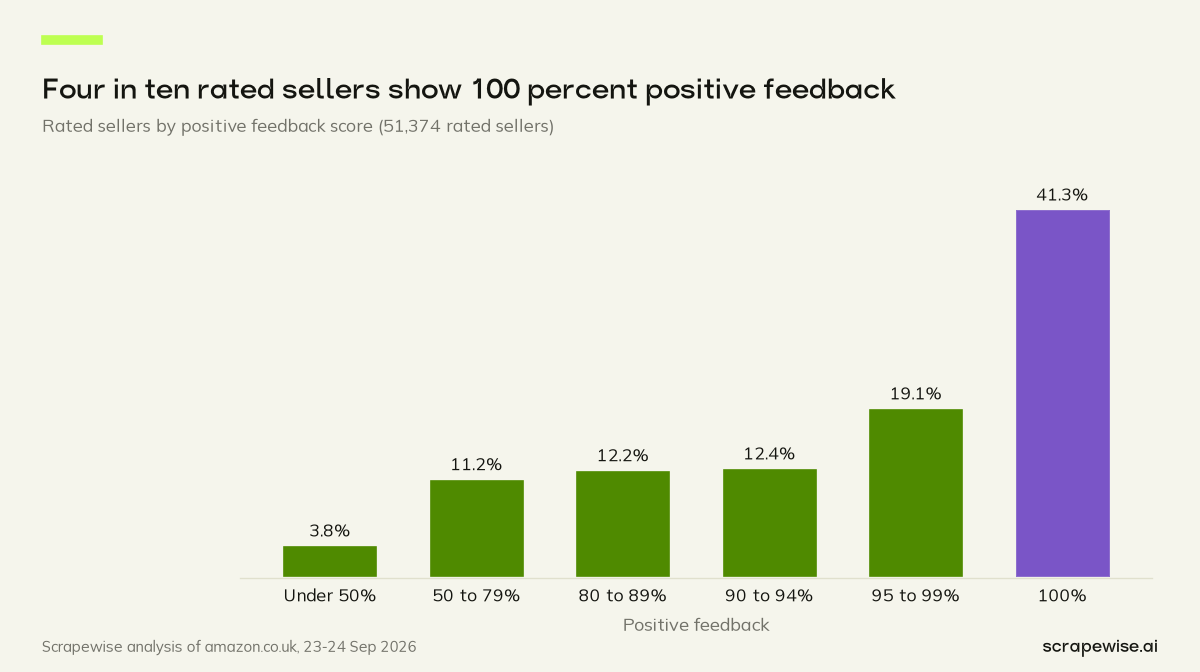
Fans of round numbers will be pleased: the single most common score is exactly 100%. The next band, 95 to 99%, holds 19.1% of rated sellers, so together these two bands cover most rated sellers. A seller at 94% sounds decent in isolation, but it sits below most rated sellers.
How Many Ratings Sit Behind a Perfect Score
A percentage means little without the count behind it. Among sellers who show exactly 100%, the median is 33 ratings. And 32.3% of them have fewer than 10 ratings. The same share, 32.3%, has 10 to 99 ratings, and the rest have 100 or more.
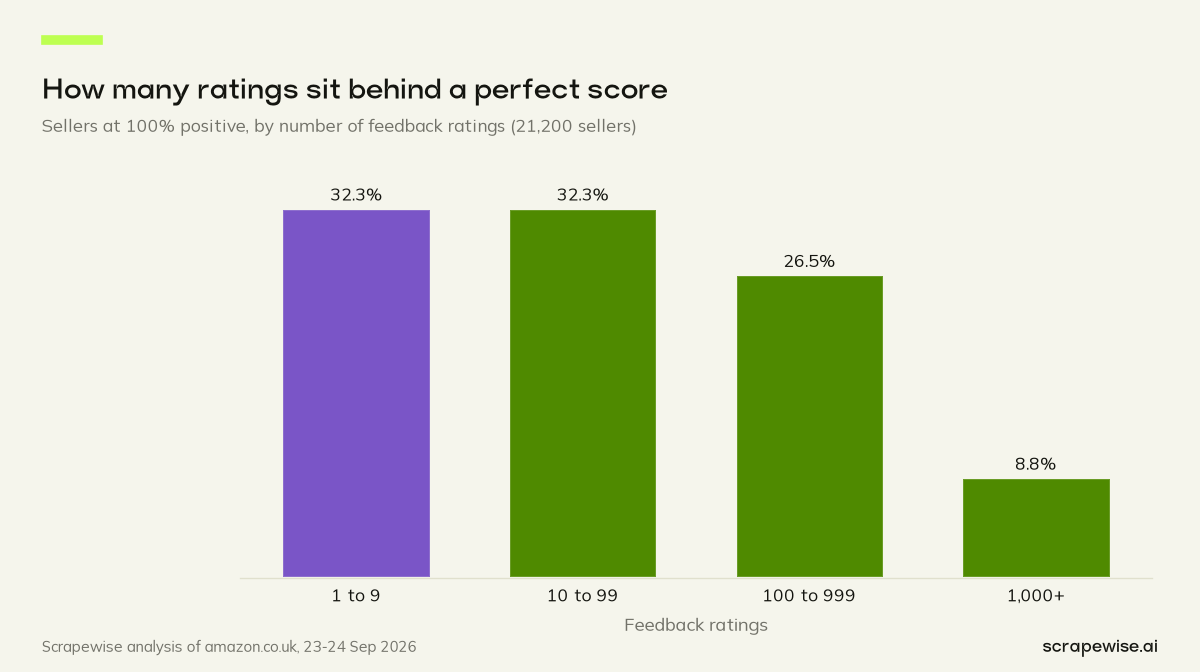
Compare that with all rated sellers, where 20.3% have fewer than 10 ratings. Perfect scores lean heavily towards thin histories. That is simple arithmetic rather than a flaw in the score: a seller with a handful of ratings stays at 100% until one buyer is unhappy, while a seller with thousands of ratings would need every single order to go well.
A 100% score on fewer than 10 ratings is a good start. It is not yet a track record.
The Pattern Across Seller Countries
The same effect shows up when we group sellers by declared business address. Groups with fewer ratings per seller show 100% more often. This is a pattern in rating counts, not a verdict on sellers from any country.
| Declared country | Median positive | Share at exactly 100% | Median ratings |
|---|---|---|---|
| Hong Kong | 100% | 59.6% | 32 |
| China | 99% | 49.2% | 60.5 |
| EU | 93% | 29.5% | 69 |
| United Kingdom | 94% | 26.8% | 200 |
| United States | 98% | n/a | 165 |
Sellers with a Hong Kong address have the lowest median rating count (32) and the highest share at 100% (59.6%). Sellers with a UK address have the highest median rating count (200) and the lowest share at 100% (26.8%). UK-based sellers carry about 3x the median ratings of China-based sellers, and they are also the group least likely to show a perfect score. For the four groups with both numbers, the order of the two columns is exactly reversed, which fits the idea that the rating count, not the country, shapes the score. For the full breakdown of who sells on the marketplace, see Amazon UK sellers by country.
Low Scores Are Rare, but Some Have History
At the other end, 3.8% of rated sellers are under 50% positive, which is one in 26, or 1,967 sellers. Many of these have short histories. But 226 sellers under 50% positive have 100 or more ratings, which means the low score is not a fluke of a few early orders.
What a Longer Record Tells You
Not every buyer leaves seller feedback, and each seller starts at zero, so the 100% group fills up with short records. For many of these sellers the perfect score says the sample is still small. It is not a reason to distrust them, because plenty of new sellers are excellent. It is a reason to weigh the count before the percentage.
The reverse holds too. A seller at 94% with hundreds of ratings has shown how it handles a bad week, a lost parcel or a difficult return. That history is information a perfect score on a short record cannot give you.
What It Means for Buyers, Sellers and Brands
For a buyer judging a seller, read the percentage and the count together:
- 100% on fewer than 10 ratings tells you almost nothing yet, good or bad.
- 95% or better on hundreds of ratings is a strong record, and a better one than a perfect score on a handful.
- Under 50% on 100 or more ratings is a pattern, not bad luck.
For sellers, the data is reassuring. Dropping from 100% to the high nineties after a few hundred orders is normal, and it puts you in the same place as most established sellers. Chasing a perfect score forever is a race against arithmetic.
For brands that watch who sells their products, feedback score and count are a quick first filter on unknown sellers, alongside other checks. Our guide to counterfeit detection and brand protection covers the wider process. The same logic applies to product reviews: our post on whether 5 stars on Amazon is trustworthy finds perfect product scores also rest on very few reviews. And our list of the largest Amazon UK sellers shows which sellers appear on the most products. The complete Amazon UK marketplace report has the rest of the dataset.
How We Collected This Data
The seller list came first. The Amazon Offers API read the other sellers page of products found in a wider 1,068-keyword pass on amazon.co.uk and returned every offer with its seller ID. The Amazon Seller API then looked up each seller's public profile and returned the positive feedback percentage, the rating count and the declared business address, which we grouped into countries. We publish aggregates only, never individual sellers. The two APIs cost the same, €0.00015 per call or €0.15 per 1,000 calls, and both can run daily, every few days, weekly or monthly, or on demand, through the REST API or a CSV/Excel export. Sign up for access to check the feedback of the sellers on your own products.
What sits behind the scores of the sellers on your listings? Pull them with 5 free requests, then pay as you go. Start with an account or compare the pricing.
Paste a marketplace URL — get structured market data
Size categories, track assortments, monitor trends. Clean feeds ready for your BI stack.
97% accuracy on Amazon benchmarks · no credit card · book a 15-min call →