
Key takeaways
- Rated products scoring a perfect 5.0 had a median of 2 reviews.
- 84.1% of perfect 5.0 scores rested on 5 or fewer reviews, and 15 had 100+.
- 11.1% of products rated 5.0 showed a sales label, against 47.3% of those rated 4.6 to 4.8.
A perfect 5-star rating on Amazon UK usually rests on very few reviews: the 10,831 rated products scoring exactly 5.0 had a median of just 2 reviews. The figures come from the star rating and review count of every product we found in amazon.co.uk search results on 23 to 24 September 2026.
The Data
Out of 182,700 rated products, 10,831 showed a perfect 5.0. Here is what sits behind those scores.
| Measure | Products rated 5.0 | For comparison |
|---|---|---|
| Median number of reviews | 2 | 20 for products rated 4.9 |
| Share with 5 or fewer reviews | 84.1% | n/a |
| Products with 100+ reviews | 15 | n/a |
| Share with a "bought in past month" label | 11.1% | 47.3% for products rated 4.6 to 4.8 |
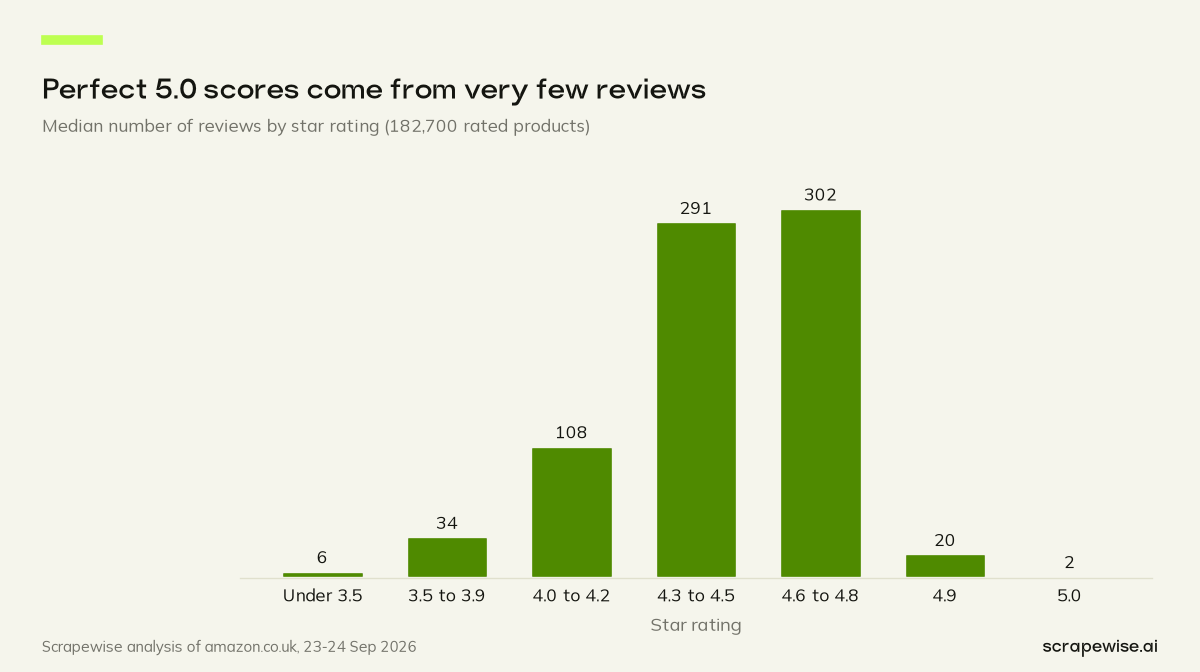
The drop is steep. At 4.9 stars the median product already has 20 reviews, and the busier rating bands sit far higher.
Why Perfect Scores Sit on So Few Reviews
The arithmetic does most of the work. A product with one or two reviews needs only those reviews to be 5 stars to show a perfect score. Every extra review is another chance for someone to give four stars, and on a product with a handful of reviews, one of those is enough to pull the score below 5.0. A perfect score is easier with two reviews than with two thousand.
The numbers bear it out. Of 10,831 perfect scores, 15 had 100+ reviews.
Why do so many products sit on so few reviews? Our data cannot say for each product, but the likely reasons are simple. A new listing has had little time to collect a mixed review. A niche product may sell a few units a month and never gather many reviews of any kind. And some early reviews may come from friends or family of the seller. We cannot tell those apart from genuine early buyers, and we do not try to.
None of this means a 5.0 product is bad. It means the score does not tell you much yet.
Where the Reliable Ratings Sit
If 5.0 says the least, which scores say more? The ones with many reviews behind them.
Among rated products, the median rating was 4.4, and 89% of rated products scored 4 stars or more. A rating in the mid fours is normal on Amazon UK, not a warning sign. Our guide to what is a good Amazon rating covers that in detail.
Sales tell the same story. Products rated 4.6 to 4.8 showed a sales label 47.3% of the time; perfect 5.0 products did so 11.1% of the time. At the top of the sales range, products labelled "5K+ bought in past month" had a median rating of 4.6 on a median of 6,800 reviews. The products that sell the most rarely look perfect. They look good, across thousands of reviews.
How to Read a 5-Star Rating
Before trusting a perfect score, check these, in this order:
- The review count. Two reviews at 5 stars is an early signal, not a verdict.
- The sales label. A "bought in past month" label shows that people are buying. A perfect score without one often means few buyers yet.
- The rest of the search. Compare the product with others in the same search. A 4.6 with thousands of reviews usually tells you more than a 5.0 with a handful.
- The review text and dates. Several 5-star reviews posted within days of each other, all short and similar, deserve a closer look.
Brands checking listings for fake or copycat products use the same signals; our guide to counterfeit detection for ecommerce brands explains how.
How to Rank Ratings Fairly
Sorting products by star rating puts the least tested products first. A product with two 5-star reviews beats one rated in the high fours on thousands of reviews. Sort a search by stars alone and you are, in effect, taking the word of two people.
The common fix is a weighted rating. You pretend every product starts with a few extra reviews at the typical score for its search, then add its real reviews on top. A product with two perfect reviews barely moves from the typical score. A product with thousands of reviews ends up close to its own score. The idea is simple enough to build in a spreadsheet, and it stops tiny samples from winning.
A simpler version works too: set a minimum review count, and only rank products above it. Pick the minimum per search, because a niche product with modest review counts can still be the leader in its own search.
Either way, keep the raw star rating and the review count side by side in your data, so nobody reads one without the other.
What It Means for Sellers and Brands
For sellers: do not chase a perfect score. Review volume matters more, both for buyers and for search position, as our study of how to rank on page 1 of Amazon shows. A 4.6 with steady reviews is a stronger asset than a 5.0 that one honest customer can end.
For shoppers: a 5.0 on a new product is not a red flag, just an unfinished one. If the product matters, pick the option with a slightly lower score and far more reviews, or wait a few weeks and look again once more buyers have had their say.
For brands and analysts: when you compare ratings across products, weight them by review count or set a minimum count before a rating enters the comparison. Otherwise the small, perfect scores will crowd the top of every ranking.
The rest of the ratings picture, and every other headline from this snapshot, is in our Amazon UK marketplace statistics for 2026.
How We Collected This Data
Everything here comes from one source, the Amazon Search API, run over results pages 1 to 7 on amazon.co.uk for 868 keywords. Each row it returned carried the star rating, the review count, the "bought in past month" label, the price and the page position. Amazon rounds review counts above a thousand and often pools reviews across variants of one product, so very large counts are approximate. It is priced at €0.00015 per call, or €0.15 per 1,000 calls, and each call covers one results page. Set up an account if you want ratings and review counts for the searches you sell in.
Do the perfect scores in your category have anything behind them? Check with 5 free requests, then pay as you go: start in the portal, and the pricing page lists the per-call rates.
Paste a marketplace URL — get structured market data
Size categories, track assortments, monitor trends. Clean feeds ready for your BI stack.
97% accuracy on Amazon benchmarks · no credit card · book a 15-min call →