
Key takeaways
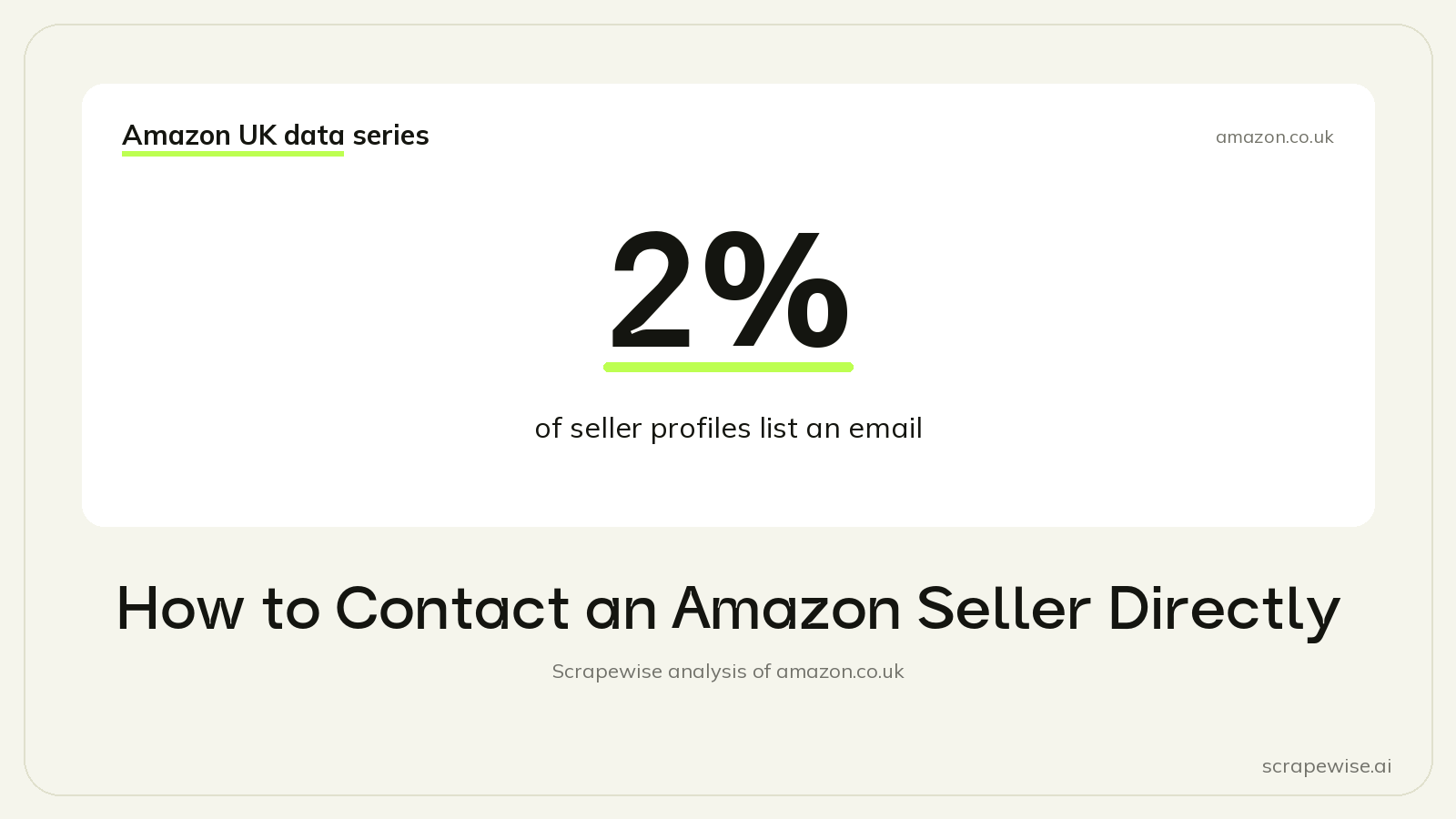
- Only 2.0% of 55,660 Amazon UK seller profiles list an email address, and 8.7% list a phone number.
- One seller profile in ten lists an email or a phone number, so Amazon's messaging is the usual way in.
- EU-based sellers list contact details most often: 28.0% show a phone and 11.2% an email.
To contact an Amazon seller directly, use Amazon's own messaging: only 2.0% of Amazon UK seller profiles list an email address, and 8.7% list a phone number. We checked 55,660 public seller profiles in a snapshot of amazon.co.uk taken on 23 to 24 September 2026, and most of them leave Amazon as the only channel.
The Data
Contact details are rare on Amazon UK seller profiles, and how rare depends on where the seller is based.
| Seller group (declared address) | Lists a phone | Lists an email |
|---|---|---|
| All sellers | 8.7% | 2.0% |
| UK-based | 21.8% | 1.5% |
| EU-based | 28.0% | 11.2% |
| China-based | 1.4% | 1.6% |
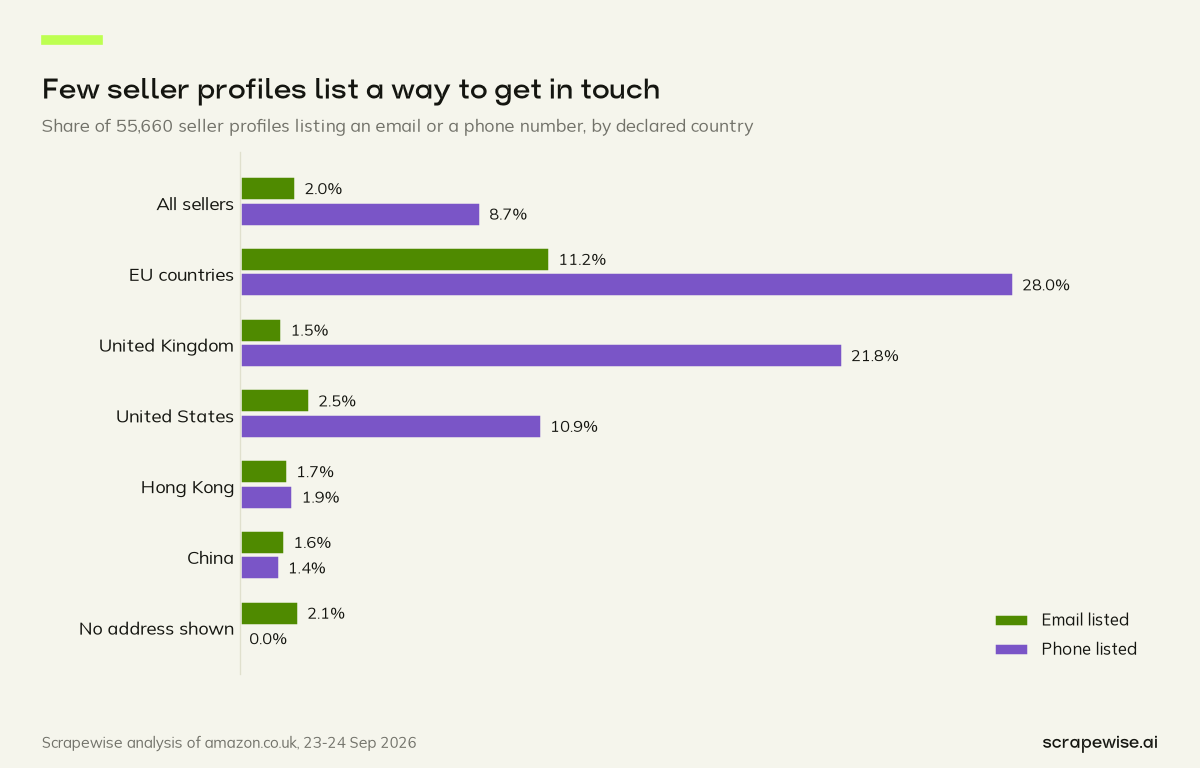
In counts, 1,090 of the 55,660 profiles show an email and 4,815 show a phone number. Put together, one profile in ten offers either route. Sellers, it seems, would rather take a call than an email, and most would rather take neither. Among the smaller groups, US-based sellers list a phone on 10.9% of profiles and Hong Kong-based sellers on 1.9%.
How to Contact a Seller Through Amazon
Amazon's message centre is the front door, and on most seller profiles there is no side door. These are the routes that work for almost everyone.
- Before you buy. On the product page, the seller's name appears next to "Sold by". It links to the seller's profile, where Amazon lets you send the seller a question through its messaging.
- After you buy. Open the order in Your Orders and choose the option to contact the seller. The message is tied to the order, which helps if there is a problem later.
- Read the reply in Amazon. Replies land in your Amazon messages, not your personal inbox, so check there before you chase.
If a seller does not answer a question about an order, Amazon's customer service is the next step. It can see the order and the messages you have already sent, so you do not need to explain it all again.
What to Put in Your Message
Short, specific messages tend to get quicker answers. A few habits help:
- Put the order number or the product name in the first line, so the seller does not have to search.
- Say what you want in one sentence: a replacement, a refund, a delivery date, or an answer to a question about the product.
- Add a photo if the problem is visible, such as damage or a wrong item.
- Keep the whole exchange inside Amazon, even if the seller suggests moving to email. The record in Amazon is the one that counts if you later need help.
If you are asking before you buy, ask about the thing the listing does not answer: size, compatibility, what is in the box. A seller can answer that in a line, and the answer tells you something about how the seller treats buyers.
Contacting a Seller as a Business
Some readers want to reach a seller for trade reasons: wholesale, a partnership, or a brand question about a listing. Amazon messaging is built for buyer questions, so it is not always the right channel for that. The business name on the profile is the better starting point, because many companies have their own website and published contact route outside Amazon.
Many sellers are small businesses or sole traders. Treat any details you find with care, and use the channel the business has chosen to publish, not one you have pieced together.
What Seller Profiles Actually Show
A profile is not empty. Most show a store name, a feedback score, and business details that include a business name and a declared address. Only 3.9% of profiles gave no country we could read. What most profiles lack is a direct way to talk to anyone.
The "About us" text is short, and the words people expect to see are rare. The most common text we found in it was standard legal wording about online dispute resolution. Phrases that describe the business itself turn up on a small share of profiles:
- "Family" appears on 3.2% of UK-based sellers' profiles and 0.2% of China-based sellers' profiles.
- "High quality" appears on 2.6% of UK-based and 1.1% of China-based profiles.
- "Factory" appears on 0.3% of all profiles.
A profile usually tells you who the seller is on paper. It rarely tells you how to reach them. For a sense of service, the feedback score is more useful than the about text. Our post on whether perfect positive feedback on Amazon is good looks at what that score does and does not prove.
Why Contact Details Differ by Seller Country
UK-based and EU-based sellers list a phone far more often than sellers elsewhere: 21.8% and 28.0%, against 1.4% for China-based sellers. EU-based sellers also lead on email, at 11.2%.
We did not measure why, and there are several plausible reasons. Business habits differ, and so do the language and time-zone costs of answering calls from UK shoppers. A seller that handles every question through Amazon messaging has little reason to list a phone at all. Country here means the business address the seller declares on its profile. It says nothing about the quality of the service behind it. The wider country split is in Amazon UK sellers by country.
What It Means for Sellers and Brands
For shoppers, Amazon messaging is the reliable route. It keeps a record tied to your order, and that record matters if you later need a refund or a return.
For sellers, a filled-in profile may be a small advantage in a field where most profiles say little. A clear about text, a working contact route and a named business can help a buyer who is choosing between two similar offers. We did not measure whether it changes sales. It is a cheap habit, and that is all we can say for it.
For brands, the same gap matters when you need to reach a reseller on your listings, for example about pricing or a suspected fake. Start with Amazon's own channels, since most sellers will not list anything else. Our guide to counterfeit detection and brand protection covers what to record before you escalate, and MAP monitoring for brands covers price policies. VAT details on profiles are covered in Amazon UK VAT numbers by seller country.
We publish these figures as aggregates only. This post does not list, and will not help you collect, any seller's contact details.
How We Collected This Data
Only one scraper was needed here. The Amazon Seller API read 55,660 public seller profiles on amazon.co.uk, found through a 1,068-keyword pass, and returned each profile's store name, about text, feedback share, ratings count and business details. From those fields we counted how many profiles fill in an email or a phone, and which phrases appear in the about text; we publish only aggregates.
Each profile read costs €0.00015 per call, or €0.15 per 1,000 calls, and you get the rows through the REST API or a CSV/Excel export. Create an account to check the profiles of the sellers on your own listings.
Your first 5 free requests are enough to read a handful of seller profiles and see what they show. After that you pay per call. Sign up or see pricing.
Paste a marketplace URL — get structured market data
Size categories, track assortments, monitor trends. Clean feeds ready for your BI stack.
97% accuracy on Amazon benchmarks · no credit card · book a 15-min call →