
Key takeaways
- Of Sports & Fitness listings, 15.5% have no reviews, the highest share of the 16 categories we checked, against 7.3% across the 197,022 products in our sample.
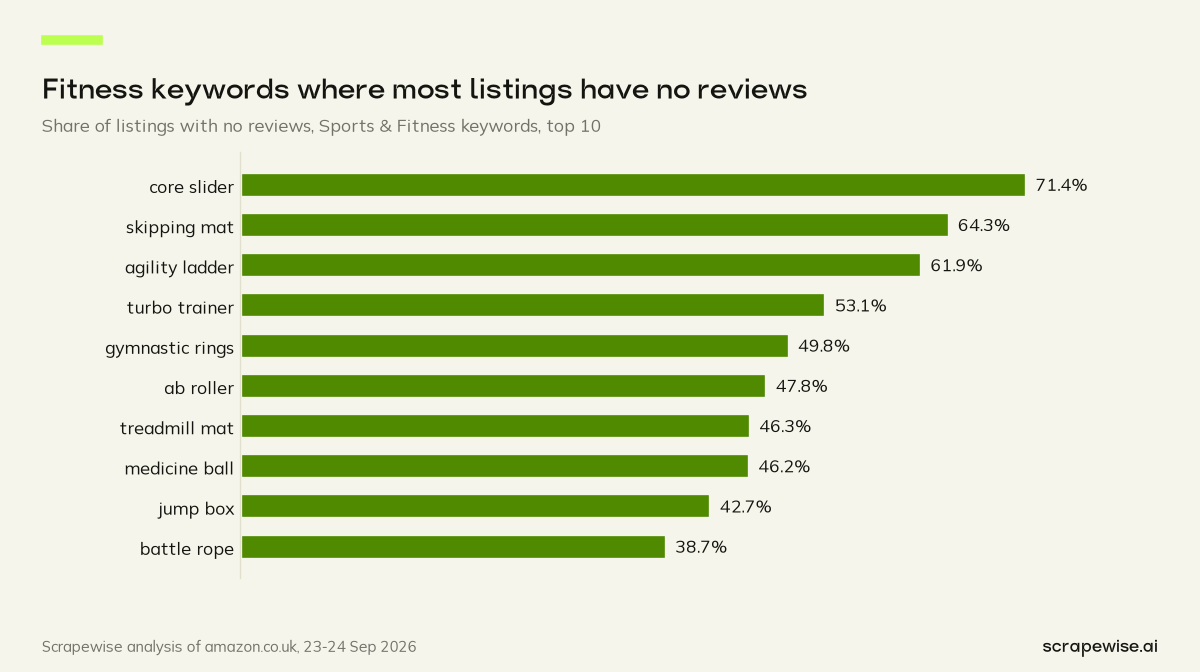
- In core slider searches, 71.4% of listings have no reviews, and fitness searches take the top three places for review-free listings in our data.
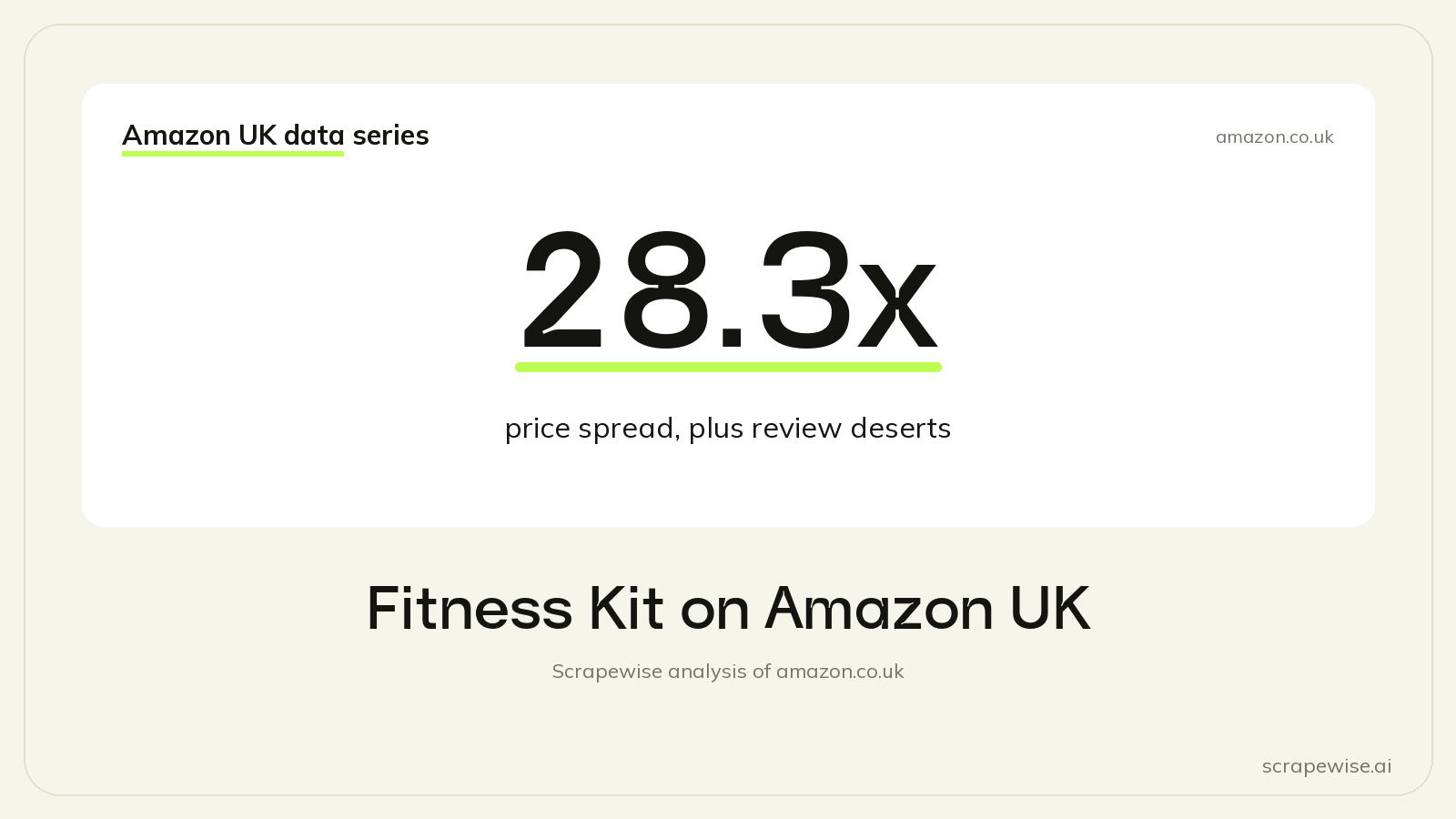
- Priced turbo trainer listings have a median price of £200.00 and a 28.3x spread between the top and the bottom of the search, the widest of any large search in our data.
Fitness equipment on Amazon UK has the thinnest review record of any category we checked: 15.5% of Sports & Fitness listings have no reviews, and in core slider searches the share reaches 71.4%. We checked the fitness searches, their prices and their reviews in a snapshot of amazon.co.uk taken on 23 to 24 September 2026.
The Data
Sports & Fitness is unusual in two ways. It has the highest share of listings with no reviews of any category, and it holds the searches where reviews are rarest in the whole study.
| Search or group | Listings with no reviews |
|---|---|
| core slider | 71.4% |
| skipping mat | 64.3% |
| agility ladder | 61.9% |
| turbo trainer | 53.1% |
| gymnastic rings | 49.8% |
| cherry pitter (Kitchen & Dining, for comparison) | 60.4% |
| All Sports & Fitness listings | 15.5% |
| All Electronics & Computing listings | 2.7% |
| All 197,022 products | 7.3% |
A kitchen gadget sneaks into the top of the list: the cherry pitter, at 60.4%. Apart from that, the top of the table reads like a home-gym shopping list. Five of the six searches with the highest no-review share in our data are fitness kit.
Where the Review Deserts Are
Core sliders lead the list. They are small discs you put under your hands or feet for floor exercises, and 71.4% of the listings in that search have no reviews. Most of them slide through the results without collecting a single review.
The next searches look similar. Skipping mats come in at 64.3%, agility ladders at 61.9%, turbo trainers at 53.1% and gymnastic rings at 49.8%. Most of these are simple products that are easy to make and to list, so a search can fill up with near-identical versions. One likely reason for the empty review sections is that reviews spread thin across so many similar listings, and a new listing starts from nothing.
Two caveats belong next to these numbers. A listing with no reviews is not the same as a listing with no sales: a product can sell for weeks before anyone writes a review, and this post does not measure sales per listing. And because Amazon often pools reviews across variants, a new colour of an established product can show its sibling's reviews. That pulls the no-review share down, so the real share of genuinely new, unreviewed products may be higher.
Zoom out to the category and the pattern holds. Across Sports & Fitness, 15.5% of listings have no reviews, the highest of the 16 categories. Across all 197,022 products the figure is 7.3%, and in Electronics & Computing it is 2.7%. Our post on whether 5 stars on Amazon can be trusted looks at the other end of the same problem: perfect ratings that rest on very few reviews.
Turbo Trainers: The Widest Price Spread We Found
A turbo trainer turns a road bike into an indoor exercise bike. Priced turbo trainer listings have a median price of £200.00. Among searches with plenty of priced listings, only rattan furniture has a higher median, at £259.97. A few small searches, such as NAS drives, go higher still.
They also have the widest price spread of any large search. Spread is measured as p90/p10: take a price near the dear end of the search and divide it by one near the cheap end. For turbo trainers it is 28.3x, against 10.6x across all priced products. Only a few much smaller searches, such as e-readers, stretch further.
The spread most likely comes from what the search returns. The same query can bring up a basic resistance stand, spare parts and a smart trainer that sets the resistance for you, and those sit at very different prices. A turbo trainer lets you ride for hours without leaving the spare room. Its prices cover far more ground.
Reviews are thin here too. Of turbo trainer listings, 53.1% have no reviews. For a product with a median price of £200.00, that leaves buyers with little to go on, and it leaves sellers with a real chance to stand out through their reviews.
For the category-level view, see average price on Amazon UK by category. Priced Sports & Fitness products have a median of £20.99 there, against £16.99 for the whole priced sample, so most fitness kit is far cheaper than a turbo trainer.
Fewer Sales Labels Too
Sports & Fitness also has the lowest share of listings with a "bought in past month" label of the 16 categories: 20%, against 36.6% across all 197,022 products. The top label is rarer still. Just 0.9% of fitness listings carry the "1K+ bought in past month" label, against 3.6% across all products.
Amazon's labels are rounded minimums, and a listing below the lowest threshold shows no label at all. So a missing label means recent sales below Amazon's lowest threshold, not necessarily zero. Even so, fewer labels and fewer reviews point the same way: a long tail of listings, each selling a little. If you try to estimate sales from reviews, as in our post on Amazon sales estimates from reviews, fitness is the category where that method has the least to work with.
Mind the calendar as well. Our snapshot was taken in late September, and the label looks back one month. Fitness kit may well sell differently in January, and we have one snapshot, so treat these shares as a September baseline rather than a year-round figure.
What It Means for Sellers and Brands
For sellers in these searches, a review is scarce, and that cuts both ways. In a search where most listings have no reviews, a product with a handful of genuine reviews already looks different from its neighbours. The reverse also holds: a new listing will sit among many others with the same empty review section, so price, images and title have to do more of the work.
Price needs the same care. In a turbo trainer search, a price that looks high may sit in the middle of the range, while in a core slider search, where prices are low, a small markup is easy to spot. Check where your price falls in your own search before you set it. Our guide to competitor pricing strategies covers how to keep that check going.
For brands, review deserts make copies harder to judge. When many near-identical listings share a search and few have reviews, buyers cannot easily tell the original from the rest. Knowing which products compete with yours, and at what price, is the starting point; our post on competitor assortment gap analysis shows how to map that.
For analysts, look at fitness at keyword level. A category that holds both a £200.00 turbo trainer and a core slider has no single typical price or review count. Every other category is compared in our Amazon UK marketplace statistics.
How We Collected This Data
One Scrapewise scraper fed this post. The Amazon Search API read pages 1 to 7 of every search in our study. For the fitness searches it returned the review count, star rating, listed price and "bought in past month" label of each product on every results page, and the keyword told us which category each product belonged to.
The Amazon Search API costs €0.00015 per call, or €0.15 per 1,000 calls, and the rows come back through the REST API or a CSV/Excel export. Create an account to see how thin the reviews are in the searches you compete in.
The first 5 free requests are on us, which is enough to check a few fitness searches. After that you pay per call. Sign up or compare pricing.
Paste a marketplace URL — get structured market data
Size categories, track assortments, monitor trends. Clean feeds ready for your BI stack.
97% accuracy on Amazon benchmarks · no credit card · book a 15-min call →