

Your competitors' unhappy customers are already writing your next product brief. They say what broke, what didn't fit, and what they expected instead. Most brand and category teams never read it in a structured way, because star ratings look fine and nobody has time to read 2,000 reviews.
Competitor review analysis is the practice of collecting the reviews on competing products, tagging every complaint by type, counting the tags, and acting on the most common ones. The useful part is the low-star text: 1, 2 and 3-star reviews. This guide covers the six steps (pick products, collect reviews, tag, count, find the need behind each complaint, decide what to do), the data that shows why stars alone don't help, and how to keep it running every week.
Why read competitors' bad reviews at all?
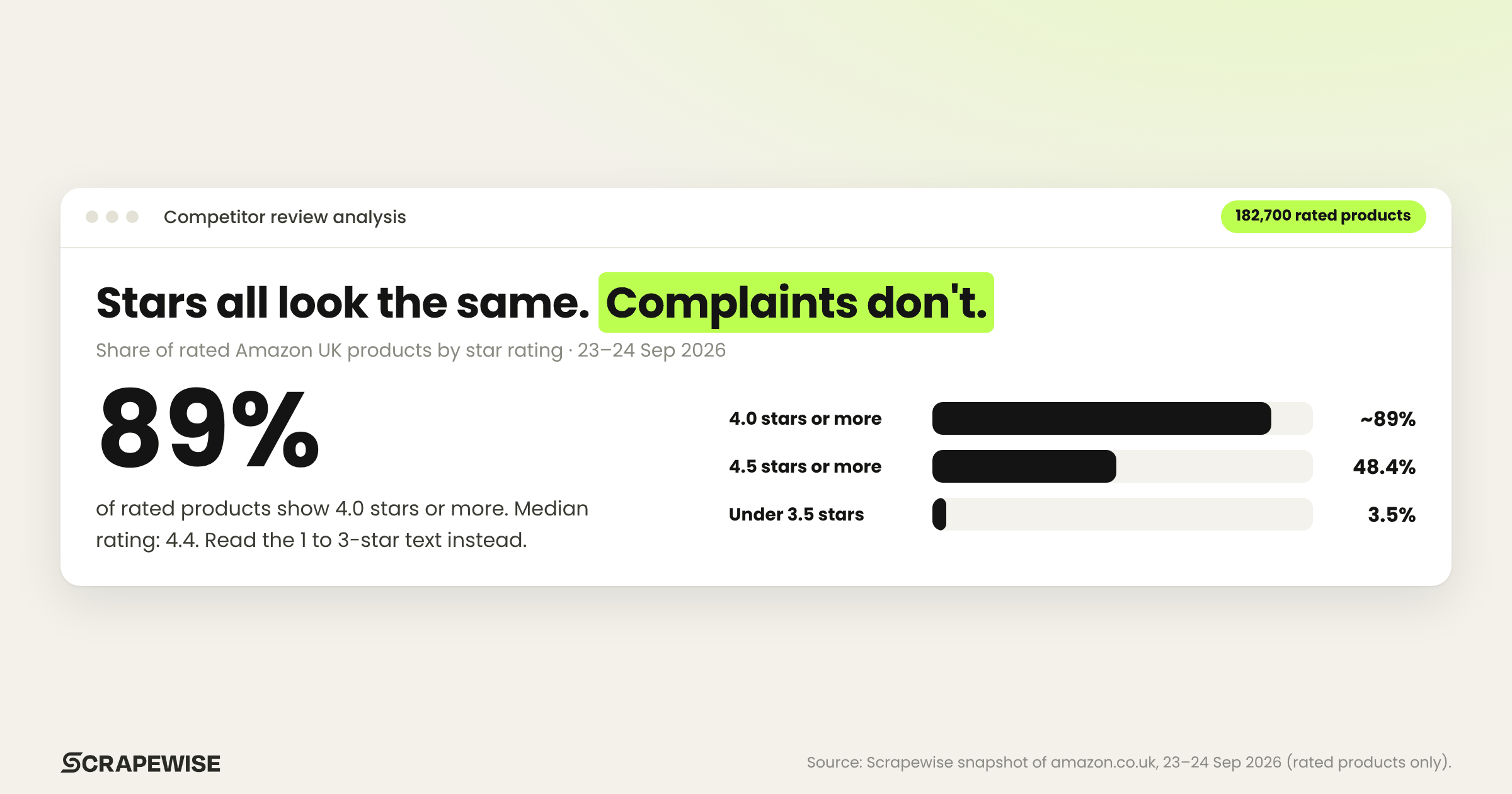
Read competitors' bad reviews because star ratings barely separate products. In the Scrapewise snapshot of amazon.co.uk (23–24 Sep 2026), about 89% of the 182,700 rated products (drawn from 868 searches) showed 4.0 stars or more, and the median was 4.4. When almost everything scores 4-plus, the reason one product disappoints sits in the review text, not in the number.
The spread is narrow. In the same snapshot:
- 48.4% of rated products scored 4.5 stars or more.
- Only 3.5% scored under 3.5 stars.
- 345 products under 3.5 stars still carried a "100+ bought in past month" label.
That last figure is the interesting one for product teams. People keep buying products they rate badly. The rating alone doesn't say why, but the low-star reviews on those listings usually do, and that's where a better product or a clearer listing can win. Our analysis of the worst-rated products on Amazon UK goes through those searches in detail.
Jungle Scout makes the same point in its guide to analysing Amazon reviews (November 2024): "Studying competitor reviews can help you identify gaps in their offerings (or yours) and adjust your strategy to meet those unmet needs." Its later piece on comparing your reviews with competitors' (November 2026) adds the practical problem: "star ratings and review counts only tell you so much."
The video above walks through the whole method in eight minutes. The steps below follow it.
Which competitor products should you analyse?
Analyse three to five competing products per category that sell well and have enough reviews to show a pattern. Skip products with a handful of reviews: in the Amazon UK snapshot, products with a perfect 5.0 had a median of 2 reviews. Pick the products your shoppers actually compare with yours, on the marketplaces and shops where they buy.
Some practical filters:
- Enough reviews. A few dozen low-star reviews per product is a good minimum. With fewer, one angry buyer can look like a trend.
- Real sales. A product that sells despite complaints tells you more than one nobody buys. Marketplace sales labels, bestseller ranks or a high review count are rough signals.
- The same job. Compare products that solve the same problem for the same buyer, even if the specs differ. Our guide to competitor assortment gap analysis covers how to choose the competitive set.
- Your markets. For a Nordic or DACH brand, the reviews that matter may sit on Amazon.de, on a local retailer's site, or on comparison sites such as Prisjakt, PriceRunner and idealo where they show product reviews. Read them in the language your buyers write in.
The perfect 5.0 problem is covered in our post asking is 5 stars on Amazon trustworthy: 84.1% of the 10,831 perfect-score products in the snapshot had five reviews or fewer.
How do you collect competitor reviews?
Collect four fields for every review: the product, the star rating, the date and the review text. Keep only 1, 2 and 3-star reviews for the complaint work, and keep the date so you can see if a problem is new or old. Copying by hand works for one product; for a category, a scraper saves days.
For a first try, copying 50 to 100 low-star reviews into a sheet is fine. It gets slow fast. Each product has its own review page, reviews load in batches, and a category with five competitors and 20 products each means hundreds of pages.
There's also a process cost. In category teams, the slow part is rarely reading one review. It's the spreadsheet that gets emailed around, with three people adding their tags in different columns, and a week passing before anyone decides anything. A shared sheet with one tag list fixes more than a faster reader does.
A few rules for the data:
- Keep the date. A complaint that appears only in the last two months may be a new batch or a new supplier.
- Keep 3-star reviews. They're often the most specific: the buyer liked the product enough to keep it and explains exactly what's missing.
- Don't edit the text. You'll want to quote buyers' own words later in your listing copy.
How do you tag and count complaints?
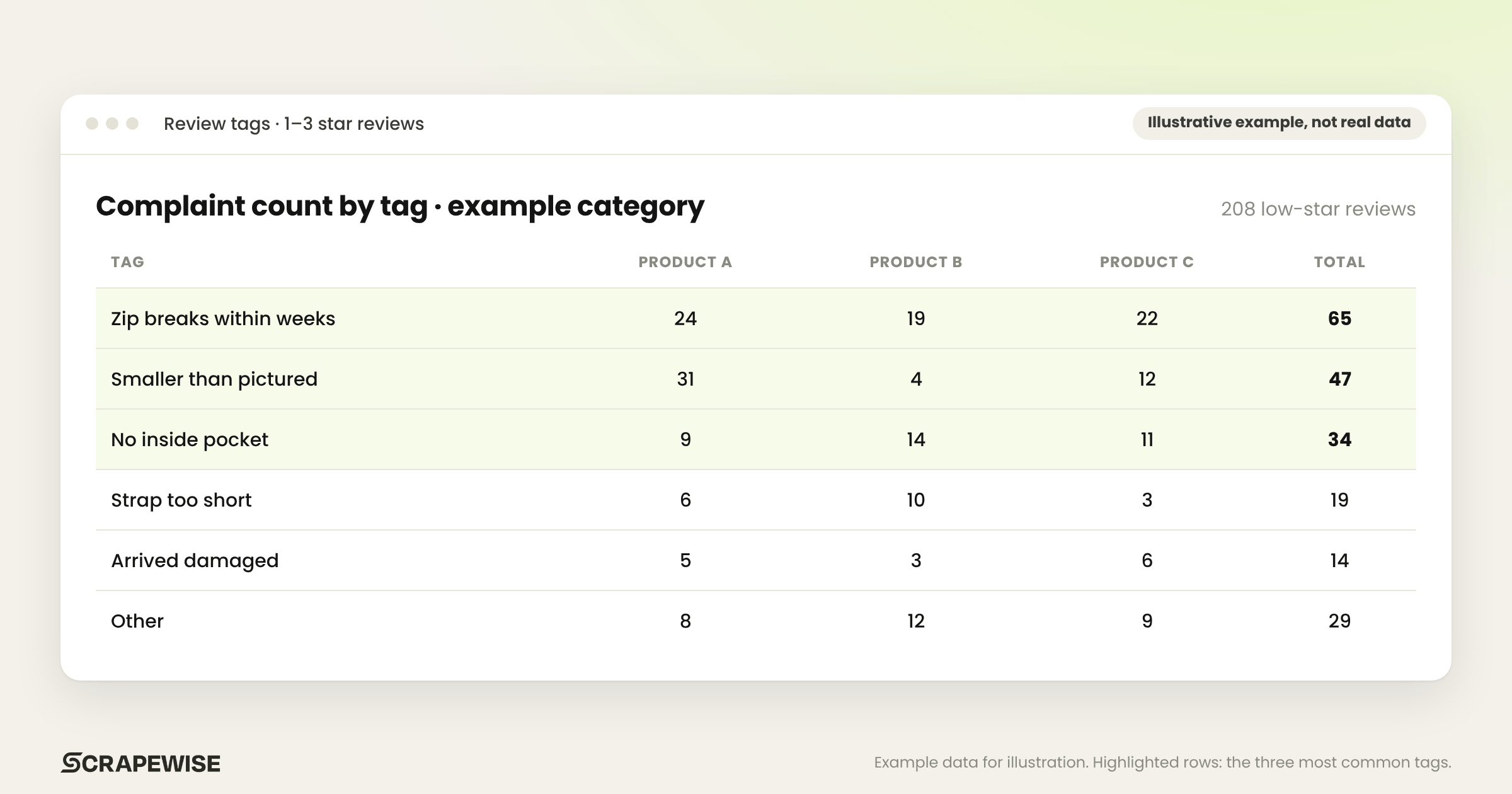
Give every low-star review one or more tags from a short, fixed list, then count how often each tag appears per product. Use 8 to 12 tags at most, such as "broke within weeks", "size runs small", "hard to assemble" or "not as pictured". Counting turns opinions into a ranked list; the top three tags are usually the opportunity.
How to build the tag list:
- Read 30 to 50 reviews first without tagging. Write down the complaints in buyers' words.
- Group them into 8 to 12 tags. Keep tags concrete. "Quality" is too broad; "zip breaks" is useful.
- Tag the rest. A review can carry two tags. Add "other" for anything that doesn't fit, and check it at the end: if "other" is big, your list is missing a tag.
- Count per product and in total. A tag that appears across every competitor is a category problem. A tag that appears on one is that product's weakness.
AI tools help here. The video shows one way to do it: export the reviews to a sheet and ask Claude to tag each one against your fixed list, then count. Check a sample of 20 to 30 tags by hand before you trust the count, and keep the tag list fixed so this month's numbers compare with next month's.
How do you turn complaints into product ideas?
Find the need behind each top complaint, then decide what kind of fix it calls for. "Size runs small" may mean a sizing chart, not a new product. "Broke after two weeks" points to a materials or supplier problem. "Wish it came with a lid" is a feature request. Each type leads to a different action and a different owner.
There are four common outcomes:
| Complaint type | Example (illustrative) | What to do | Who owns it |
|---|---|---|---|
| Expectation gap | "Smaller than it looked" | Fix your listing: dimensions, photos with scale, clearer copy | E-commerce / content |
| Quality or durability | "Handle snapped in a month" | Brief your supplier; test before you claim it's fixed | Category / sourcing |
| Missing feature | "No way to hang it on the wall" | Variant or new product, if enough buyers ask | Brand / product |
| Service or delivery | "Arrived damaged" | Check your own packaging and carrier, not the product | Operations |
Jungle Scout's 2024 guide uses a travel mug as its example: "If multiple customers mention that a travel mug leaks when tilted, this feedback signals a design flaw that needs to be addressed." If your mug doesn't leak, say so in the listing and show it. RaveCapture's guide to competitive review analysis puts the counting logic simply: "Recurring 1-star reviews often indicate systemic problems rather than isolated incidents."
Not every complaint is worth fixing. Ask three questions before you act: how many buyers mention it, does it affect the reason people buy the product, and can you actually fix it at your price point.
Which product categories get the lowest ratings?
Low ratings bunch in a few searches. In the Amazon UK snapshot, the six lowest-rated searches with enough rated listings all had fewer than 59% of products at 4 stars or more, against about 89% for the whole sample. Posture correctors were the lowest, with a median of 3.9 stars.
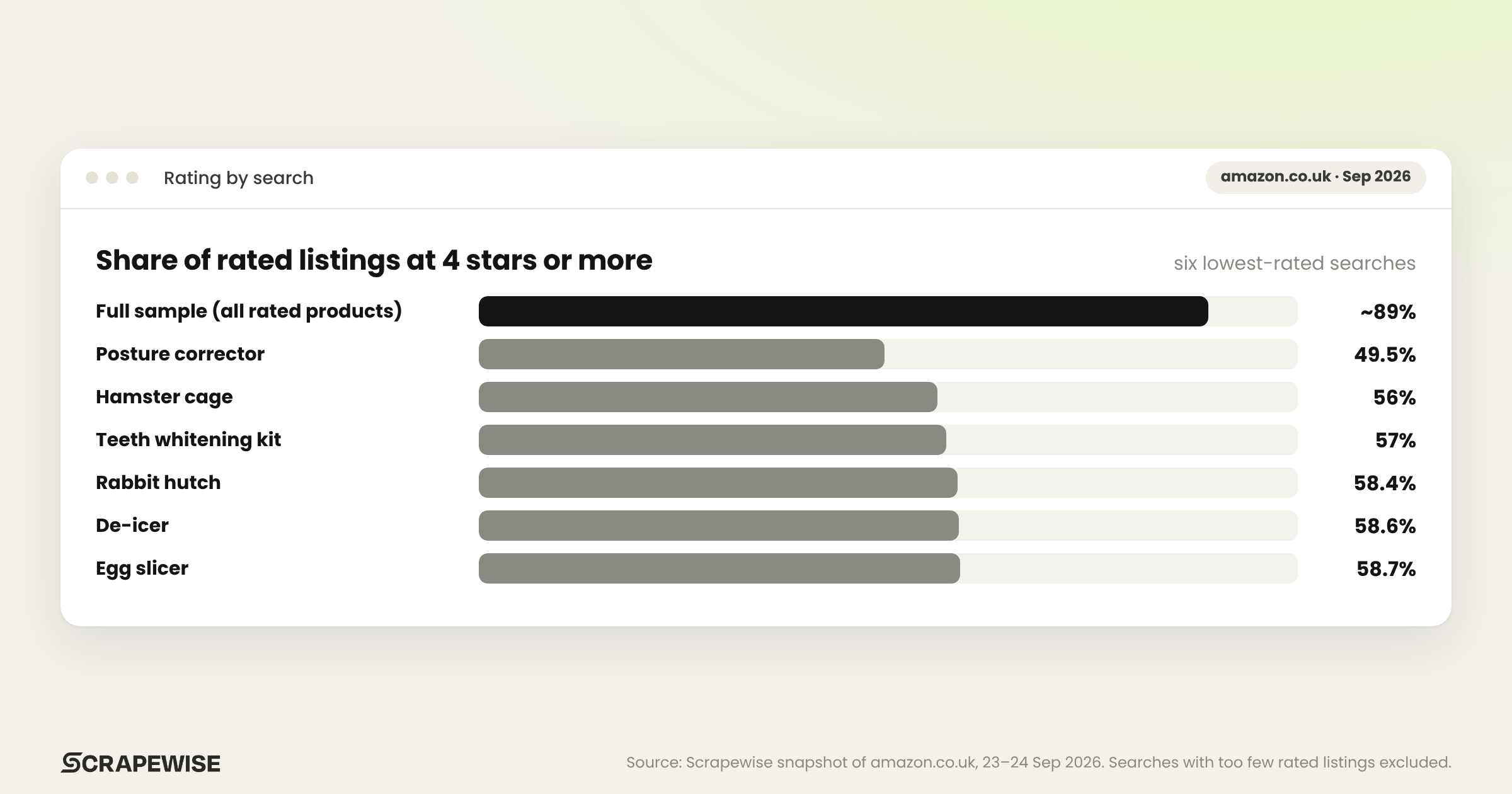
The six searches and their share of rated listings at 4 stars or more:
- Posture corrector: 49.5%
- Hamster cage: 56%
- Teeth whitening kit: 57%
- Rabbit hutch: 58.4%
- De-icer: 58.6%
- Egg slicer: 58.7%
For a brand in one of these categories, the low-star reviews are the first place to look for fixes. For a buyer or category manager deciding which products to add, they show where a better product has room to stand out. Chattermill's guide to mining competitor reviews for CX gaps makes a similar case from the customer-experience side, aimed at CX and product teams.
What should European brands keep in mind?
Treat the reviews you read as data, not proof, and keep your own review practice clean. Since May 2022, under the EU's Omnibus Directive (2019/2161), shops that show reviews must tell shoppers whether and how they check reviews come from real buyers, and fake reviews are banned. Reading competitor reviews is fine; buying or faking reviews is not.
Three practical points:
- Some reviews are fake or incentivised, on both sides. A burst of 1-star reviews on one day may be an attack, not a product problem. Look at dates and wording before you count them.
- Language matters. A brand selling in Sweden, Germany and the Netherlands gets complaints in three languages. Tag them against the same list so the counts add up.
- Store only what you need. For the analysis you need the text and the rating. You don't need reviewer names, so leave them out of your sheet.
This is not legal advice. Check with your national consumer authority if you're unsure about your own review set-up.
How do you keep competitor review analysis running?
Run it monthly per category, with the same products and the same tag list, so you can see when a complaint grows or disappears. A one-off analysis finds ideas; a monthly one tells you if a competitor fixed their problem or if a new one appeared. Set it up once and the monthly work drops to reading the counts.
What a repeatable set-up looks like:
- A fixed list of competitor product pages per category.
- A scheduled collection of new reviews with the four fields: product, stars, date, text.
- The same tag list, applied by a person or by an AI tool with a person checking a sample.
- One monthly table of tag counts per product, shared in one place instead of emailed.
ScrapeWise is one way to do the collection step. ScrapeWise publishes this blog, so weigh that. You define the fields you want (product, stars, date, review text) for the competitor pages you list, run them once or on a schedule (at most once a day), and get a table, CSV or Excel file. You pay per page, from €0.15 per 1,000 plain pages up to €3.75 for sites that need a browser and proxy (prices as of November 2026), with no plan or seats. There are no alerts, so someone reads the table. Some sites block scrapers or need a login, so check your key sources first. The e-commerce market research page shows other ways teams use the same data, and the brand protection page covers the counterfeit and grey-market side.
Other routes work too: marketplace seller tools, review platforms that sell competitor benchmarks, or an assistant with a spreadsheet for a handful of products.
What should you do next?
Pick one category and three competing products this week. Copy 50 low-star reviews from each, build a tag list of no more than 12 tags, and count. You'll have a ranked list of complaints in an afternoon, and usually one or two ideas worth taking to your supplier or content team.
If you want the reviews for a whole category without the copying, collect your own competitors' reviews with ScrapeWise: the first 5 requests are free, no card needed. Pair it with our post on competitor data beyond price tracking to see where review data fits with prices, stock and assortment.
The rating figures in this post come from the public Scrapewise Amazon UK datasets (CC BY 4.0).
Paste your first URL and get structured data
No code, no credit card. Most public websites, turned into a table you can export.
Not ready to sign up? See 12 rows of real Amazon data →
5 free requests no credit card · pay per page, no monthly plan · book a 15-min call →