

Your price file has a tab for every competitor anyone ever mentioned. Twenty-five shops, some last updated in spring. Nobody reads half of them, and the shop that undercut you last week isn't in the file at all.
Here is the short answer on which competitors to monitor. Pick them per category, not for the whole company. Track the few shops that sell the same products to the same shoppers, plus whoever wins the cheapest spot on the comparison sites and marketplaces where your customers look. For most categories that is three to five core rivals checked daily, three to five price setters checked weekly, and a short watch list you look at less often. Review the list every quarter and before big sales.
This guide shows how to pick them, how many to keep, where to find the rivals you don't know about yet, and what our Amazon UK data says about how much the field changes from one category to the next.
What is a competitive set?
A competitive set is the list of competitors whose prices, stock and promotions you collect and compare against your own, for a defined group of products. It is narrower than "everyone in our market". It holds the shops a shopper would realistically buy from instead of you, for that category, in that country.
The key word is for that category. A home and furniture retailer competes with a furniture chain on sofas, with a DIY chain on paint and with marketplace sellers on lamps. One list for the whole business mixes all three, and the useful signal gets lost.
How many competitors should you track?
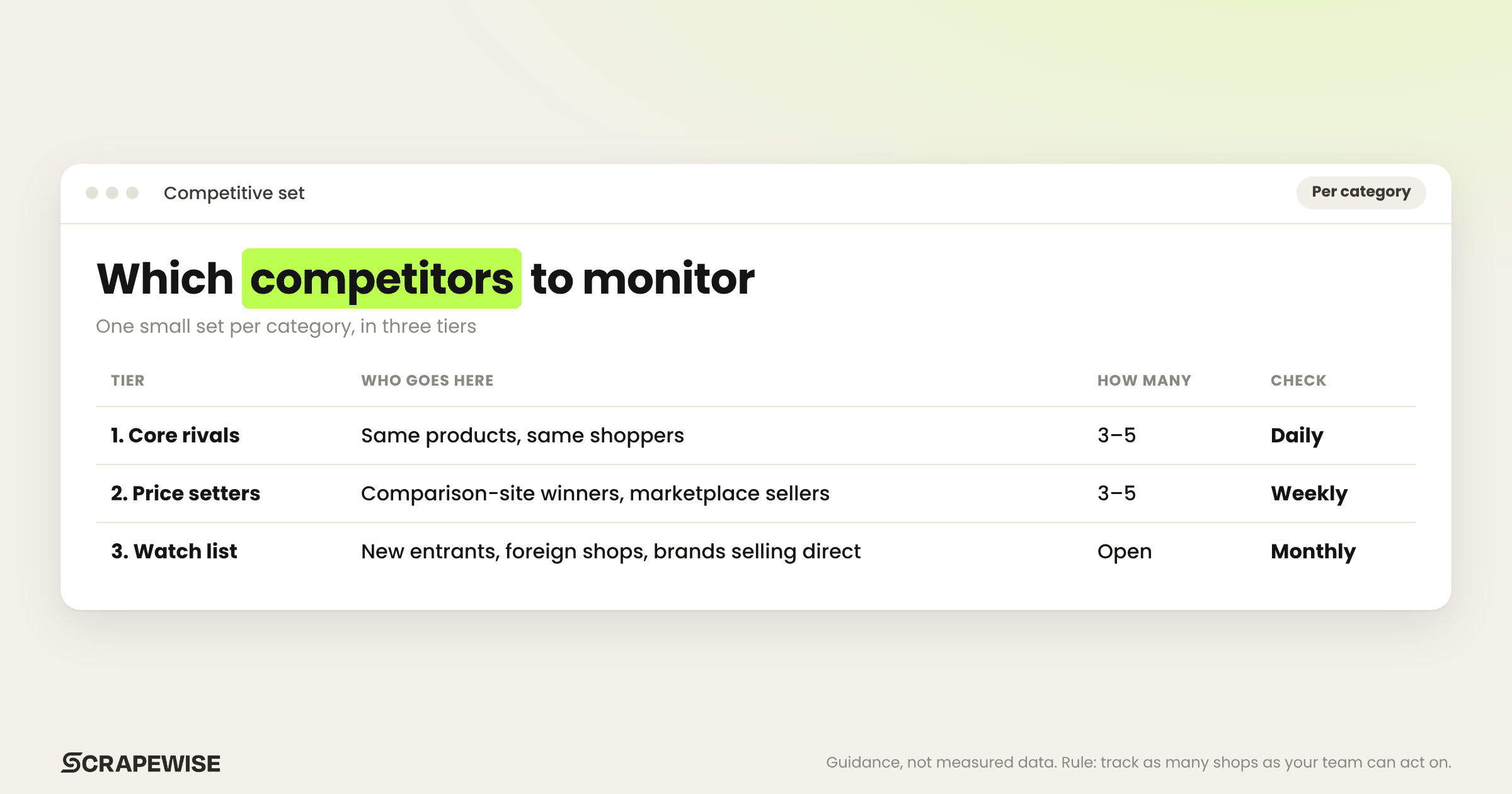
Track as many as your team can read and act on each week. A practical starting point is three to five core rivals per category, checked daily, plus three to five price setters and marketplace sellers checked weekly. Anything beyond that goes on a watch list you review monthly or before peak season.
The limit is rarely the data. Collecting prices for one more shop costs little. The limit is the person reading the table.
In my supply chain and retail work, I saw the same pattern again and again. The slow part wasn't getting a price. It was the Excel file emailed between three people, each adding their bit, until the file was called something like "Category X_Prices_FINAL_v3.xlsx" and the moment to react had passed. Adding ten more competitors to that process makes it slower, not better.
A tiered set keeps the daily view small:
| Tier | Who goes here | How many per category | How often to check | What you do with it |
|---|---|---|---|---|
| 1. Core rivals | Shops selling the same products to the same shoppers | 3–5 | Daily | Price decisions, weekly meeting |
| 2. Price setters | Comparison-site winners, marketplace sellers, the shop others follow | 3–5 | Weekly | Spot pressure early, check if a low price is real |
| 3. Watch list | New entrants, foreign shops, brands selling direct | Open | Monthly or before peak season | Decide who moves up |
These are starting points, not rules. A category with heavy promotions may need more core rivals. A niche B2B range may need two.
Which competitors should you monitor in each category?
Monitor the shops that sell the same products to the same shoppers in the same country, show up where your customers compare prices, and move prices the others follow. Test each candidate on five points: product overlap, shopper overlap, visibility, influence and channel. Three or more passes puts a shop in tier 1 or 2. Fewer puts it on the watch list.
- Product overlap. Does it sell the same products, ideally with the same EAN or model number? Take your top 20 sellers in the category and count how many the shop carries. Low overlap means you will spend most of your time on matching, not on prices.
- Shopper overlap. Would your customer realistically buy there instead? Same country, similar delivery promise, similar price level. A premium shop and a discounter can stock the same blender and still not be competing for the same person.
- Visibility. Does it show up where your shoppers compare? Look at idealo in Germany and Austria, Prisjakt and PriceRunner in the Nordics, and Google Shopping everywhere. If a shop keeps appearing in the top offers for your products, it competes with you whether or not you have heard of it.
- Influence. Do other shops follow its prices? In many categories one or two players move first and the rest react. Watching the leader tells you what is coming.
- Channel. Does it sell through a marketplace you also use, or one your customers use? On Amazon, the seller next to you on the listing is often the real price setter.
Brand managers can use the same test the other way round. Your "competitors" are often your own resellers, and the questions become: who sells our products, who shows up first on comparison sites, and whose price do the others copy? Our guide to MAP monitoring covers that view.
Why should the competitive set differ by category?
Because who you compete with changes a lot from one category to the next, even on the same marketplace. In the public Scrapewise snapshot of amazon.co.uk (23–24 September 2026), UK-based sellers held 48.3% of single-seller listings in Health and Supplements, but only 14.5% in Electronics and Computing and 12.5% in Arts, Crafts and Music.
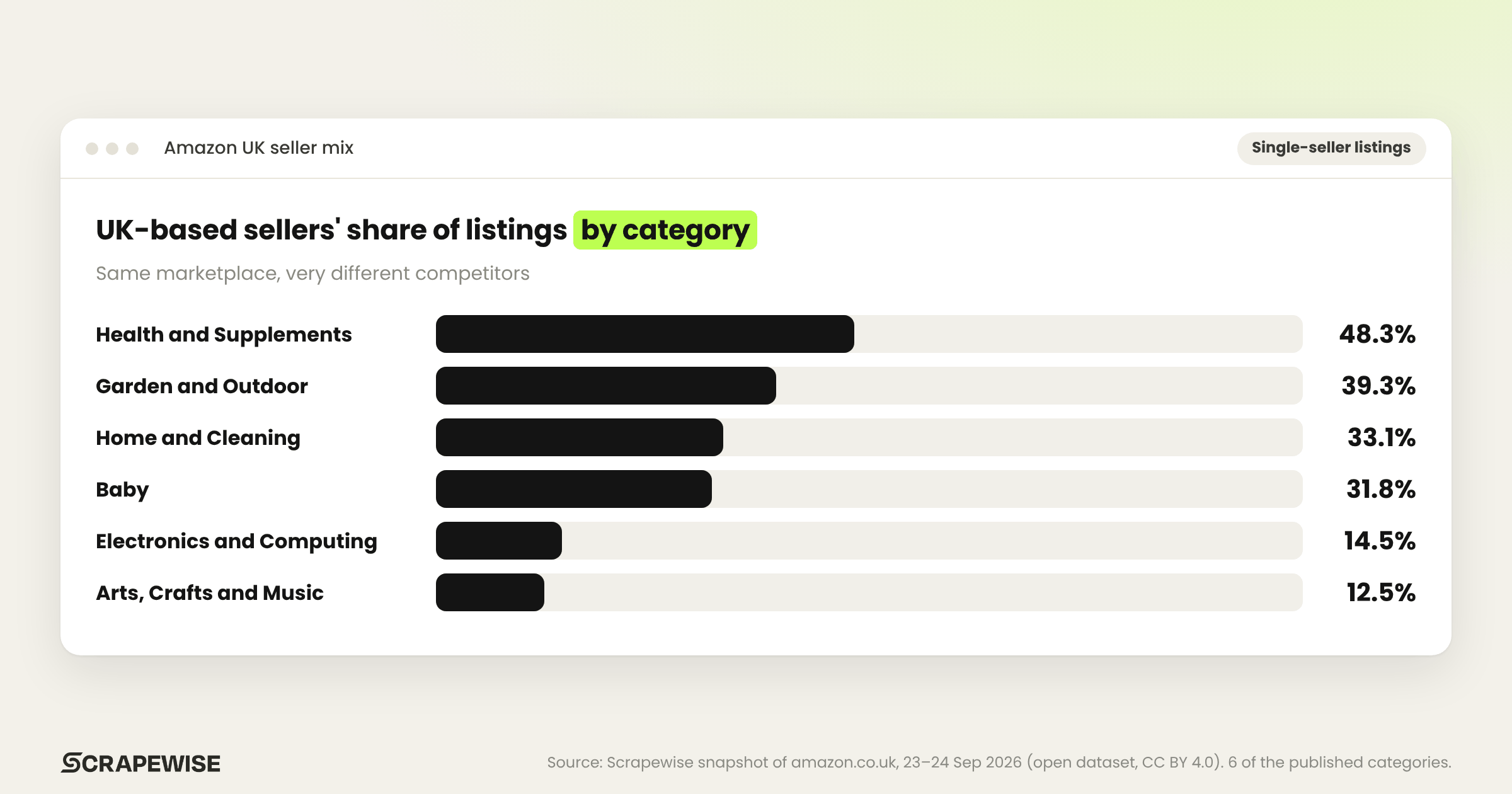
| Category (Amazon UK, Sept 2026) | UK-based sellers' share of single-seller listings | China-based sellers' share |
|---|---|---|
| Health and Supplements | 48.3% | 26.7% |
| Garden and Outdoor | 39.3% | not published |
| Home and Cleaning | 33.1% | not published |
| Baby | 31.8% | not published |
| Electronics and Computing | 14.5% | 55.4% |
| Arts, Crafts and Music | 12.5% | 59.5% |
Six of the published categories. Shares are of single-seller listings in the snapshot, which covered 868 search keywords.
The gap is bigger at the level of single searches. Of the 636 searches with enough single-seller listings to compare, 403 had a majority of those listings held by sellers based in China or Hong Kong. For "model kit" it was 94.4%. For "whey protein" and "vegan protein" it was 0%.
So a supplements brand selling on Amazon UK mostly faces other UK sellers, and a craft supplies shop mostly faces sellers it may never have heard of. A single company-wide competitor list can't describe both. The full numbers are in the open dataset on GitHub and the Amazon UK sellers by category write-up.
Marketplaces matter for this question. Amazon says its selling partners "account for more than 60% of sales in Amazon's store" (Amazon, April 2026). That figure covers Amazon's store worldwide, not only the UK. If you sell on Amazon, most of the prices next to yours are likely set by other sellers, not by Amazon.
Where do you find competitors you don't know about yet?
Start from your products, not from a list of company names. Take your 20 to 50 best sellers per category and see who else sells them on comparison sites, Google Shopping and the marketplaces your customers use. The shops that keep appearing near the top are your real competitive set, whether you knew them or not.
The video above includes a block on "who's actually selling" in Amazon UK search results. In that ScrapeWise snapshot from 11 November 2026, 14 products showed Amazon's "1K+ bought in past month" label while having fewer than 1,000 ratings. Products can sell well before they build a long review history, so a seller you have never heard of can already be one of your competitors.
Comparison sites are a quick place to start in Europe. According to idealo's partner page at Productsup, idealo sends traffic to "more than 50,000 merchants every day" and users "can compare up to 500 million offers". In Sweden, Norway and Denmark, Prisjakt and PriceRunner play the same role. We cover how Nordic retailers use Prisjakt and PriceRunner in a separate guide.
Don't stop at your own country, either. According to Eurostat (data extracted February 2026), 78% of EU internet users aged 16–74 bought or ordered goods or services online in 2025. According to the EuroCommerce and Ecommerce Europe report (September 2025), European B2C e-commerce turnover grew 7% in 2024 to €819 billion. A German shop shipping to Austria, or a Danish shop selling into Sweden, can be in your set without ever opening a store there. If you sell in several EU markets, build one set per market.
How do you turn the list into a working monitoring setup?
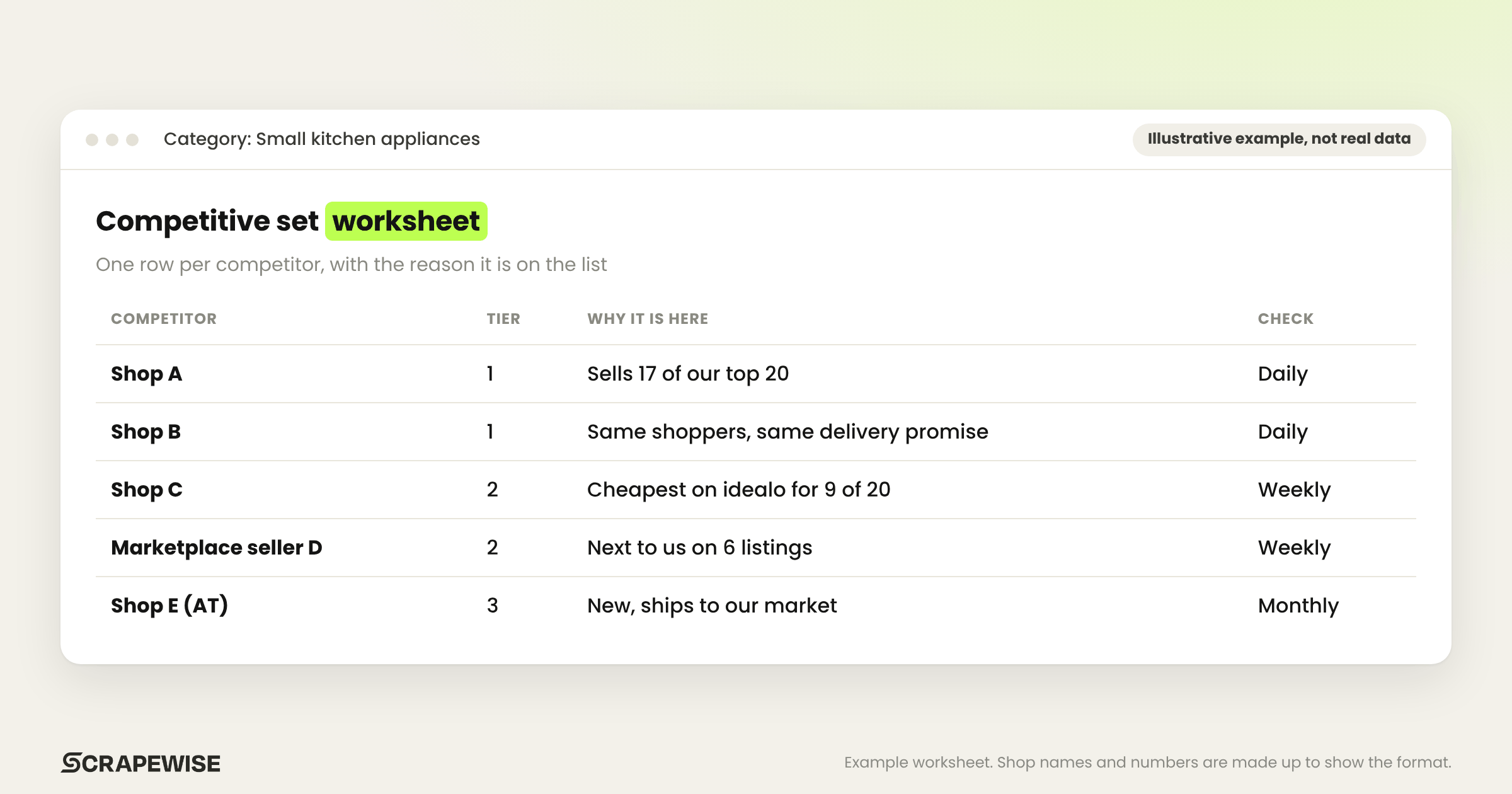
Write the set down as one table per category: competitor, tier, country, product URLs and check frequency. Then match each competitor's listing to your own product, collect prices on a schedule, and agree who reads the table and when. Without matching, the comparison is guesswork.
A five-step setup:
- Pick the products. Start with the items shoppers judge you on, usually your best sellers and most-searched products. You don't need the whole catalogue on day one.
- Fill the table. For each category, list tier 1 and tier 2 competitors with a reason for each ("sells 17 of our top 20", "cheapest on idealo for 9 of 20").
- Match products. Link each competitor listing to your SKU, by EAN where both sides show it and by title, brand and size where they don't. Our product matching page explains the options, and the matching guide goes into why it decides whether the numbers can be trusted.
- Set the schedule. Daily for tier 1, weekly for tier 2. Our frequency guide has starting points by category.
- Name a reader. One person per category owns the table and brings it to the weekly pricing meeting.
For a set this size, collection costs a few euros a month. A worked example with ScrapeWise's self-serve prices (published on /pricing, November 2026): 200 products across 6 competitors is 1,200 pages per daily run, or 36,000 pages over 30 daily runs. At €0.15 per 1,000 plain pages that is €5.40 a month. Shops that need a browser render cost €0.75 per 1,000 pages, which makes it €27.00. Matching the listings to your SKUs by EAN or text costs €0.15 per 1,000 products per matching run, with a minimum of €1 per run.
Other tools price this differently, per SKU or per competitor. We compare the models in what competitor price monitoring costs. ScrapeWise publishes this blog, so check other vendors' pricing pages as well.
How often should you review the competitive set?
Review it every quarter, and again four to six weeks before your biggest sales period. Between reviews, move a shop up a tier when it keeps appearing as the cheapest offer for your top products, and move one down when its overlap with your range drops. A set that never changes is a sign nobody is checking.
The weeks before Black Week are the usual trigger. New sellers appear, marketplace sellers switch on promotions, and a shop you ignored all year may suddenly hold the lowest price. Our Black Friday competitor price tracking checklist covers that period for the Nordics and DACH.
EU rules make a review useful too. When a competitor in your set announces a price cut, EU law (Article 6a of the Price Indication Directive, added by the Omnibus Directive) requires the "before" price to be its lowest price in at least the 30 days before the cut. In September 2024 the EU Court of Justice ruled in the Aldi Süd case (C-330/23) that the advertised reduction must be calculated from that 30-day low. If you keep price history for your core rivals, you can tell a real discount from an inflated one. We explain the rule in our Omnibus price history guide.
What mistakes should you avoid when choosing competitors?
The common ones are tracking only the biggest names, using one list for every category, and tracking more shops than anyone reads. Each one gives you data that looks complete but doesn't change a single price decision. The fix is the same in every case: build the set per category from your own best sellers, and only keep shops someone reads.
- Only the famous names. The large chain everyone talks about may not be the shop that wins your shoppers. Check who is cheapest for your products on comparison sites.
- One list for everything. As the Amazon UK data shows, the field in supplements and in craft supplies has little in common. Split by category.
- Too many shops, no reader. In Estonia, I've often seen category managers with assistants who collect competitor prices by hand. Every shop added to the list is hours of their week. Cut the list before you add tools.
- No matching. A price for "a 5-litre air fryer" is not a price for your model. Without matching on EAN or attributes, the comparison misleads.
- Ignoring your own resellers. For brands, the most important prices are often the ones your retailers set on your products.
What should you do next?
Take one category this week. List your top 20 products, look up who sells them on idealo, Prisjakt, PriceRunner, Google Shopping or Amazon, and sort the shops into the three tiers. That gives you a first draft of your competitive set, and it shows you where your current list is out of date.
When you want the collection to run on its own, you can put your competitors' product URLs into ScrapeWise and see the prices in a table: the first 5 requests are free, no card needed. If you'd rather have someone else build and maintain the set, Managed Data does the scraping, cleaning and matching for you. For a wider view of the tools on the market, see our competitor price tracking overview.
Paste your first URL and get structured data
No code, no credit card. Most public websites, turned into a table you can export.
Not ready to sign up? See 12 rows of real Amazon data →
5 free requests no credit card · pay per page, no monthly plan · book a 15-min call →