

Your team checks competitor prices on Monday. By Wednesday someone forwards a screenshot: a rival cut the price on your best seller two days ago. Now the question comes up again. Should you check every day? Every hour?
Here is the short answer to how often to monitor competitor prices. Check as often as you can act on what you find, and no less than daily in the weeks around big sales. For most retailers and brands that means daily data, read in a weekly pricing meeting. Hourly checks only pay off when competitors reprice several times a day and you can respond the same day.
This guide gives a starting frequency for each category, a way to test it, what our own nightly price records showed, and how the EU's 30-day discount rule changes the answer.
What is price monitoring frequency?
Price monitoring frequency is how often you collect competitor prices for the same products: hourly, several times a day, daily or weekly. It sets how quickly you see a change and how much history you keep. It is a separate decision from how often you change your own prices, which depends on your pricing meeting and approval process.
That split matters. Many teams buy fast data and then review it once a week. The extra checks don't hurt, but they don't help either, unless something reacts to them in between.
The video above shows what that weekly reading can look like: one page on a Monday with what changed, which discounts are new and who is selling now. In that Amazon UK snapshot from 11 November 2026, 92 of 132 products on page one showed a crossed-out price. Discounts are the normal state, so the question is which ones are new since last week.
How often do competitor prices actually change?
It depends on the channel and the week. Online prices change far more often than shelf prices, and most of that movement happens around promotions. For many products in a normal month, a daily check catches every change that matters. In the weeks before Black Friday, the same products can move every few days.
Research backs this up. Economists Yuriy Gorodnichenko and Oleksandr Talavera studied nearly 20 million weekly price quotes from a US and Canadian price comparison site (2016). They found that price changes occur "much more frequently in online stores (approx. once every 3 weeks or less) than in regular stores (once every 4-5 months or more)". Alberto Cavallo (NBER, 2015), working with daily prices of 80 thousand products in five countries, found that scraped online prices are "stickier" than earlier studies suggested. Both points hold. Online prices move more than shop prices, but most products still sit still most days.
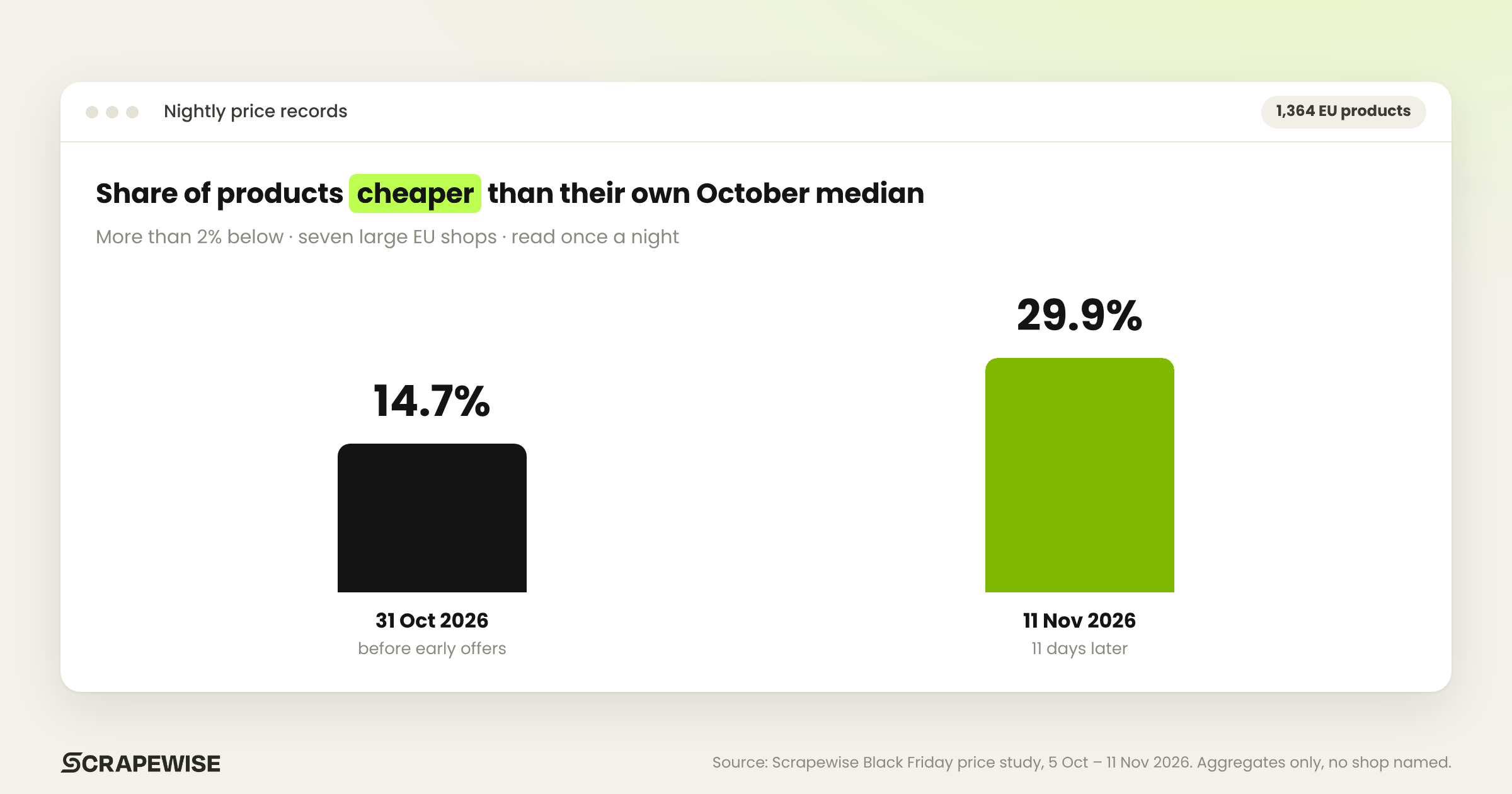
Our own records show the same pattern. From 5 October to 11 November 2026 we read the price of products at seven large EU shops once a night. For the 1,364 products with complete data, half had not moved by more than 2% against their own October median by 11 November. The other half had, and the timing is the useful part:
| Compared with each product's October median | On 31 Oct 2026 | On 11 Nov 2026 |
|---|---|---|
| Cheaper by more than 2% | 14.7% | 29.9% |
| More expensive by more than 2% | 15.4% | 20.5% |
The share of cheaper products doubled in 11 days, as early Black Week offers started. A team checking weekly would have seen that shift a week late. Our records are nightly, so they can't show moves within a day. For a shift like this one, a nightly check was early enough.
How often should you check competitor prices in each category?
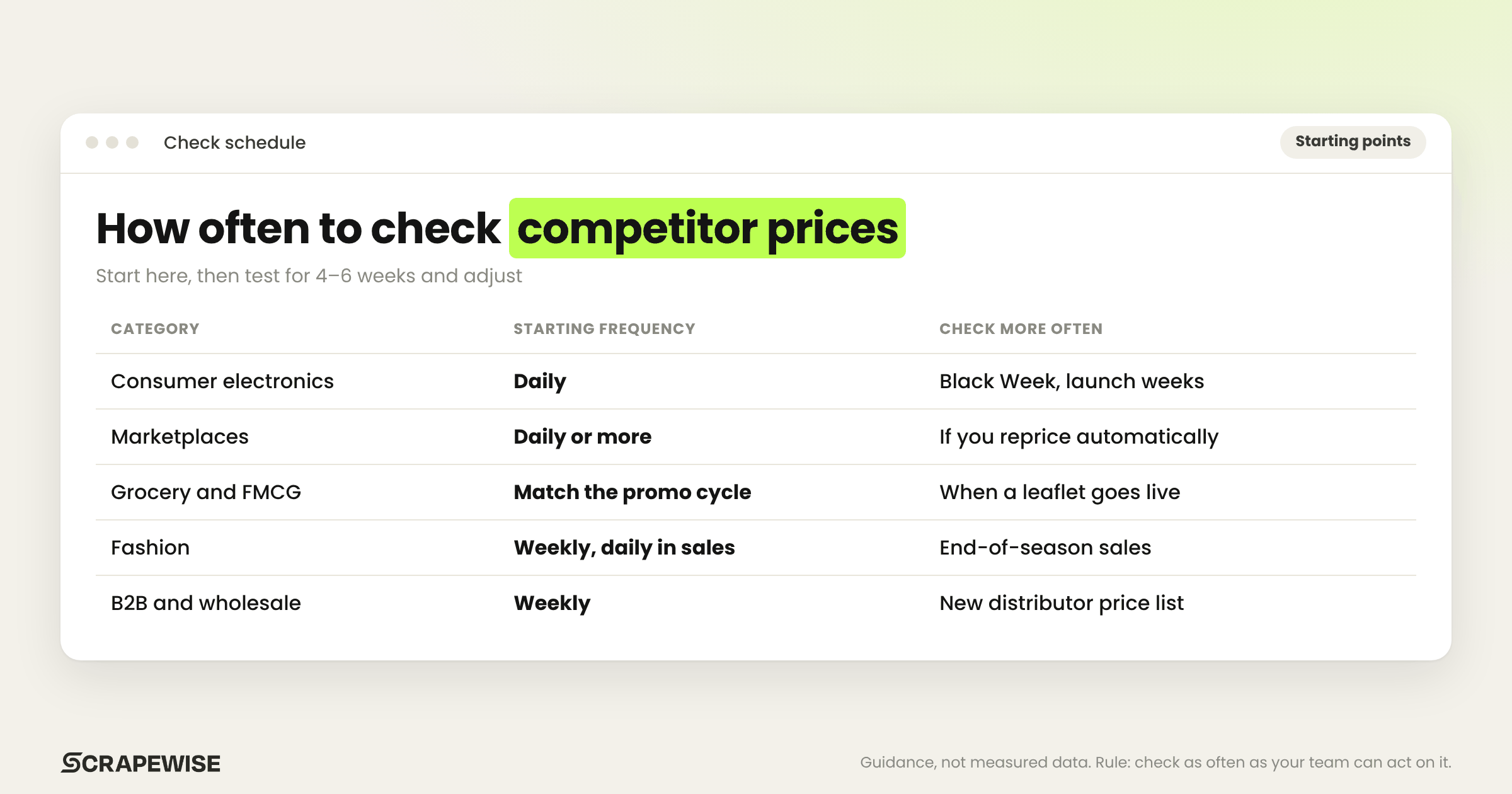
Start daily for most categories, step up in fast categories and on marketplaces, and step down for slow B2B ranges. The right frequency follows how often competitors reprice and how fast your team can respond. Use the table as a first setting, then test it for four to six weeks and adjust.
| Category | What drives price changes | Starting frequency | When to check more often |
|---|---|---|---|
| Consumer electronics | Model launches, retailer promotions, marketplace sellers | Daily | Black Week, launch weeks, if you reprice the same day |
| Marketplaces (Amazon, Zalando, bol, Allegro) | Automated repricing by many sellers | Daily, more if you reprice automatically | When you sell on the marketplace yourself |
| Grocery and FMCG | Weekly promotions and leaflets | Daily or weekly, matched to the promo cycle | When a competitor's leaflet goes live |
| Beauty and pharmacy (OTC) | Promotions, online pharmacy campaigns | Daily | Around campaigns at big online pharmacies |
| Fashion | Seasonal markdowns | Daily in sale periods, weekly otherwise | End-of-season sales |
| Home and furniture | Campaigns, slow list price changes | Weekly to daily | Campaign weeks |
| B2B and wholesale | Price lists and contracts | Weekly | When a distributor publishes a new list |
Vendors suggest faster settings. Price2Spy's own starting points by industry put consumer electronics at every 6–12 hours and marketplaces at every 3–24 hours, and the post calls them "not in any way universal standards". Import.io suggests hourly for high-velocity items, daily for core ranges and weekly for stable items. Faster is not wrong. It has to be worth what it costs, and someone has to read it.
Why does your decision cycle matter more than check speed?
Your decision cycle matters more than check speed because a price you see but can't act on is just a number in a file. If prices are approved in a weekly meeting, the useful question is whether the data on the table is complete and current, not whether it was collected at 09:00 or 09:05. Fix the process first, then choose the frequency.
From what I've seen working in supply chain planning and retail, the slow part is rarely the data. It's the Excel file called "Category X_Prices_FINAL_v3.xlsx" that goes around by email while three people add their input. In Estonia, many category managers still have assistants who collect competitor prices by hand. By the time the file is agreed, days have passed. Checking hourly does not fix that. A table that refreshes itself every morning and that everyone reads at the same time does.
A simple rule of thumb:
- You change prices weekly: daily data, read once a week, is enough. Look at what changed since last Monday.
- You change prices daily: daily data, read every morning, with clear rules on when to react.
- You reprice automatically several times a day: you need checks at least that often, plus floors so a rule can't push you below margin.
How do EU discount rules change how often you should check?
They raise the floor. Under the EU Price Indication Directive, as amended by the Omnibus Directive, an announced price reduction must show the prior price, meaning the lowest price in the 30 days before the reduction. To judge whether a competitor's "-40%" is real, you need their daily prices, not a weekly snapshot.
The rule is set out in Article 6a of the amended directive. In the Aldi Süd case (C-330/23, September 2024), the EU Court of Justice confirmed that the advertised percentage has to be calculated from that 30-day low. We explain what this means for your own price records in a separate guide.
For monitoring, this has two effects:
- Weekly checks can miss the reference price. A competitor can hold a lower price for three days between your checks. That low becomes the reference for any discount they announce in the next 30 days, and you never saw it.
- Daily history is evidence. If a rival's discount looks inflated, a daily record of their prices is what lets you raise it with the shop, a comparison site or a consumer authority.
This matters most in the Nordics and DACH, where shoppers compare on Prisjakt, PriceRunner and idealo. Those sites show price history, so a shopper can see a fake discount as easily as you can.
What does daily vs weekly monitoring cost?
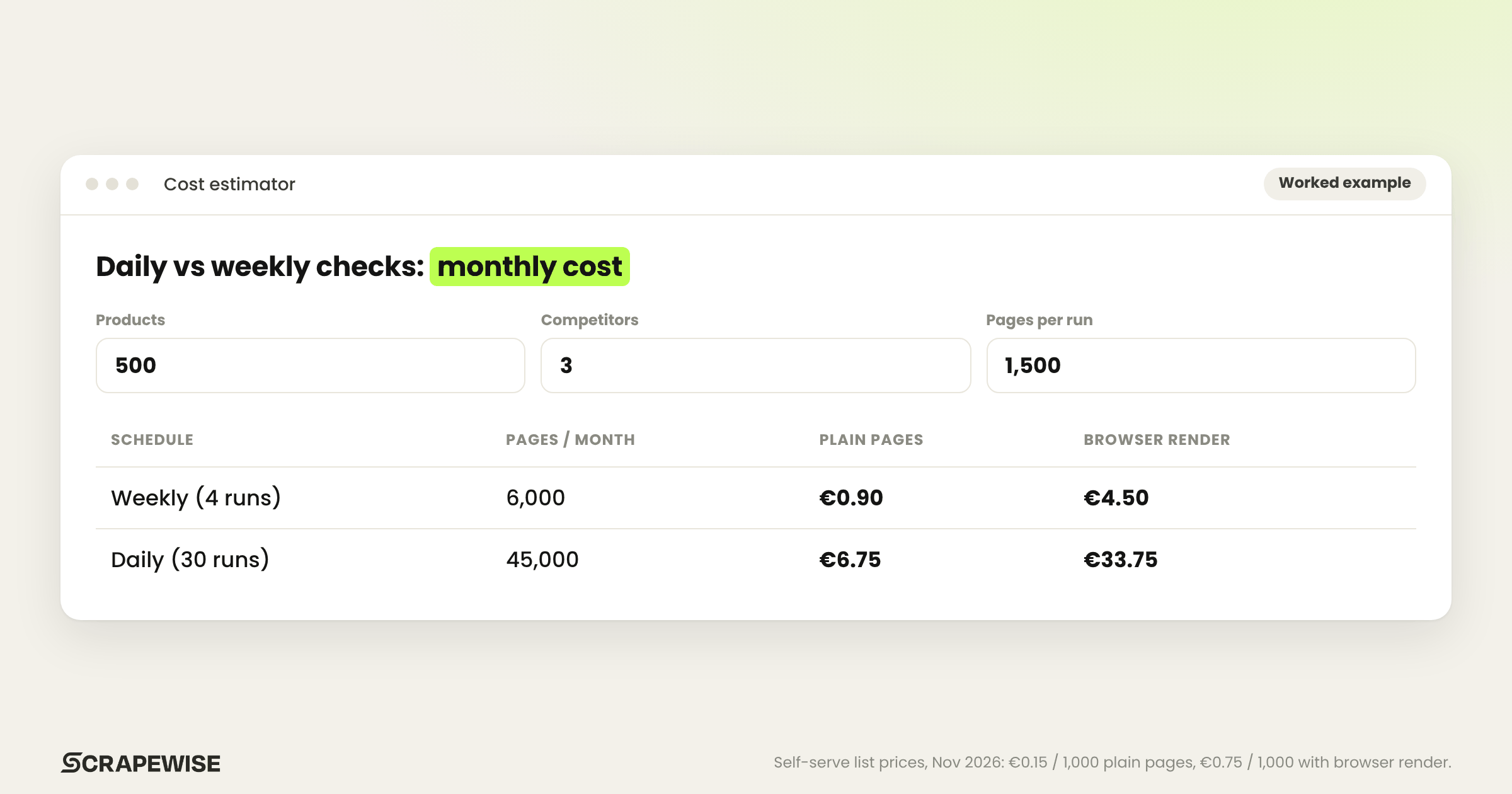
Not much, if you pay per page. With self-serve pricing at €0.15 per 1,000 plain pages, 500 products at 3 competitors checked daily costs about €6.75 a month. Weekly costs about €0.90. Sites that need a browser render cost five times more per page.
Here is the maths, so you can redo it with your own numbers. 500 products × 3 competitors = 1,500 pages per run. A month is 30 daily runs or 4 weekly runs.
| Setup (500 products, 3 competitors) | Pages a month | Plain pages (€0.15 / 1,000) | Browser render (€0.75 / 1,000) |
|---|---|---|---|
| Weekly | 6,000 | €0.90 | €4.50 |
| Daily | 45,000 | €6.75 | €33.75 |
These are ScrapeWise's self-serve prices in November 2026 (ScrapeWise publishes this blog), taken from our pricing page. Other tools price per product or per plan, so check whether faster checks cost extra on yours. Our shortest schedule is once a day, for both self-serve and managed data; there is no hourly option. If your category needs hourly checks, a tool built for that is the better fit.
The bigger cost is people. If an assistant spends a day a week collecting prices by hand, that day costs far more than any of the lines above. We worked through that in the cost of manual competitor price collection.
How do you find the right frequency for your products?
Run a short test. Collect prices for a sample of your products more often than you think you need, for four to six weeks. Then count how many changes each frequency would have caught, and how many of those you would have acted on. Pick the slowest frequency that catches the changes you care about.
Step by step:
- Pick 50–100 products across your main categories, including your top sellers and the ones competitors discount most.
- Collect daily for at least four weeks. If one week includes a big promotion, even better.
- Count real changes. Ignore moves under 2%, as we did in the table above. Small moves are usually rounding, currency or a seller swap.
- Compare frequencies. How many changes would a weekly check have missed? Were any of them on products where you would have changed your price?
- Set frequency by group. Fast movers daily, slow ranges weekly. Step everything up to daily for Black Week and end-of-season sales.
Price2Spy's guide suggests a similar test and treats a frequency as enough if it catches at least 90–95% of relevant changes. That is a sensible target. The word that matters is relevant.
What should you do next?
Decide your frequency from your pricing calendar, not the other way round. Write down when prices get approved, then make sure fresh, complete data is ready the morning before. For most teams that means daily data and a weekly review, with every day read closely around big sales.
Then try it on your own products. Check a few links right now with the free competitor price checker, or read how competitor price tracking works end to end. If you want a daily table without the copy-paste, add your own competitor URLs and schedule a daily run: the first 5 requests are free, no card needed.
Stop checking competitor prices by hand
Paste a competitor product URL. ScrapeWise checks it every day and matches it to your product. 5 free requests, no card.
Not ready to sign up? See 40 rows of real Google Shopping price data →
5 free requests no credit card · pay per page, no monthly plan · book a 15-min call →