

Your US team has a MAP policy. Retailers who advertise below the minimum price lose co-op money or get their supply cut. Now the European sales director wants the same thing for Germany, Sweden and the Netherlands, and someone asks whether that is even allowed.
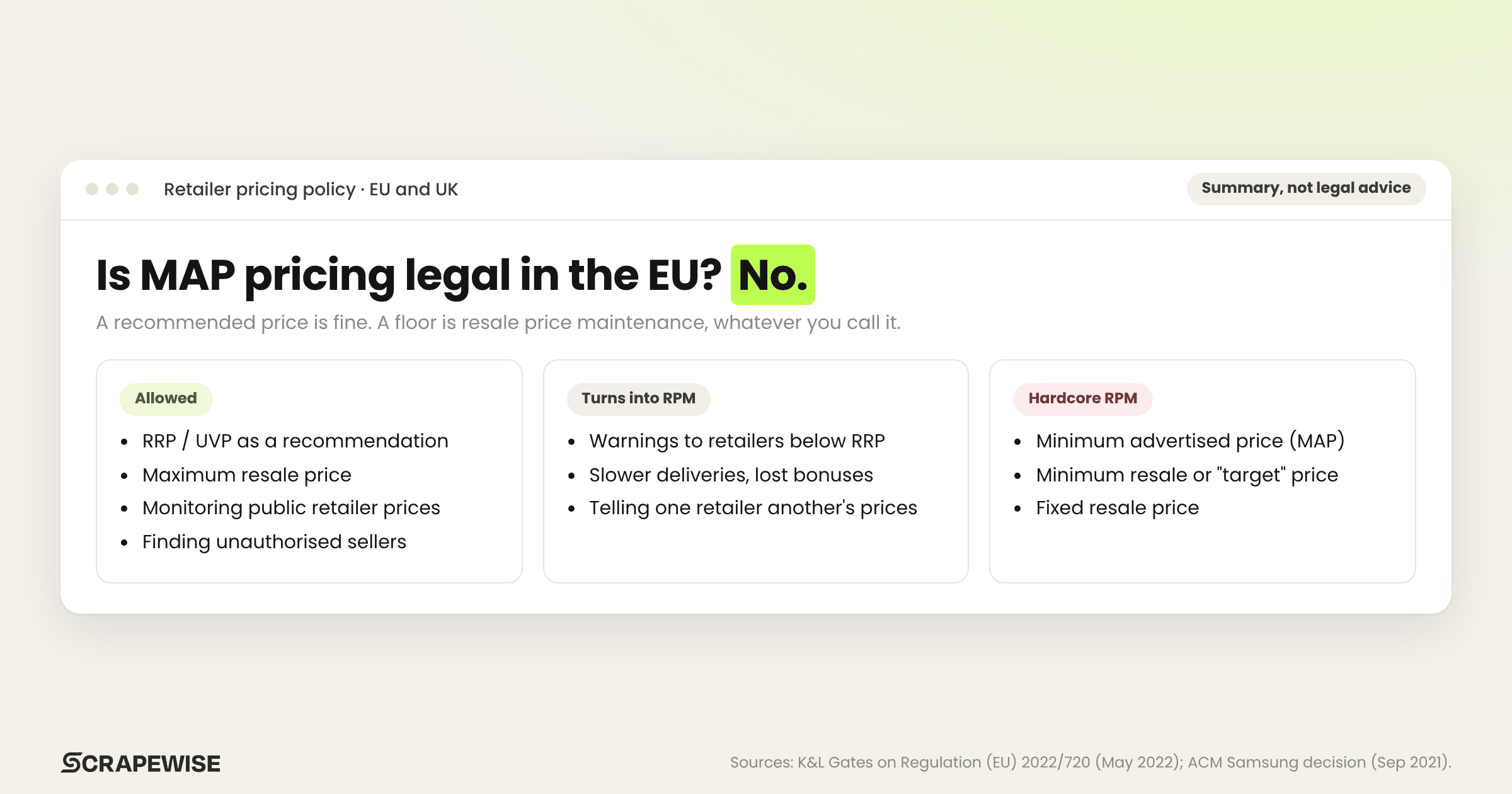
The short answer is no. MAP pricing is not legal in the EU or the UK in the form US brands use it. Agreeing or imposing a minimum resale price, and that includes a minimum advertised price, is treated as resale price maintenance (RPM). EU rules call it a "hardcore" restriction, so the block exemption doesn't cover the agreement. What you can do is publish a recommended retail price (RRP, or UVP in Germany), set a maximum price, and monitor where retailers actually sell.
This guide covers what the rules say, six enforcement cases from 2019 to 2026, and what a brand team can safely track. It is a summary for brand and pricing managers, not legal advice.
What is MAP pricing?
MAP pricing (minimum advertised price) is a policy where a brand tells retailers the lowest price they may show in ads, on product pages or on comparison sites. Retailers can often still sell for less at checkout. In the US, brands usually enforce MAP one-sidedly, by cutting supply or marketing funds. In Europe, that model runs into competition law.
The idea behind MAP is to protect brand image and stop a price war between your own retailers. Those are fair goals. The problem in Europe is the method.
Is MAP pricing legal in the EU?
No. In the EU, a minimum advertised price is treated as an indirect form of resale price maintenance, which is a hardcore restriction under the Vertical Block Exemption Regulation. That means no block exemption applies and fines can be large. Recommended and maximum resale prices are allowed, as long as they don't turn into a minimum in practice.
The rules come from the Vertical Block Exemption Regulation (EU) 2022/720, which has applied since 1 June 2022, and the Commission's guidelines that go with it. Law firm K&L Gates summed up the new rules in May 2022: it "remains illegal and very high risk in the European Union and United Kingdom to agree a minimum or fixed resale price", and this "also includes prescribing a minimum advertised price". The same K&L Gates briefing notes that recommended or maximum resale prices are acceptable, but pressure on retailers to stick to the RRP is unlawful RPM.
The UK left the EU, but its own rules, the Vertical Agreements Block Exemption Order, treat minimum resale prices the same way. National authorities enforce the rules too: the Bundeskartellamt in Germany, Konkurrensverket in Sweden, the ACM in the Netherlands and the CMA in the UK.
What is the difference between MAP, RRP and UVP?
An RRP (recommended retail price) is a suggestion that the retailer is free to ignore. UVP (unverbindliche Preisempfehlung) is the German name for the same thing; the word "unverbindlich" means non-binding. MAP is a floor. The legal line is simple: a recommendation is fine, a floor is not, whatever you call it.
| Practice | What it means | Status in the EU and UK |
|---|---|---|
| RRP / UVP | A suggested price the retailer may ignore | Allowed |
| Maximum resale price | A ceiling the retailer may not go above | Allowed, if it doesn't act as a fixed price |
| Monitoring retailer prices | Collecting public prices to see the market | Allowed in itself |
| Minimum advertised price (MAP) | A floor on the price retailers may show | Hardcore RPM |
| Minimum resale price or "target price" | A floor on the selling price | Hardcore RPM |
| Pressure to stay at RRP | Warnings, slower deliveries, lost bonuses | Turns an RRP into RPM |
The Dutch competition authority put it plainly in its Samsung decision: "Monitoring online retail prices by suppliers is, in and of itself, allowed", and suppliers can give "non-binding price recommendations" (ACM, September 2021). The trouble starts when monitoring leads to a phone call that asks a retailer to raise its price.
What happened to brands that enforced minimum prices in Europe?
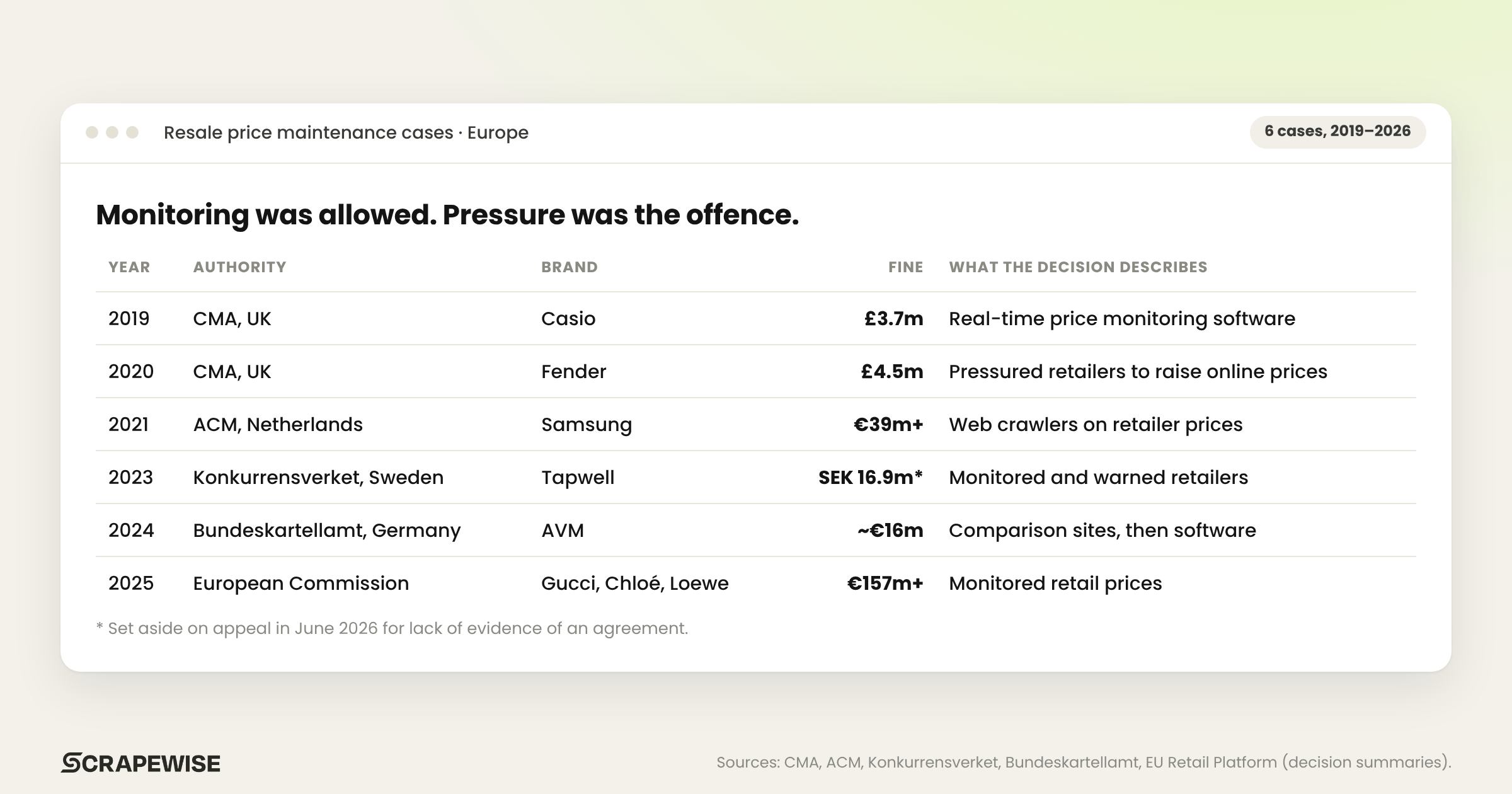
Since 2019, authorities in the UK, the Netherlands, Germany, Sweden and the EU have fined brands for minimum resale prices; the Swedish fine was later set aside on appeal. In five of the six cases the brand monitored retailer prices, then pushed retailers who went below the price it wanted. The monitoring was not the offence. The pressure was.
| Year | Authority | Brand | Fine | What the brand did |
|---|---|---|---|---|
| 2019 | CMA (UK) | Casio | £3.7m | Set minimum online prices for digital pianos and keyboards, 2013 to 2018 |
| 2020 | CMA (UK) | Fender | £4.5m | Required guitars to be sold at or above a minimum price, 2013 to 2018 |
| 2021 | ACM (Netherlands) | Samsung | over €39m | Used web crawlers on retailers' TV prices and urged them to raise prices, 2013 to 2018 |
| 2023 | Konkurrensverket (Sweden) | Tapwell | SEK 16.9m (set aside on appeal, June 2026) | Minimum selling price for online retailers, with warnings to those below it |
| 2024 | Bundeskartellamt (Germany) | AVM | nearly €16m | "Target prices" with six electronics retailers, checked with software |
| 2025 | European Commission | Gucci, Chloé, Loewe | over €157m | Stopped retailers deviating from RRPs and set maximum discounts, 2015 to 2023 |
A few details stand out.
Monitoring shows up in five of the six cases. The CMA says Casio "used price monitoring software to monitor online prices in real time" (CMA case study). Samsung used web crawlers. The Bundeskartellamt says AVM staff "continuously monitored the retailers' end consumer prices using in-store research and online price comparison services" and, from mid-2019 at the latest, specialised software (Bundeskartellamt, 2 July 2024).
An RRP can become the floor. In the AVM case, the "target prices" sat between the recommended retail price and the retailer's purchase price. In the fashion case, the Commission found that Gucci, Chloé and Loewe stopped retailers from deviating from recommended retail prices, maximum discount rates and set sale periods. Gucci's share was €119.7 million, Chloé's €19.7 million and Loewe's €18 million, according to the EU Retail Platform summary of the decision (November 2025).
"Recommendation" is not a shield. The ACM chair said that "under the pretense of 'price recommendations'", Samsung made sure retailers raised their prices to the level it wanted.
Fender tried not to write things down. The CMA says some Fender staff deliberately recorded as little as possible in writing (CMA, January 2020). It did not help.
Does the Swedish Tapwell ruling change the rules?
No. In June 2026, Sweden's Patent and Market Court of Appeal set aside the SEK 16.9 million fine on Tapwell, because Konkurrensverket had not proven an agreement with retailers. The ruling is about evidence, not about whether minimum prices are allowed. Minimum resale prices are still a hardcore restriction in Sweden.
The original decision from December 2023 said Tapwell had a policy with a minimum selling price that retailers were not allowed to undercut, and that it monitored compliance and warned retailers who went below it (Konkurrensverket, December 2023). The appeal court found there was not enough evidence of an agreement. Konkurrensverket's director general said the ruling "means that very high evidential standards apply" (Konkurrensverket, 30 June 2026).
For a Nordic brand, the lesson is not "the risk went away". The case ran from a public decision in December 2023, through the Patent and Market Court, which upheld it in March 2025, to a final ruling against the authority in June 2026. Any pricing policy that names a floor is a risk, whatever the final ruling.
What can brands legally monitor in Europe?
Brands can collect public retailer prices, compare them with their RRP, spot unauthorised sellers and track stock moving between markets. They can publish an RRP or a maximum price. What they can't do is use that data to push a retailer's price up, through warnings, slower deliveries, lost bonuses or by telling one retailer what another plans to charge.
In practice, that leaves a lot of useful work:
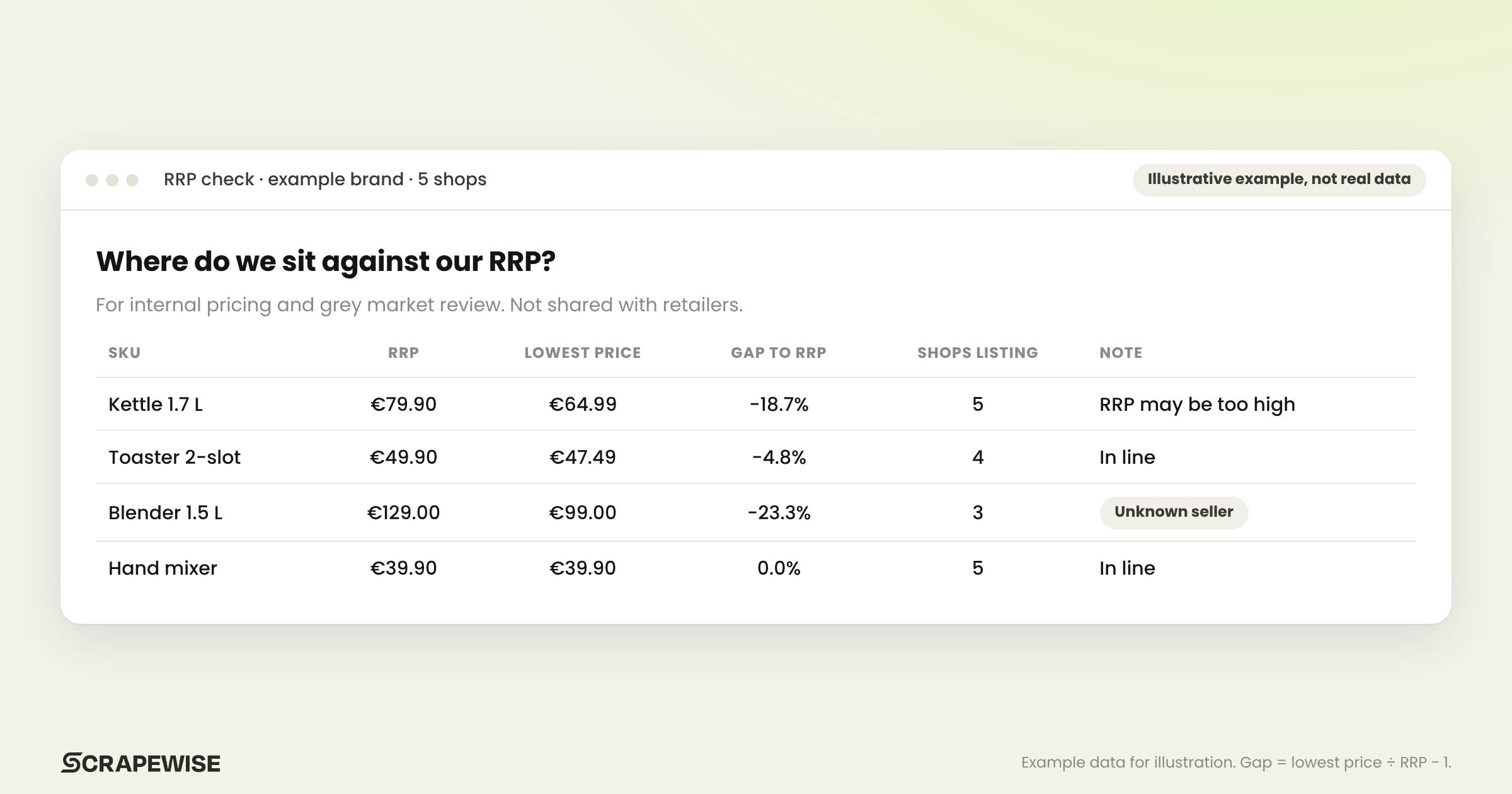
- Where you sit against your RRP. Compare each retailer's price with your UVP or RRP on idealo in Germany, Prisjakt and PriceRunner in the Nordics, and the retailers' own sites. Use it to plan your own pricing, promotions and RRP changes.
- Unauthorised sellers. If you run a selective distribution system, find sellers who aren't in it. Our post on grey market monitoring for European brands covers this.
- Stock moving across borders. A price that is 20% below RRP in one country may point to parallel imports, not a discounting retailer. That is a supply chain question.
- Content and listing errors. Wrong pictures, old product names and missing specs can be raised with retailers without touching price.
- Your own channels. Your webshop, your marketplace accounts and your outlet are yours to price.
The ACM's Samsung decision also says that suppliers who tell retailers about the planned prices of other retailers "go too far". So keep the monitoring data inside your own team. Don't share one retailer's prices with another.
How should a brand set up RRP monitoring without the legal risk?
Decide what the data is for before you collect it: your own pricing, RRP reviews, unauthorised sellers and grey market. Write down that sales teams will not contact retailers about their prices. Then collect retailer and comparison-site prices on a fixed schedule, match them to your SKUs, and review the gaps internally.
A simple setup looks like this:
- List the products and shops. Start with your top 50 SKUs and the retailers and comparison sites that matter in each market.
- Match on EAN. Most branded products carry an EAN, so matching each listing to your SKU is mostly mechanical. Check pack sizes and bundles by hand.
- Record the evidence. Keep the date, the shop, the price, shipping and a link. You need this for grey market work, and it shows what the data was used for.
- Read it as a market view. Ask "where does our product sit?" and "is our RRP still realistic?" Don't ask "who do we call?"
- Keep sales and legal aligned. Agree once, in writing, what the data may be used for and who may see it, so the file doesn't go back and forth between sales, key account managers and legal before anyone acts.
This short demo shows one way to pull the shops and prices listed for a product on idealo.de into a table, which is the raw material for an RRP check.
Tools for this range from manual checks to price monitoring software to managed services. ScrapeWise, which publishes this blog, is one option. It collects prices from the shops you name as often as once a day, matches them to your SKUs and returns a table, with no alerts. Because there are no alerts, someone on your team reads the table and decides what to do with it, which makes it easier to keep the data for internal use. The brand protection use case and competitor price tracking use case show how the data looks. Other tools, compared in our post on MAP monitoring tools for brands, do the same job in different ways.
Is it legal to scrape retailer prices for RRP monitoring?
Collecting publicly shown prices is generally allowed in the EU, if you stay on public pages, don't overload the sites and avoid personal data. Prices and product details usually aren't personal data, but a marketplace seller who trades under their own name can be. The competition law question is what you do with the prices, not that you collect them.
Our guide to whether price scraping is legal in the EU covers database rights, terms of service and GDPR in more detail. If you also show "was" prices or RRP comparisons in your own shop, the Omnibus rules on price reductions are a separate topic, covered in our Omnibus price history guide.
What should you do next?
Retire the word "MAP" from your European policy documents, and check that no email, contract or sales script sets a price floor. Keep your RRP or UVP as a recommendation, and set up price monitoring for market insight and grey market work only. Then get a competition lawyer to review the policy before you roll it out.
To see where your products sit against your RRP today, run your own retailer URLs in ScrapeWise: the first 5 requests are free, no card needed. If you'd rather have the whole thing run for you, our Managed Data service delivers one matched comparison table across the shops you name.
This article summarises public decisions and law firm commentary as of November 2026. It is not legal advice. Rules differ for agency agreements and specific cases, so talk to a competition lawyer before you write or enforce a pricing policy in Europe.
Paste a competitor URL and start tracking prices
The shops you name, as a structured table once a day at most. No code, pay per page, the first 5 requests are free.
Not ready to sign up? See 40 rows of real Google Shopping price data →
5 free requests no credit card · pay per page, no monthly plan · book a 15-min call →