
Key takeaways
- The old price on a sticker is regulated in the EU, so a discount can be tested if somebody wrote the old prices down.
- Shops do not all print the same kind of old price. A recommended price, a usually price, a one-month median and a 30-day low are four different numbers.
- Write the price down now. A screenshot with today's date is enough to check a claim in three weeks.
A "was 199, now 119" sticker shows you two numbers. Only one of them is a fact.
The second number is what you pay. The first one is a claim about the past, and in the EU that claim is regulated. When a shop announces a price cut, the "before" price it shows has to be the lowest price that shop charged in the 30 days before the cut. That is Article 6a of the Price Indication Directive, and we have written about what it asks of retailers in more detail.
The useful part for a shopper is simple. It means any discount you see can be tested, as long as somebody wrote the old prices down.
Data and method: Since 5 October 2026 the Scrapewise Black Friday price study has recorded the price of 1,477 tracked product links at seven large EU shops, once a night, every night, together with whatever reference price each shop prints beside it. This post reports no measured discount figures. We publish those with the full study in December 2026, after Black Friday, so that the before period and the sale period are both complete. We do not name the shops in the study.
First, read the label, not just the number
Here is the thing almost nobody tells you, and the thing we did not expect when we started reading these pages every night.
Shops do not all print the same kind of old price. Across the large European shops we read, the crossed-out number beside the sale price came with quite different words attached. Some shops print a recommended retail price, the manufacturer's suggested figure, which may never have been charged by that shop at all. Some print what the item usually costs there. Some print the median price over the last month, with promotional prices taken out. Some print the lowest price of the previous 30 days, which is the figure the EU rule is built around. And some print a genuine previous price with the dates it applied.
All of those are legitimate things for a shop to show, and several of them are genuinely helpful. The point is that they are not the same number, and a percentage calculated off one of them does not mean what a percentage calculated off another one means. A 40% cut from a recommended price that nobody ever paid is a different animal from a 40% cut from the lowest price the shop charged last month.
So the first move is not arithmetic. It is reading. Look at the words next to the crossed-out figure and work out which of those things it is. If the page does not say, that itself is worth noticing.
The four-step test you can run yourself
This is the week to start, because the test only works if you have a before period. You cannot reconstruct one in late November.
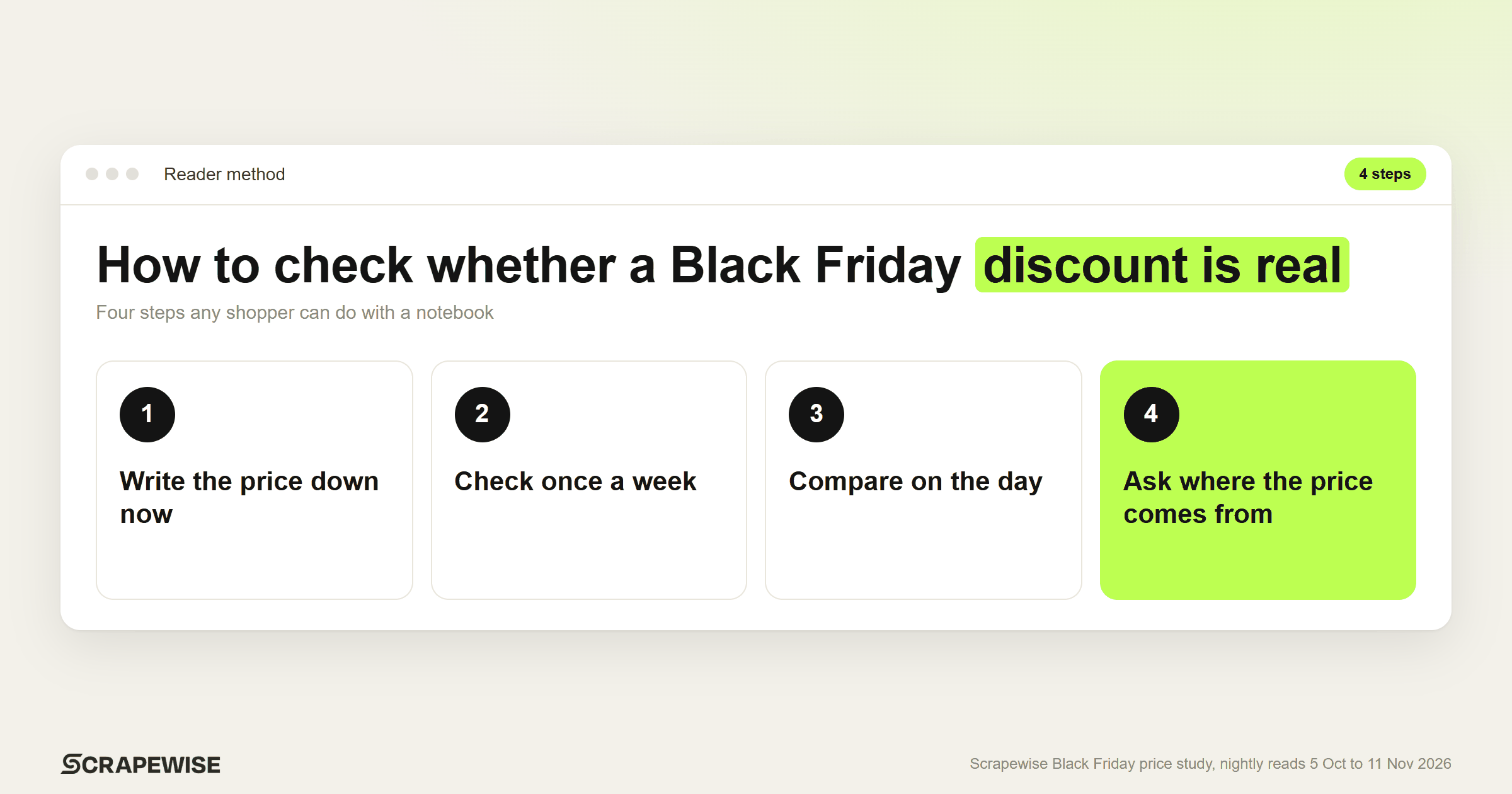
- Write the price down now, before the sale. A screenshot with today's date is enough. A note on your phone with the price and the date is enough. Do it for the two or three things you actually intend to buy, not for everything.
- Check the same page once a week until Black Friday. Four checks is plenty. You are looking for the shape of the price, not a precise series. If the price climbs in the first half of November, that is worth knowing before the sticker appears.
- On the day, compare. Put the shop's "before" price next to the lowest price in your own notes. Then read the label again, so you know what the shop is claiming that number is.
- If the shop's "before" price is higher than anything you saw, ask the shop where that price comes from. In the EU you are allowed to ask, and a shop that is showing a proper 30-day low can answer easily. If you are not satisfied with the answer, your national consumer protection authority is the place to take it.
That is the whole method. It needs a phone and about four minutes a week.
What a gap does and does not prove
A gap between a shop's "before" price and your own record is not proof that anything was wrong, and it is worth being honest about why.
You are reading one variant of one product, at the times you happen to look. A shop may have charged a lower price at a time you did not check, in a channel you do not see, on a size or colour you did not track, or to customers holding a loyalty card. The same caution applies to our own measurement, which reads one variant of one product once a night, and which counts the days we miss and publishes them rather than filling them in.
So treat a gap as a question, not a verdict. It is a good question, and under the EU rule you are entitled to ask it.
One thing worth knowing if you sell rather than buy
The rule runs on your own history, and it does not forget.
A price you raise in November does not become your "before" price in December. The lowest price in the previous 30 days does, whatever you put on the shelf afterwards. If you are planning a Black Week promotion, your October and November prices are already locked in, and the reference price you are allowed to show follows from them rather than from what would look best.
That is the practical reason retailers keep a timestamped record of their own prices per product and per market, and increasingly of their competitors' prices too. Our Black Week checklist for 2026 covers the dates and the day-by-day side of that.
If you need that record kept for you across a list of competitor product pages, daily, with the days that failed marked as missing rather than quietly filled in, that is what we do at competitor price tracking.
Paste a competitor URL and start tracking prices
The shops you name, as a structured table once a day at most. No code, pay per page, the first 5 requests are free.
Not ready to sign up? See 40 rows of real Google Shopping price data →
5 free requests no credit card · pay per page, no monthly plan · book a 15-min call →