
Key takeaways
- Across 78 products held by three or more large EU shops, the median gap between the cheapest and dearest shop was 37.3%.
- A quarter of the products had a gap above 56.2%, and the widest tenth above 71.2%.
- The same item is listed under a different name in every language, so the barcode is the only thing that reliably says two listings are one product.
One barcode. One night. Five large EU shops.
Since October we have been reading the price of the same products at large European shops every night, matched not by name but by the barcode printed on the box. That matters more than it sounds. The same toy or coffee machine is listed under a different name in every language, and nothing about those names tells a computer they are the same item. The barcode does.
On the night of 11 November 2026, 823 barcodes carried a price at one of the EU shops we track. 78 of those products were held by three or more of those shops as the shop's own listing. Across those 78, the median gap between the cheapest and the dearest shop holding the same item was 37.3%. A quarter of the products had a gap above 56.2%, and the widest tenth above 71.2%.
Data and method: Scrapewise Black Friday price study, nightly reads from 5 October to 11 November 2026. This post uses the reading of 11 November. A product counts when three or more EU shops held it with the same barcode and a valid price that night. Prices are converted to euro at the day's rate before comparison. Prices more than 2.5 times or less than 0.4 times the typical price for that product that night are treated as outliers and removed: that rule removed 1 price out of 305. The 78 products sit across five shops in five countries, a mean of 3.87 shops per product and a maximum of 5. We do not name the shops, and we do not say which country was cheapest. UK shops are excluded. Aggregates only.
What one product looks like
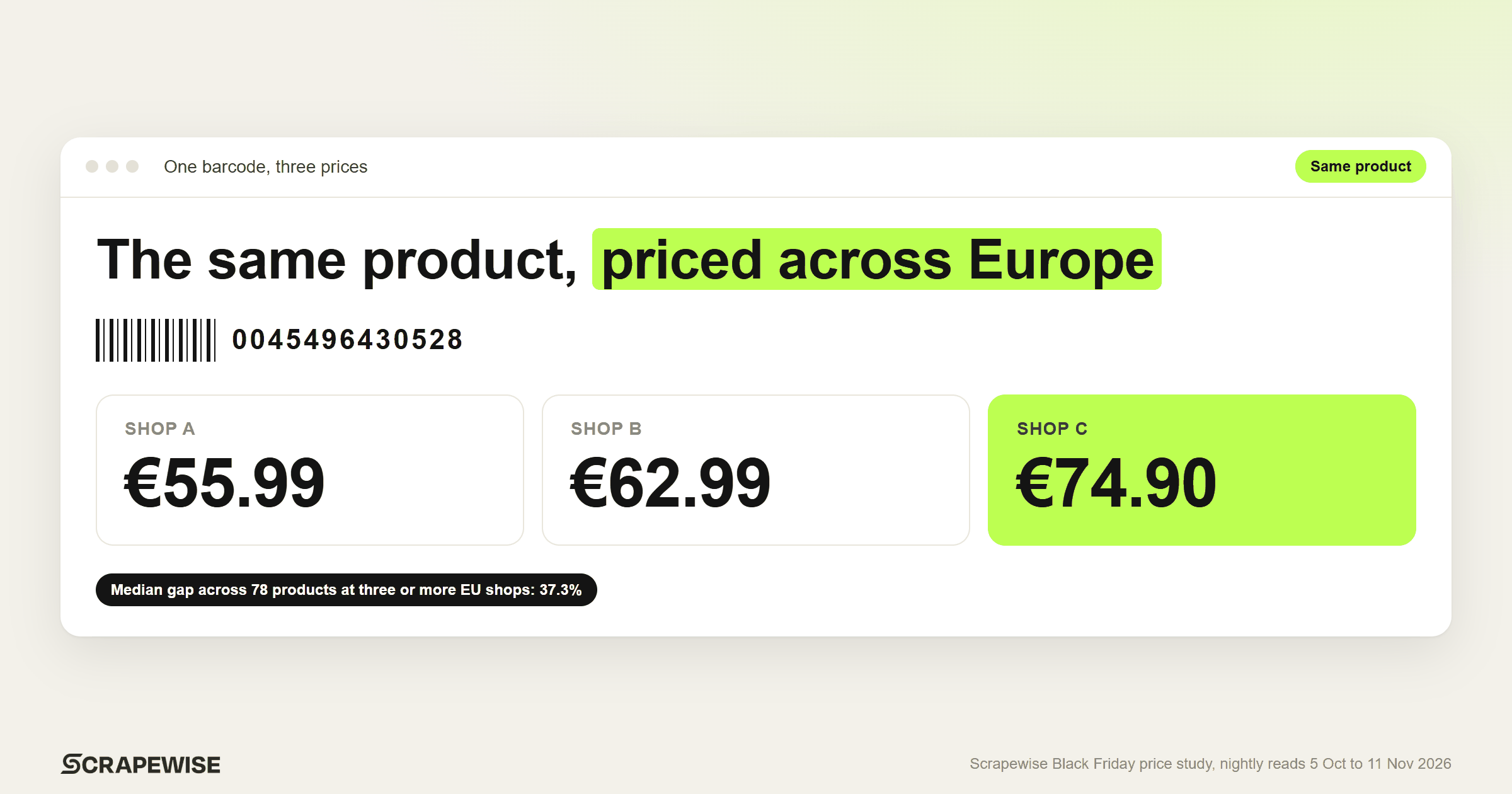
Here is a single product, as five shops held it. Three of them had it as their own listing that night.
| Shop A | Shop B | Shop C | |
|---|---|---|---|
| Barcode on the page | 0045496430528 | 0045496430528 | 0045496430528 |
| Price, converted to euro | 55.99 | 62.99 | 74.90 |
One barcode, three prices, a gap of 33.8% between the cheapest and the dearest. The product is a Nintendo Switch Pro Controller, and the three product names on those three pages were written in three different languages, none of them identical to another. The barcode was identical on all three.
That is the whole argument for matching on identifiers rather than on names. A human can see that "Mando Pro-Controller" and "Switch Pro Controller" are the same thing. A system comparing text across six languages, thousands of products and several catalogues cannot, not reliably, and the cost of getting it wrong is a price comparison between two different items.
Why we are not telling you which country was cheapest
Because that would name the shop.
Our EU set has one shop per country in most cases. Saying "the cheapest shop was in Poland" is the same sentence as naming the one Polish shop in the study, and we publish this work anonymised and aggregated. So the geography stays out, in this post and in the full study.
What a gap does not mean
A 37% gap is not 37% of free money, and it would be dishonest to present it that way.
Shipping, local VAT rates, warranty terms, bundles, included accessories, stock position and promotional timing all move the number, and none of them are visible in a price alone. A shop that is cheaper on the shelf may not be cheaper at the checkout once it has shipped the item to another country, assuming it ships there at all.
Two more things are worth saying about this particular measurement.
The first is third-party sellers. On some large shops, a listing can be sold by an outside seller rather than by the shop itself. Those listings are priced independently and they widen the picture considerably. If we include them, the set grows from 78 products to 106 and the median gap rises from 37.3% to 43.2%, with a quarter above 61.2%. We lead with the narrower figure because a comparison between two shops' own prices is the more honest one, and we publish the wider figure here so the difference is visible rather than hidden in a method note.
The second is what is in the basket. These 78 products are toys and consumer electronics, which is what the study tracks, and 50 of the 78 are from a single toy brand whose products every shop in our set happens to carry. That is a narrow basket and a small one, and it is the reason this post reports a measurement rather than a conclusion about European retail. The full study in December covers the whole tracked set.
Two of the seven EU shops in the study contribute nothing to this comparison at all. One carries a different range, so it holds none of these items. For the other we hold no barcode on its listings, so there is nothing to match on. The overlap set therefore runs on five shops rather than seven.
The part that is actually hard
People assume the difficult bit of cross-border price comparison is collecting the prices. It is not. The difficult bit is being sure that the two prices you are comparing belong to the same product.
Names differ by language and by shop convention. Model codes get written five ways. A listing may be a bundle, a different pack size, or a regional variant with its own barcode. Getting from a few thousand raw listings to a set where you can honestly say "these two rows are one product" is most of the work, and it is the part that decides whether the resulting number means anything.
That is what the barcode is for, and where it is missing, it is what product matching is for.
For the sale-period side of this, our Black Week checklist for 2026 covers the dates, and we have written separately on how to check whether a discount is real.
Paste a competitor URL and start tracking prices
The shops you name, as a structured table once a day at most. No code, pay per page, the first 5 requests are free.
Not ready to sign up? See 40 rows of real Google Shopping price data →
5 free requests no credit card · pay per page, no monthly plan · book a 15-min call →