

Key takeaways
- Turnstile is not a CAPTCHA you solve. By the time the widget renders, Cloudflare has already scored your TLS handshake, your IP and your browser internals — the checkbox only reports the verdict.
- That is why CAPTCHA solving services mostly do not help on Turnstile. They answer a challenge; Turnstile is grading the client that asked for one.
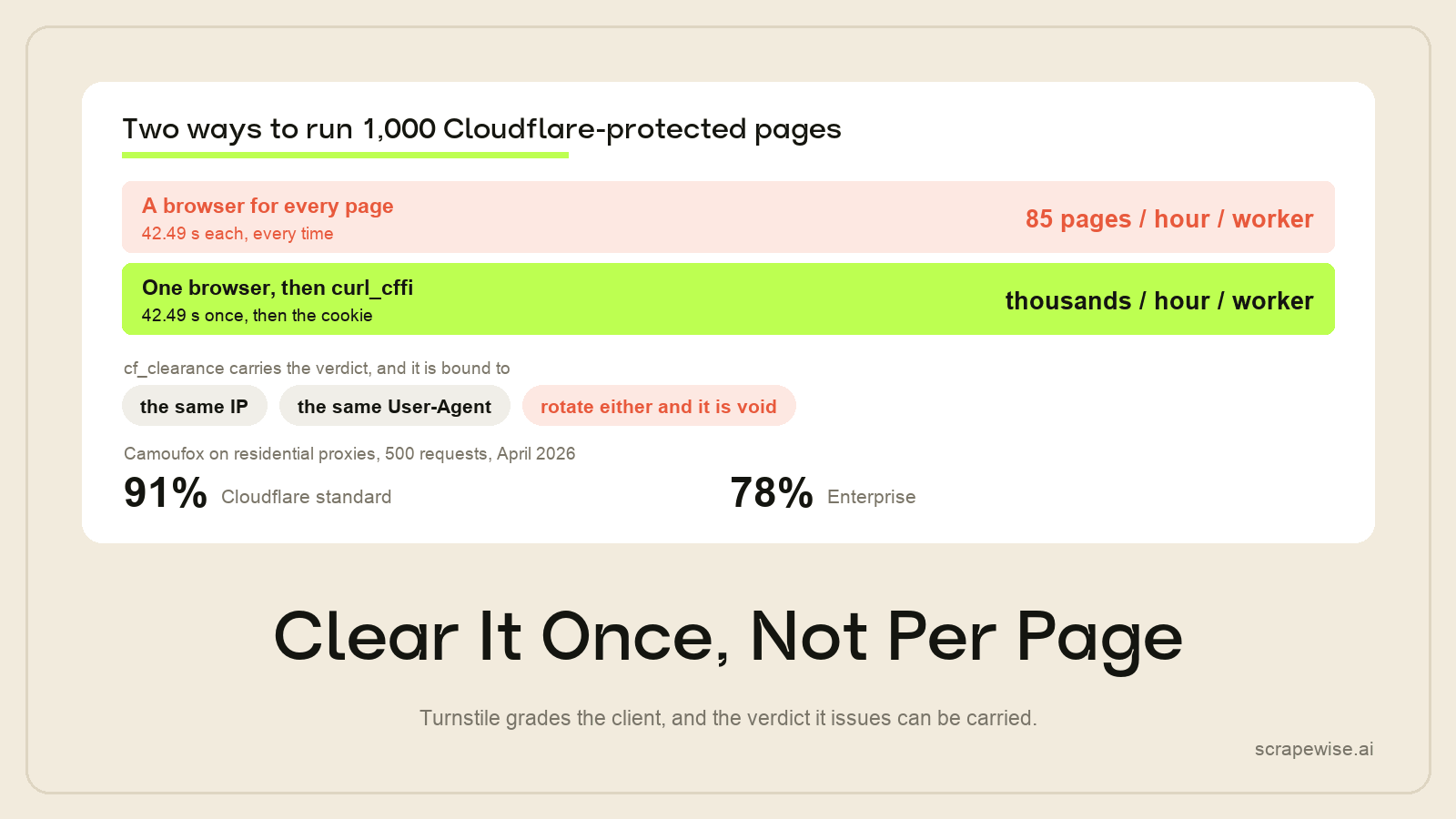
- Camoufox on residential IPs passed 91% of Cloudflare standard and 78% of Enterprise in our April 2026 run — the highest of six approaches, and the slowest.
- The measured cost of a cleared challenge is about 42.5 seconds, roughly 85 challenged pages per hour per worker. That number, not the pass rate, is what breaks price-monitoring schedules.
- The real leverage is the cf_clearance cookie: clear once in a browser on a sticky session, then run the rest of the crawl over a TLS-impersonating HTTP client until it expires.
Turnstile is not a puzzle you solve. It is a verdict being displayed to you. By the time the widget paints, Cloudflare has already fingerprinted your TLS handshake, checked your IP's reputation and probed the browser for automation traces. The checkbox is the receipt.
That single framing explains most of the frustration around it: teams buy a CAPTCHA solver, wire it in, and nothing changes. The solver answers challenges. Turnstile is grading the client that asked for one.
Choose Before You Read
| Your situation | Do this |
|---|---|
| You bought a solver and it changed nothing | Expected — here is why |
| You are getting challenged on every single page | Stop re-clearing. Reuse the cookie |
| You are on datacentre proxies | Fix that first. It caps every row in the table below |
| You need to know if it is even Turnstile | Thirty-second check |
| Your crawl schedule is slipping, not failing | The 42 seconds is your problem, not the pass rate |
| You want the rows, not a challenge pipeline | Skip to the last section |
Turnstile Is a Score, Not a Puzzle
Turnstile is Cloudflare's replacement for the interactive CAPTCHA. It runs a short battery of browser checks — proof-of-work, API surface probing, interaction timing — and hands the result to the same bot-scoring engine that sits in front of the rest of the Cloudflare edge.
That engine assigns every request a bot score from 1 to 99, where 1 means almost certainly automated and 99 means almost certainly a person. The widget does not compute that score from scratch. It contributes to a verdict that was already most of the way formed from:
- The TLS handshake — your JA3/JA4 fingerprint, read before any JavaScript runs
- IP reputation — ASN, abuse history, whether the range belongs to a cloud provider
- HTTP/2 frame ordering — settings, window sizes, header order, all of which differ between a real browser and a library
- Browser internals — the properties and quirks that a patched or instrumented runtime cannot fully hide
Three of those four are decided before the widget exists. This is why the managed challenge sometimes passes you through in under a second with no interaction at all, and sometimes loops forever on the same code: nothing about your script changed, your score did.
The practical consequence: you do not get past Turnstile by getting better at Turnstile. You get past it by presenting a client that scores well enough never to be seriously challenged.
The clearest expression of that idea is thermoptic, a proxy that describes its own job as cloaking requests "as the Chrome browser across all layers of the stack." It does not answer a challenge at any point; its Turnstile tutorial and the Hacker News thread about it are both worth reading for what they do not contain.
How to Tell Turnstile From a Managed Challenge
Worth thirty seconds, because the fixes differ and the symptoms look identical from a failing scraper's logs.
- A
cf-turnstile-responsefield in a form, or achallenges.cloudflare.comiframe — the Turnstile widget proper, usually guarding a login or a signup - An interstitial page with
cf_clearanceset on exit — the managed challenge, which is what most catalogue and price pages run __cf_bmwith no interstitial at all — bot management is on, but you are passing. Do not touch anything- A
cf-rayheader with a 403 — you are being refused outright, which is an IP-reputation problem, not a challenge problem
If instead you see _abck and sensor_data, that is Akamai Bot Manager and the correct fix is almost the opposite one. _px cookies mean PerimeterX. __ddg means DataDome.
Michael Mintz, who maintains SeleniumBase, demonstrating the widget being cleared by a driver that simply scores well enough to be allowed to click. Note what is absent from that clip: there is no puzzle being answered.
What Cleared It in Our April 2026 Run
Six approaches, 500 requests each, spread over six hours against production Cloudflare-protected sites. Full method in bypassing Cloudflare, Akamai and PerimeterX; the Cloudflare slice is below.
| Approach | Cloudflare Std | Cloudflare Enterprise |
|---|---|---|
| Requests library + datacentre proxies | 19% | 4% |
| curl-cffi + datacentre proxies | 61% | 38% |
| Camoufox + datacentre proxies | 72% | 44% |
| curl-cffi + residential proxies | 79% | 52% |
| Patchright + residential proxies | 83% | 69% |
| Camoufox + residential proxies | 91% | 78% |
Two things to read out of this.
The proxy tier moves the numbers more than the tool does. Camoufox loses nineteen points by being put behind datacentre IPs — more than the gap between Camoufox and a plain HTTP client on good IPs. If you are on shared datacentre proxies, every hour spent on stealth libraries is being spent on the wrong layer.
Firefox beats Chromium here, and only here. Camoufox patches a Firefox build at the C++ level, and Cloudflare's fingerprinting treats Firefox TLS signatures differently from the Chromium family that nearly every automation tool descends from. On Akamai the ranking inverts and a browser-free HTTP client wins outright. There is no tool that is simply best.
The 42 Seconds Is the Real Cost
Pass rate is the number everyone quotes and the wrong one to plan against.
A cleared Turnstile challenge in Camoufox takes an average of 42.49 seconds — that is the figure behind the Camoufox vs Patchright comparison, and it works out to roughly 85 challenged pages per hour per worker.
Run that against a real brief. Four competitors, 5,000 SKUs each, refreshed daily is 20,000 pages. If even a fifth of them get challenged, that is 4,000 challenges, which is 47 worker-hours. You do not have a bypass problem at that point. You have a fleet-sizing problem, and it arrived without anything failing.
This is the failure mode that does not page anyone: the scraper is not broken, it is late. Prices land in the afternoon instead of before the morning repricing run, and the only visible symptom is somebody noticing the dashboard looks stale.
Solve Once, Reuse the Cookie
The highest-leverage change available on Cloudflare, and the one most teams skip because it is not a library.
When a challenge is cleared, Cloudflare issues a cf_clearance cookie. It is bound to your IP and your user agent, and for its lifetime it carries the verdict you just paid 42 seconds for. Clearing a challenge per page throws that away every time.
The pattern that works:
- Clear one challenge in a real stealth browser, on a sticky residential session
- Export
cf_clearanceand__cf_bm - Run the rest of the crawl through a TLS-impersonating HTTP client such as curl_cffi, on the same IP and the same user-agent string
- Fall back to the browser only when a request starts getting challenged again
from curl_cffi import requests

# cf_clearance is bound to the IP and the UA that earned it.
# Change either one and it is worthless.
session = requests.Session(impersonate="chrome124", proxies=STICKY_PROXY)
session.cookies.update({"cf_clearance": CLEARANCE, "__cf_bm": BM})
session.headers["User-Agent"] = UA_THAT_EARNED_THE_COOKIE

r = session.get(url)
if "challenges.cloudflare.com" in r.text or r.status_code == 403:
    refresh_clearance_in_browser()   # pay the 42 seconds, once
The two failures that make people conclude this does not work: rotating the proxy per request, which invalidates the cookie immediately, and sending a different user agent than the browser that earned it. Both are defaults in most scraping stacks. The mechanics of the impersonation layer are in curl_cffi and TLS fingerprint impersonation.
What CAPTCHA Solvers Can and Cannot Do Here
Solver services do have a place, and it is narrower than their marketing suggests.
They work when a human-answerable challenge is genuinely presented — reCAPTCHA v2 image grids, hCaptcha, an explicit interactive Turnstile widget on a form you are submitting once.
They do not work when your client is being scored down before the widget loads. You can buy a valid token and still be refused, because the token is checked against the session that requested it. A good token presented by a badly-scoring client is not a pass; it is evidence.
So the order of operations matters: fix the TLS fingerprint and the IP tier first, and only then consider whether anything is left for a solver to do. Usually there is not. If you are comparing services anyway, we tested four of them.
What This Costs to Keep Alive
| Approach | Monthly infra at 10k pages/day | Engineering maintenance |
|---|---|---|
| curl-cffi + residential + cookie reuse | ~$140–200 | 4–6 hrs/month |
| Patchright + residential proxies | ~$380–520 | 8–12 hrs/month |
| Camoufox + residential proxies | ~$440–600 | 10–15 hrs/month |
Cloudflare ships changes continuously and does not announce them. A pass rate that held for three months can drop twenty points in a week, and the first signal is usually a quieter one than an error: fewer rows than yesterday.
If what you need is competitor prices and stock levels arriving on a schedule rather than a challenge pipeline to keep alive, the Turnstile question is the wrong one to be answering. ScrapeWise runs the browsers, the proxies and the challenge handling and delivers structured rows. No plan and no compute units: a balance you top up, and a published charge per delivered page — EUR 0.15 per 1,000 for plain requests, EUR 0.75 with rendering, EUR 1.50 through the residential tier and EUR 3.75 for render plus residential. New accounts get 5 free requests and the balance never expires.
You can also call ready-made scraping API endpoints directly, or see how this feeds competitor price tracking.
So What Should You Run?
- Camoufox on residential IPs — the target is Cloudflare Enterprise and the pages are high-value. 78% at Enterprise, and plan for 85 challenged pages per hour per worker.
- Patchright on residential IPs — you are on Node.js or unwilling to adopt Firefox. Three points behind on standard, nine behind on Enterprise, meaningfully faster.
- Browser once, then curl_cffi on the cookie — the highest throughput per euro available on Cloudflare, and the one most teams have not tried.
- A solver — only for a genuine interactive widget on a form, after the fingerprint and the IP tier are already right.
- None of the above — you want delivered rows on a schedule and would rather not maintain a challenge pipeline.
Paste any URL — ScrapeWise handles the anti-bot
Managed infrastructure that adapts when sites change. No proxies, no code, no per-request fees.
Not ready to sign up? See 12 real Amazon rows, 972 columns →
97% accuracy on Amazon benchmarks · no credit card · book a 15-min call →