

Someone in your management meeting says "we need a pricing tool". One person means a dashboard of competitor prices. Another means software that changes your prices by itself. A third thinks Prisjakt or idealo already does the job for free. All three are talking about different things, and buying the wrong one wastes a budget cycle.
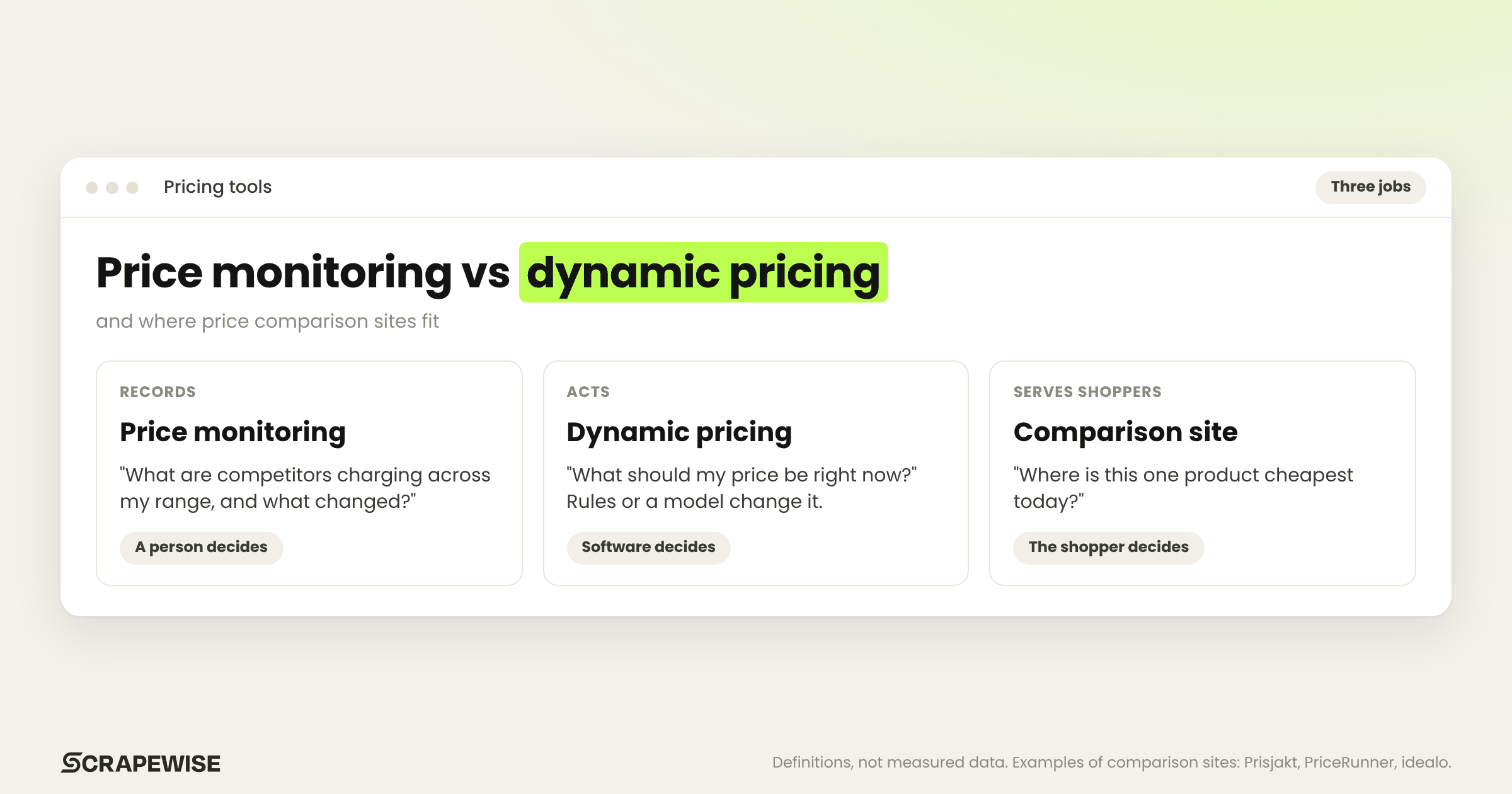
Here is the short answer on price monitoring vs dynamic pricing. Price monitoring collects your competitors' prices, stock and promotions so a person can decide what to do. Dynamic pricing changes your own prices automatically, using rules or an algorithm that often feeds on monitoring data. A price comparison site shows shoppers who is cheapest for one product today. Monitoring tells you what happened, dynamic pricing acts on it, and comparison sites are built for the shopper, not for you.
In our view (ScrapeWise sells monitoring data), most retailers need monitoring first. Dynamic pricing only works once you trust the data going into it, and a comparison site can't give you history, your full product list or the shops it doesn't list.
What is price monitoring?
Price monitoring is collecting competitor prices, was-prices, stock status and promotions for the products you sell, on a schedule, and matching each competitor listing to your own SKU. The output is a table or report that a category or pricing manager reads. It records what the market did. It does not change any price by itself.
Vendors describe it the same way. Intelligence Node calls it "the technical act of collecting and tracking competitor prices, promotions, and stock statuses". The hard part isn't reading a price off a page. It's matching the right product across shops, keeping the dates straight, and getting the result to the people who decide. In my experience the real cost is the process around it: Excel files emailed back and forth, several people adding input, and days lost before anyone acts.
"Price intelligence" is the same data with analysis on top: price index, price position per category, and recommendations. Intelligence Node puts it this way: "Where price monitoring tells you what is happening, price intelligence tells you what to do next." Many tools sold as intelligence are monitoring plus a few charts.
What is dynamic pricing?
Dynamic pricing is changing your own prices automatically, sometimes several times a day, based on inputs such as competitor prices, stock, demand, time of day or margin targets. Software applies rules ("stay 2% below the cheapest in-stock competitor, never below cost plus 15%") or a model, and pushes new prices to your shop or marketplace.
Repricing is the narrow version that most marketplace sellers know. A repricer watches the other offers on one listing, for example the Amazon Buy Box, and moves your price within a floor and a ceiling. Full dynamic pricing platforms look at the whole catalogue and add demand and elasticity models.
The key point is that dynamic pricing is a decision engine, not a data source. It needs competitor data from somewhere, and its decisions are only as good as that data. A rule that matches "the lowest price" will happily match a shop that is sold out, or a multipack it took for a single unit.
What is a price comparison site?
A price comparison site such as Prisjakt, PriceRunner or idealo lists one product with the offers from many shops, sorted by price, for shoppers. It answers "where is this cheapest right now?" Shops often pay per click for their listings. It is built for consumers, not for a retailer's pricing team.
These sites matter a lot in Europe. Prisjakt says it recorded 156 million sessions in 2025 and runs in eight countries, including Sweden, Norway, Denmark, Finland and the UK. PriceRunner's merchant page cites YouGov saying that nearly half of Sweden's population uses PriceRunner at least once a month, and refers merchants to its click prices. In the Nordics and DACH, shoppers often check one of these before they visit your shop, so your position there is part of your price image.
Minderest, which sells monitoring software, sums up the difference as "A price comparison app or website is exclusively tailored to the end consumer." That's fair. A comparison site shows today's offers for one product. It doesn't give you an exportable history, your whole range in one table, or the shops that aren't listed there.
Price monitoring vs dynamic pricing vs comparison sites: how do they compare?
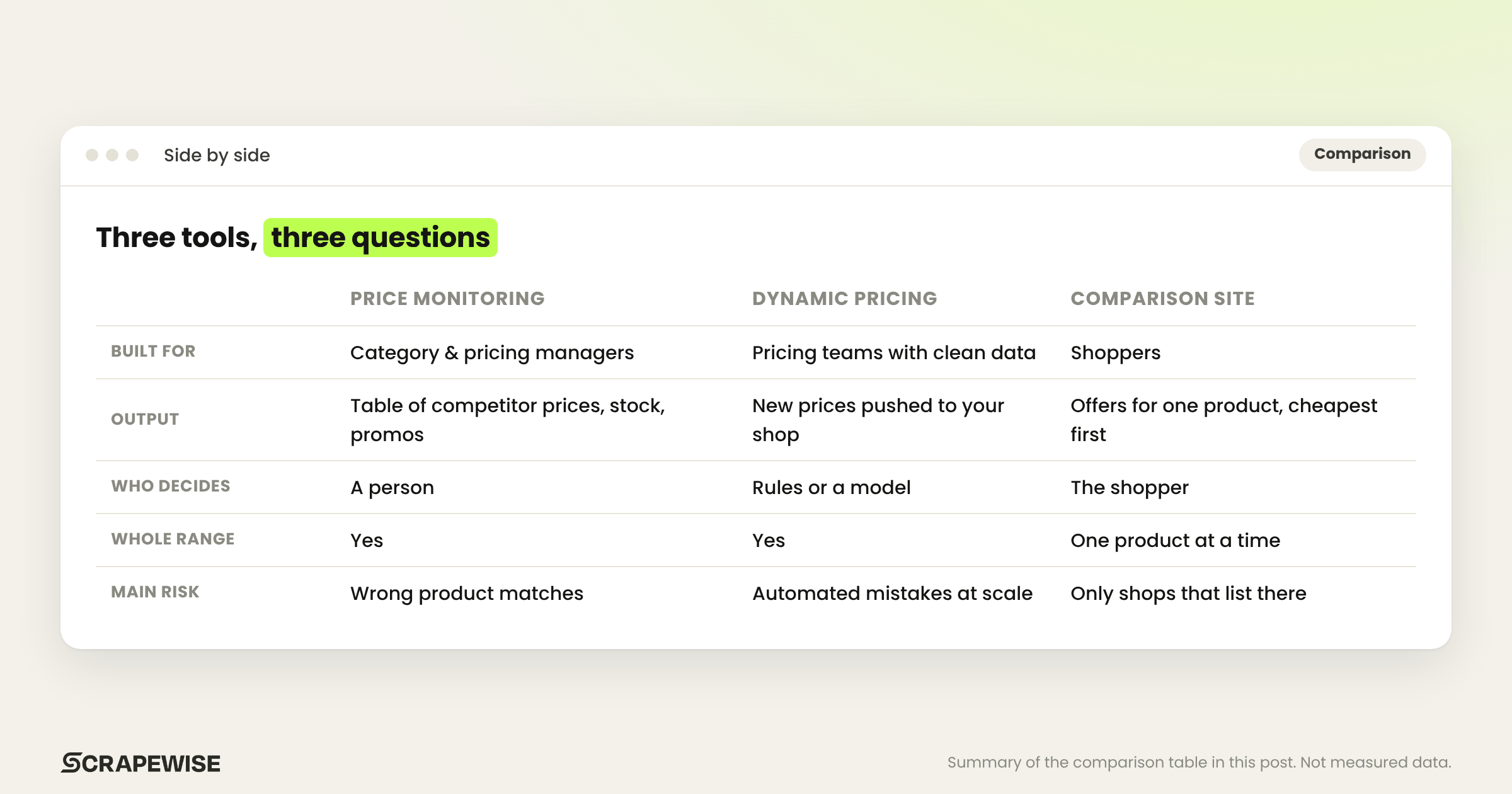
They answer three different questions. Monitoring answers "what are competitors charging across my range, and how has it changed?" Dynamic pricing answers "what should my price be right now?" and acts on it. A comparison site answers a shopper's question, "where is this one product cheapest today?" Many teams end up using all three.
| Price monitoring | Dynamic pricing | Price comparison site | |
|---|---|---|---|
| Built for | Category, pricing and e-commerce managers | Pricing teams and marketplace sellers with clean data | Shoppers |
| Main output | Table or report of competitor prices, stock, promotions | New prices pushed to your shop or marketplace | List of offers for one product, cheapest first |
| Who decides | A person | Rules or a model, within limits a person sets | The shopper |
| History | Yes, every run is kept | Usually its own price log | Some show a price chart, for one product at a time |
| Coverage | The shops you choose, including ones not on comparison sites | Whatever data you feed it | Shops that list there |
| Your whole range at once | Yes | Yes | No, one product page at a time |
| Typical first step | Track 3–5 core rivals in one category | Start with a few rules on one category after monitoring is reliable | Check your position on the products shoppers compare most |
| Main risk | Wrong product matches | Automated mistakes at scale, price wars | Seeing only the shops that list there |
What does each tool show for the same product?
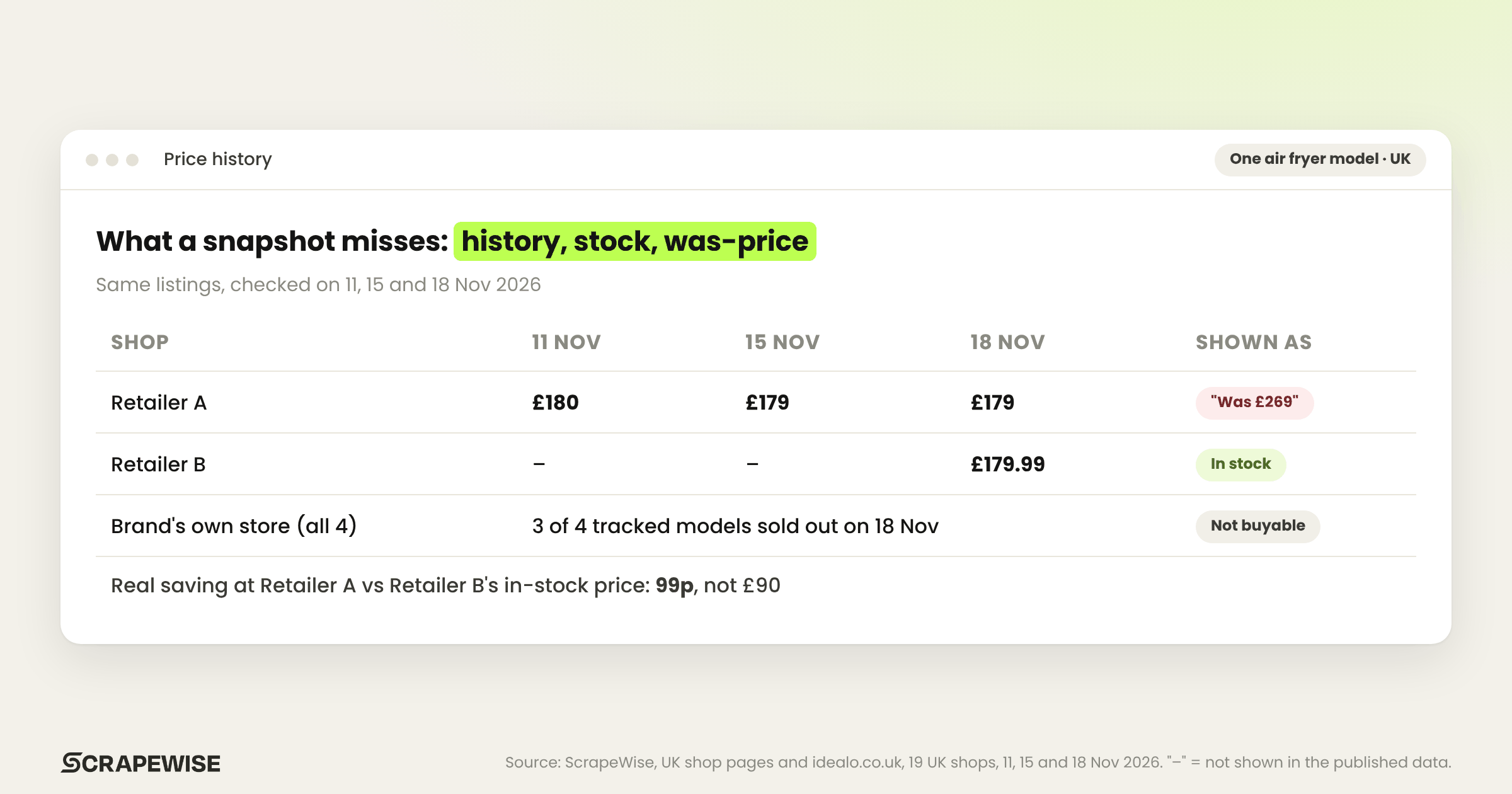
On 18 Nov 2026, ScrapeWise read 33 Black Friday prices for four air fryer models from one brand at 19 UK shops, using shop pages and idealo.co.uk. Looking at the same numbers through each tool shows why they aren't interchangeable.
The comparison-site view. One model was listed at 14 UK shops on 18 Nov, from £179 to £269.99, a gap of £90.99. A shopper sees that list, picks the £179 offer and leaves. For you, that is one product on one day.
The monitoring view. Because some of the same listings were checked earlier, on 11–12 and 15 Nov, the history shows things a single 18 Nov snapshot can't:
- Change over time. Of 12 prices checked on 11–12 Nov and again on 15 Nov, 10 hadn't moved. Between 15 and 18 Nov, three shops cut one model: £159 to £129, £159.99 to £139.99 and £149 to £139.
- Stock. Three of the four models were sold out on the brand's own store on 18 Nov. A sold-out price isn't a real alternative for a shopper.
- Was-prices. One retailer showed a was-price of £269 on a model it had charged £180, £179 and £179 on 11, 15 and 18 Nov. Against another shop's in-stock price of £179.99, the real saving was 99p.
The dynamic pricing view. A rule like "match the cheapest competitor" would have acted on these numbers. Whether that was a good move depends on things the rule needs from monitoring: is the cheaper shop in stock, is it the same product, and is its "discount" real? Without those checks, a repricer can cut your margin to match a price nobody can buy.
The full walkthrough is in the video above. For how to check discount claims in detail, see how to check if a Black Friday discount is real.
Which EU rules apply to dynamic pricing?
Dynamic pricing is legal in the EU, but three sets of rules touch it. Announced price reductions must use the lowest price of the last 30 days. Personalised prices based on profiling must be disclosed. And the Commission's Digital Fairness Act proposal of 11 November 2026 targets "obscure dynamic pricing". Monitoring itself isn't regulated by these rules.
Price reductions (Omnibus, Article 6a). The Price Indication Directive, as amended by the Omnibus Directive, says an announced price reduction must show the prior price, meaning the lowest price in at least the previous 30 days. The Court of Justice confirmed in Aldi Süd, C-330/23 (26 September 2024) that the reduction is measured against a prior price that "must be determined on the basis of the lowest price applied by the trader during a period not shorter than 30 days". The Commission's 2021 guidance on Article 6a says the rule doesn't apply to price changes that aren't announced as reductions (see the Commission's 2021 guidance on Article 6a, section 1.1). So a repricer moving prices up and down falls outside Article 6a, though general unfair-practice rules still apply. The moment you put a "was" price or "-20%" badge next to it, your 30-day low has to back it up. A repricer that cuts and raises prices all month makes that 30-day low hard to track unless you log every price.
Personalised prices. Since the Modernisation Directive (EU) 2019/2161, traders selling online must tell consumers when a price was personalised on the basis of automated decision-making. Garrigues notes that "Personalized prices should not be confused with dynamic prices, which change in response to market demand". Prices that change for everyone because a competitor moved are dynamic, not personalised.
The Digital Fairness Act proposal. On 11 November 2026 the Commission adopted its proposal for a Digital Fairness Act. The Commission lists "obscure dynamic pricing and misleading pricing practices" among the problems it addresses. It is a proposal, so Parliament and Council still have to agree a final text. If you are choosing dynamic pricing software now, ask the vendor how it would show customers what changed and why.
For the price-history side of compliance, see our guide to Omnibus price history.
Which one do you need first?
Start with price monitoring unless you already have reliable, matched competitor data. You need it to judge your position, to check rivals' discount claims and to feed any dynamic pricing later. Add dynamic pricing once the data is trusted and your rules are clear. Use comparison sites as one input, not as your monitoring.
A simple way to decide:
- You collect competitor prices by hand today. In Estonia, for example, many category managers still have assistants copying competitor prices into Excel. You need monitoring first. Pick one category and three to five core rivals, and see how often to check them.
- You have monitoring data but people act on it slowly. Fix the process before you automate it: one shared table, one owner per category, a weekly decision slot.
- You sell on marketplaces with fast-moving offers. A repricer can make sense, but feed it offer data with stock and fulfilment flags. Our marketplace repricing data page shows what that feed looks like.
- You have clean data, clear rules and a big catalogue. That's when a dynamic pricing platform starts to earn its fee. Set floors, ceilings and a log of every change.
In practice the first step matters most. The customers we work with include a home and furniture retailer checking its positioning across retailers, a fitness equipment seller watching its own and competitors' prices, and a yarn and crafts brand watching competitors across markets. What they need first is one clean competitor table per category that people trust.
Where does ScrapeWise fit?
ScrapeWise, which publishes this blog, is a monitoring data tool, not a dynamic pricing engine. It collects prices, stock and promotions from the competitor sites you choose, matches them to your products, and delivers a table, CSV or Excel file, or an API feed that a repricer can read. It runs at most once a day and sends no alerts, so a person reads the table.
That makes it one option for step 1 and for feeding step 3 or 4. Dedicated dynamic pricing platforms are a different purchase. If you're comparing monitoring vendors, our guide to choosing price monitoring software lists the questions to ask, and the competitor price tracking page shows how a run is set up.
What should you do next?
Write down which question you're trying to answer. If it's "what are competitors charging across my range?", you need monitoring. If it's "change my prices without a person", you need dynamic pricing, and monitoring underneath it. If it's "where do shoppers see us on Prisjakt or idealo?", check those sites, but don't stop there.
Then test monitoring on a handful of products you know well, so you can tell at a glance whether the matches and prices are right. You can run your own competitor URLs on ScrapeWise: the first 5 requests are free, no card needed. Compare the result with what you'd have copied by hand, and decide from there.
Stop checking competitor prices by hand
Paste a competitor product URL. ScrapeWise checks it every day and matches it to your product. 5 free requests, no card.
Not ready to sign up? See 40 rows of real Google Shopping price data →
5 free requests no credit card · pay per page, no monthly plan · book a 15-min call →