
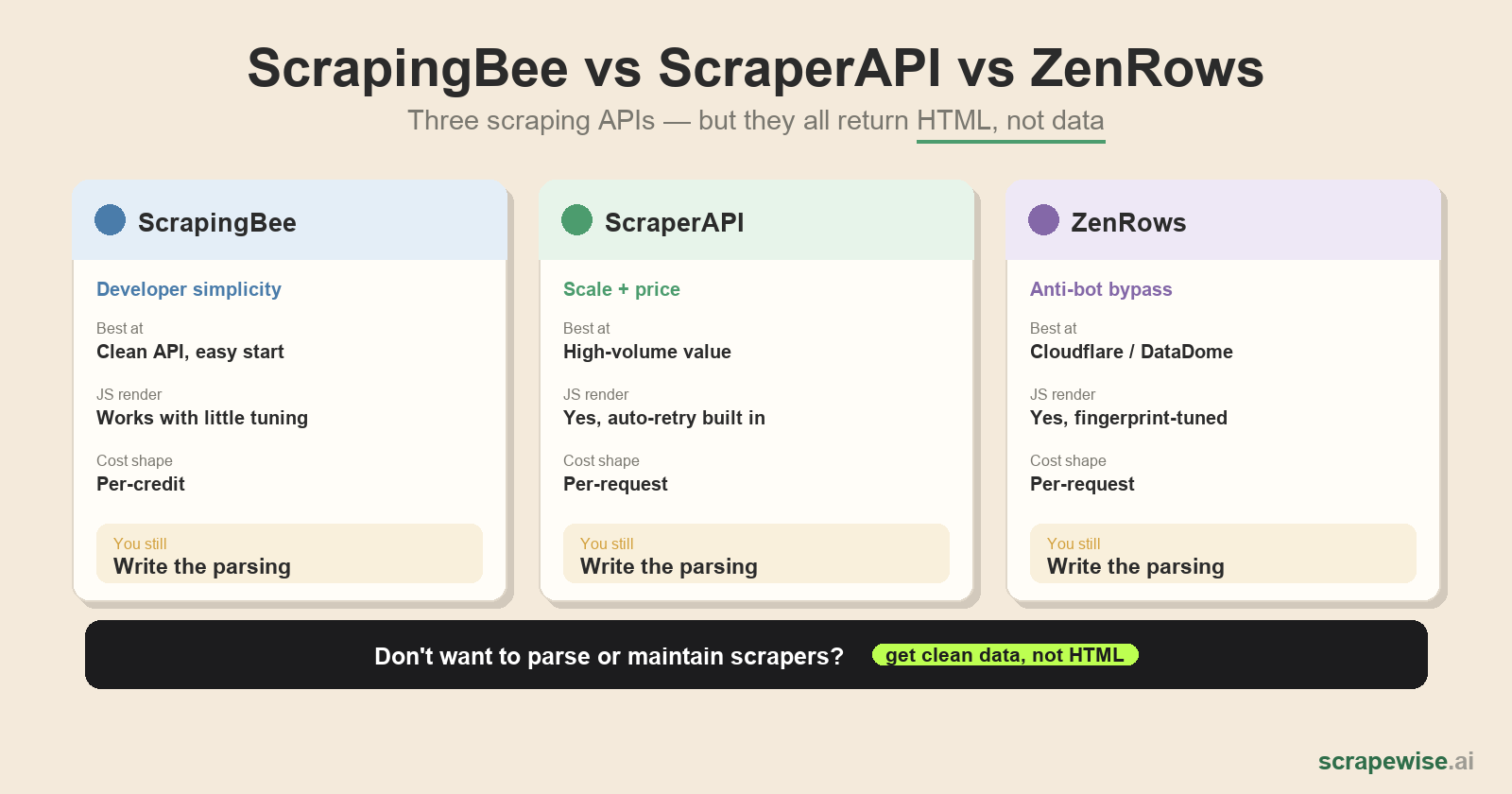
If you've outgrown raw proxies but don't want to run a headless-browser fleet, a scraping API is the middle path. You send a URL, the service handles proxies, JavaScript rendering and anti-bot, and returns the HTML. The three names that dominate this tier are ScrapingBee, ScraperAPI and ZenRows: similar on the surface, different in where they put their engineering and how they count credits.
The honest caveat first: a scraping API returns HTML, not data. You still write and maintain the parsing on top, and you still watch success rates when a target hardens. It removes the proxy layer, not the operation.
ScrapeWise publishes this blog and appears at the end as a different kind of option, so read that part with that in mind. Prices and credit rules below come from each vendor's own pricing page, checked in November 2026.
Which One Fits Your Situation?
| Your situation | Better fit |
|---|---|
| Simple API, good docs, JS rendering that "just works" | ScrapingBee |
| High volume with per-domain credit rules and retries built in | ScraperAPI |
| Toughest anti-bot targets (Cloudflare, DataDome) | ZenRows |
| Don't want to parse or maintain scrapers at all | Ready data feed |
If the end goal is competitor prices rather than raw HTML, scraping is only step one: the rows still have to be cleaned and matched to your own products. ScrapeWise self-serve gives you the scraped rows and can match them to your SKUs: you upload your product list, and rows match on EAN or ID first, then on title, brand and size, then on pictures. If you'd rather hand the whole job over, Managed Data does it for you. See product matching and competitor price tracking.
Quick Comparison
| ScrapingBee | ScraperAPI | ZenRows | |
|---|---|---|---|
| Focus | Developer simplicity | Scale | Anti-bot bypass |
| JS rendering | Yes | Yes | Yes |
| Best at | Clean API, easy start | High-volume work | Hard targets |
| You still do | Parsing | Parsing | Parsing |
| Pricing | Monthly credits | Monthly credits | Monthly credits |
Published Pricing (checked Nov 2026)
All three sell monthly credit bundles, and a request costs a different number of credits depending on what it needs. That makes the headline plan price a poor guide on its own.
| ScrapingBee | ScraperAPI | ZenRows | |
|---|---|---|---|
| Entry plan | $19/month, 75,000 credits | $49/month, 100,000 credits | $19/month, 45,000 credits |
| Basic request | 1 credit | 1 credit | 1 credit |
| JavaScript rendering | 5 credits | Not stated as a fixed multiplier | 5 credits |
| Premium proxy | 10 credits, or 25 with JS rendering | Not stated as a fixed multiplier | 10 credits, or 25 with JS rendering |
| Site-specific costs | Not listed | Amazon 5 credits; bot-protected sites +10 credits | Not listed |
| Free start | 1,000 credits, no card | 7-day trial with 5,000 credits, no card | 5,000 credits a month, no card |
Sources: ScrapingBee pricing, ScraperAPI pricing, ZenRows pricing.
A few details matter more than the plan price. ScrapingBee credits expire after a month and don't carry over. ZenRows says failed requests are not charged. ScraperAPI points to a cost estimator in its dashboard for per-domain costs, so check your own target domains there before you compare.
ScrapingBee: Developer Simplicity
ScrapingBee focuses on the developer experience: a clean API, solid documentation, and JavaScript rendering that works without much tuning. For teams that want to point an API at a URL and get rendered HTML back with minimal setup, it's a low-friction option.
The trade-off is in the credit maths. A request with JavaScript rendering and premium proxies costs 25 credits instead of 1, so a plan that looks large shrinks fast on well-protected sites.
ScraperAPI: Scale
ScraperAPI leans into volume, with plans up to 21.5 million credits a month before enterprise pricing. Auto-retry and proxy rotation are built in, and its pricing page lists per-domain costs for some sites, such as 5 credits for Amazon.
The trade-off is that bot-protected sites cost extra: the pricing page lists an additional 10 credits per request when a Cloudflare, DataDome or PerimeterX check is bypassed. On well-defended targets, your real cost per page is several times the basic rate.
ZenRows: Anti-Bot Bypass
ZenRows positions itself on the hardest problem: getting past modern anti-bot systems like Cloudflare Bot Management and DataDome, which sites use to detect and block automated traffic before it reaches the page. If your bottleneck is blocking rather than rendering or price, that focus is the reason to look at it.
The credit rules are spelled out clearly: 1 credit for a basic request, 5 with JavaScript, 10 with a premium proxy, 25 with both. Failed requests aren't charged. Like the others, it still hands you HTML to parse yourself.
The Common Ceiling: They Return HTML, Not Data
All three stop at the same line. They get you rendered, unblocked HTML. Then you write CSS or XPath selectors, maintain them when the site changes, structure the output and monitor success rates. The scraping API removes proxies and rendering; it doesn't remove the scraper.
A service that returns rows instead of HTML closes that last gap. With ScrapeWise you add the product or category URLs and get rows back as a table, CSV or Excel, through the REST API or the MCP server, with proxies and rendering handled for you. It charges per page delivered: €0.15 per 1,000 plain pages, €0.75 when a browser render is needed, €1.50 with a residential proxy and €3.75 for both. Runs can be scheduled up to once a day or started by hand, and data is kept for 90 days. See how that applies to ecommerce market research.
What it does not do: no alerts, no repricing, and nothing faster than daily, so a scraping API is still the better fit for intraday jobs. Product matching to your SKUs works on self-serve from a product list you upload, or is done for you in Managed Data, from €1,500 a month plus setup. And some sites block automated visits or need a login, for ScrapeWise as for the three APIs above. See scraping without getting blocked for what that means in practice.
How to Choose
- What's your bottleneck? Simplicity → ScrapingBee. Volume with built-in retries → ScraperAPI. Blocking → ZenRows.
- How hard are your targets? Work out the credits per request for your own sites, not the basic 1-credit rate. Cloudflare and DataDome-heavy targets cost several times more on all three.
- Do you want HTML or data? If you'd rather skip parsing and maintenance entirely, a feed that returns rows removes that whole layer.
The Bottom Line
ScrapingBee is built for developer experience, ScraperAPI for volume, ZenRows for hard anti-bot targets. All three return HTML you still have to parse and maintain. If you'd rather receive the rows, a feed removes the operation instead of moving it.
If you're unsure whether you need the API layer at all, try a few of your own product URLs in ScrapeWise and see whether the rows cover what you need: the first 5 requests are free, no card needed.
For the short two-way version, see Scrapewise as a ZenRows alternative.
Test ScrapeWise on your own URL
Paste the page you need and judge the output yourself. Pay per page, no monthly plan. 5 free requests, no card.
Not ready to sign up? See 12 real Amazon rows, 972 columns →
5 free requests no credit card · from €0.15 per 1,000 pages · or call it from Python or MCP →