

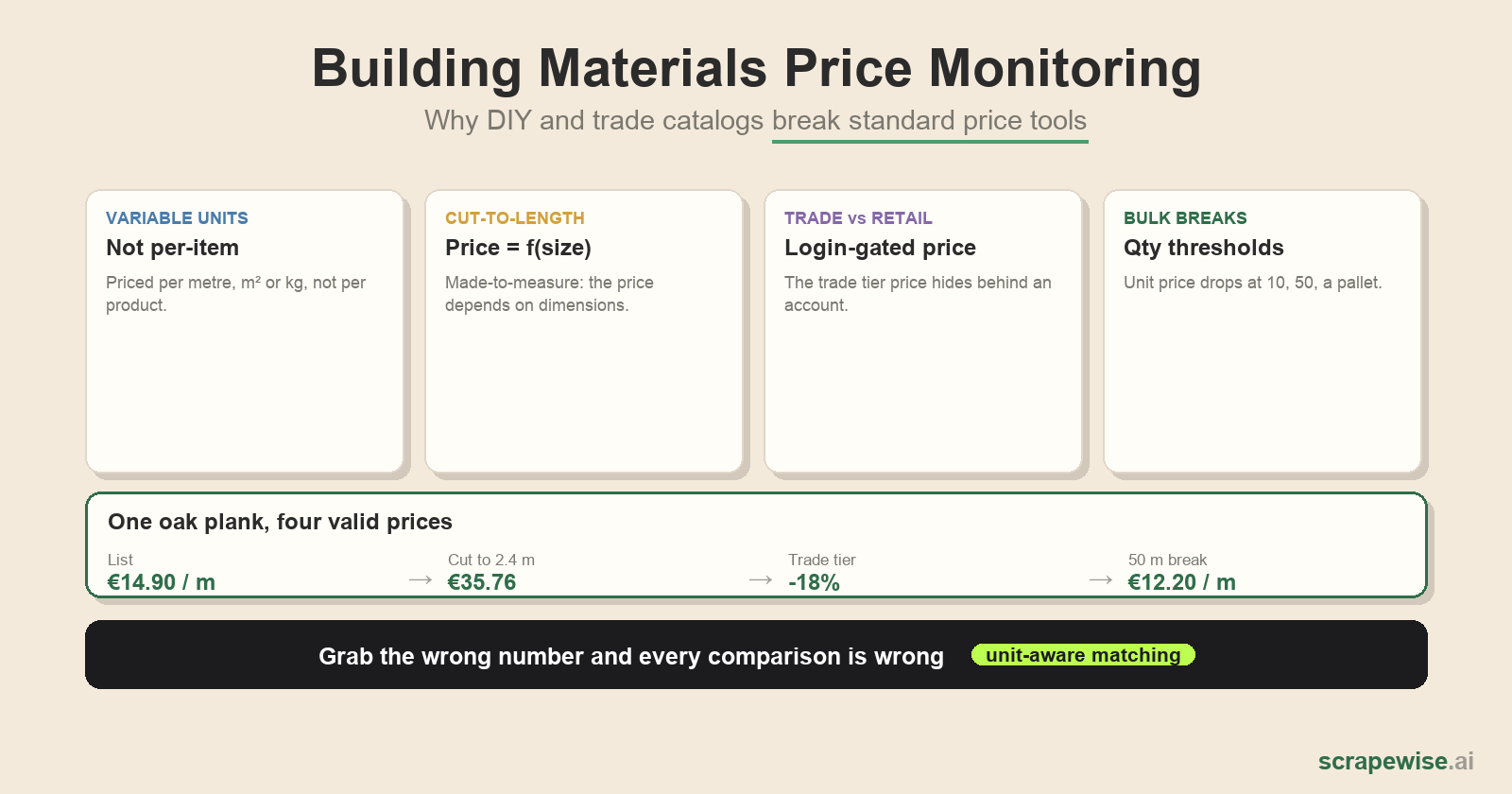
Price-monitor a smartphone and life is simple: one product, one price, one number to compare. Price-monitor a length of oak, a bag of screws, or a run of decking, and the whole model falls apart. The "price" is €14.90 — per metre. Cut to 2.4 metres it's €35.76. The trade customer logged in sees it 18% cheaper. Buy 50 metres and the per-metre price drops again. That's four legitimate prices for one product, and a standard price tool grabs whichever one it happens to see first.
Building materials, DIY, and home improvement is the vertical that quietly defeats generic price monitoring. There are mature tools for electronics, fashion, grocery and pharma — categories where a product is a discrete, per-unit thing. Building materials isn't, and every assumption baked into a standard tool breaks on contact with a builders' merchant catalogue.
This is what makes the category hard, and what a monitoring setup has to do differently to produce numbers you can actually price against.
Why This Vertical Is Different
The core problem is that in building materials, price is rarely "per product." It's a function of unit, dimension, customer type, and quantity — often all four at once. A monitoring system built on the assumption that a product page yields one comparable number will pull a number, but not a comparable one. Four structural quirks drive it.
1. Variable units — the price isn't per item
Timber is priced per metre or per linear foot. Sheet materials per square metre. Aggregates, sand and cement per kilogram, per tonne, or per bag. Paint per litre. Two competitors can list "the same" insulation board at €9 and €24 and both be cheaper than each other — because one is pricing per board and one per square metre. Unless your system knows the unit and normalises to a common basis, you're comparing numbers that share a currency symbol and nothing else.
2. Cut-to-length and made-to-measure — price is a function of size
Worktops, timber, blinds, cable, guttering, roofing sheet — a huge share of the category is sold cut, mixed, or made to a dimension the customer specifies. The displayed price may be a base rate, a per-unit-of-length rate, or the output of a configurator that only produces a number after you enter dimensions. There's often no single "price" on the page at all until an input is provided. A scraper that reads the first price it finds captures the starting rate and misses that the real, comparable figure depends on a length.
3. Trade vs retail tiers — the real price is behind a login
This is the big one, and it's specific to the vertical. Builders' merchants and many DIY sheds run two prices: the public retail price, and a trade price visible only to logged-in account holders — frequently 10–30% lower, and sometimes negotiated per account. The price a member of the public scrapes is not the price a tradesperson pays, which is not the price a big contractor negotiates. Monitor only the public price and you're benchmarking against a number half your competitors' customers never see.
4. Bulk break points — the unit price steps down with quantity
Quantity breaks are the norm, not the exception. €12.20 per metre at 50 metres, more per metre for a single length, a different rate again by the pallet. The "price" is a schedule, not a scalar. Capture only the single-unit price and you'll conclude a competitor is expensive when they're actually the cheapest option for the order size your customer is placing.
One Oak Plank, Four Valid Prices
Put the quirks together on a single SKU and the trap is obvious:
| Basis | Price | Why it differs |
|---|---|---|
| List (per metre) | €14.90 / m | The headline rate on the page |
| Cut to 2.4 m | €35.76 | Dimension applied |
| Trade tier | −18% | Logged-in account price |
| 50 m bulk break | €12.20 / m | Quantity threshold |
A standard tool records "€14.90" and moves on. Every downstream comparison built on that number is wrong for any customer who isn't buying exactly one metre at retail.
What Proper Monitoring Has to Do
The fixes all come down to capturing more than the headline number and normalising before you compare.
Capture the unit, not just the price. Extract "€14.90" and "per metre" together, and normalise every competitor to a common basis (per m, per m², per unit) before any comparison. A price without its unit is noise in this category.
Handle configurators and dimensioned pricing. For cut-to-length and made-to-measure items, capture the base rate and the pricing rule, or drive the configurator with representative inputs so you're comparing like for like. This is squarely a JavaScript-heavy scraping problem — the real price often only appears after interaction.
Decide deliberately about trade pricing. You have to choose whether you're benchmarking public retail or trade tiers, and be consistent. Where trade prices sit behind an account, monitoring them raises access questions you should resolve properly — but at minimum, don't silently compare your trade price to a competitor's retail price and call it insight.
Capture the break schedule, not one point. Where quantity breaks are shown, capture the whole schedule so you can compare at the order sizes that matter to your customers, not just at quantity one.
Match on more than a name. Product matching here leans even harder on attributes — dimensions, grade, material, unit — because EAN matching frequently isn't available on private-label building products, and "18mm OSB3 2440x1220" has to match its equivalent regardless of how each merchant phrases it.
This is the same decision-first approach any monitoring setup needs — the category just raises the bar on what "comparable" means.
Where ScrapeWise Fits — and Where It Doesn't
ScrapeWise is a managed feed you point at builders' merchant and DIY storefronts, and it's built to capture the things generic tools drop: the unit alongside the price, configurator-driven and dimensioned pricing, and quantity-break schedules — normalised so what you compare is actually comparable. Because it's AI-driven rather than a fixed template, an awkward configurator page is just another target.
Honest limitations: trade-tier prices that sit behind an authenticated account are a case-by-case conversation, not an automatic capture — we resolve access legitimately or benchmark the public tier, rather than pretend a login barrier isn't there. Coverage is scoped to your merchant set, though the billing itself is the same pay-as-you-go per delivered page as everything else we run.
Conclusion
Building materials breaks standard price tools because its prices aren't per-item — they're per unit, per dimension, per customer tier, and per quantity, frequently all at once. Grab the wrong number and every comparison downstream is wrong. Capture the unit with the price, handle configurators and break schedules, decide consciously about trade tiers, and match on attributes. Do that and one of the hardest verticals to monitor becomes one of the most defensible pricing edges you can build — precisely because most of your competitors are still comparing €14.90 to €24 and calling it analysis.
Want your merchant and DIY competitor prices captured unit-aware and delivered clean? Get a quote for your catalogue.
Paste a competitor URL and start tracking prices
Any e-commerce site, any SKU count. Clean structured feeds on your schedule, no code required.
97% accuracy on Amazon benchmarks · no credit card · book a 15-min call →