

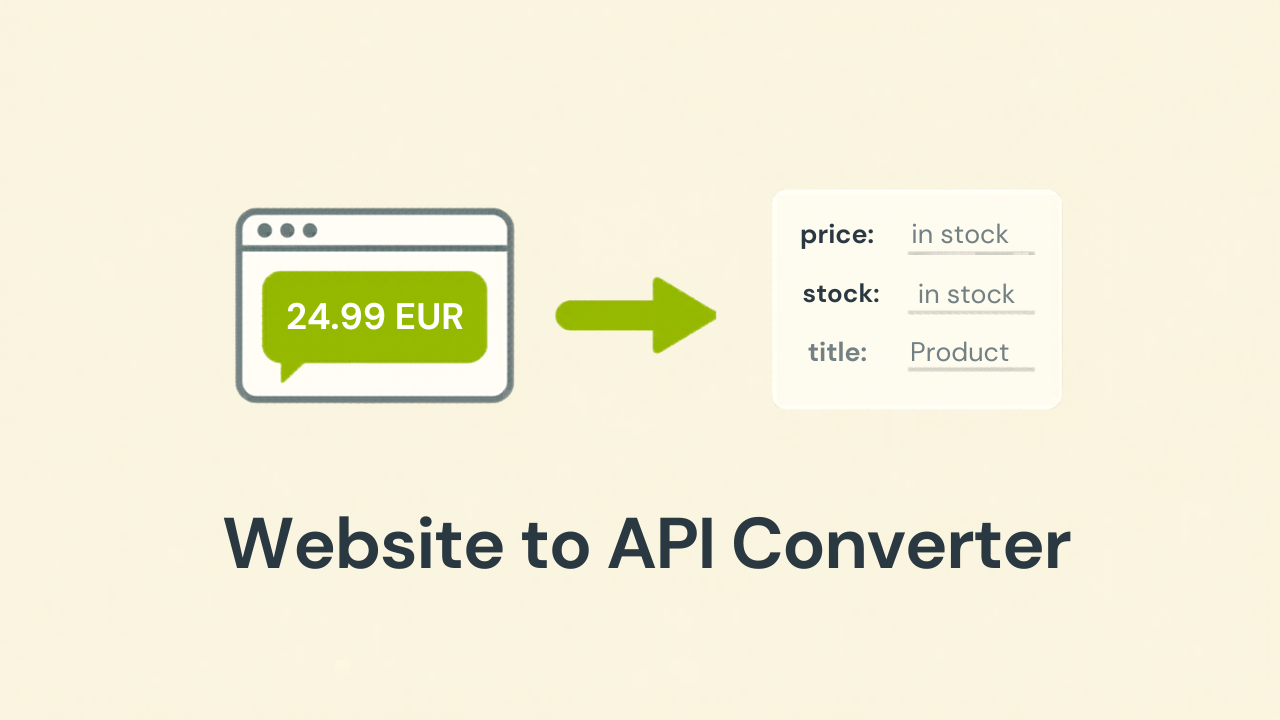
Your competitors update prices multiple times a day. Their stock levels, product specs, and promotional offers change in real time. If your team is still copying that data into spreadsheets by hand — or waiting on a developer to build a scraper — you're already behind. A website to API converter changes that equation entirely: it turns any e-commerce website into a structured, queryable data feed your systems can consume automatically, without a single line of code.
This guide explains what a website to API converter actually is, how it works for product data use cases, what to look for when choosing one, and how European retail and pricing teams are already using this approach to stay ahead.
What Is a Website to API Converter?
A website to API converter is a tool that extracts structured data from a website and delivers it through a programmable endpoint — an API — that your systems, dashboards, or spreadsheets can call on demand or on a schedule.
Think of it as installing a tap on a competitor's product catalogue. Every time you turn the tap, you get clean, structured JSON or CSV with the exact fields you defined: price, stock status, product title, EAN, rating, delivery time. No HTML parsing, no browser automation, no developer tickets.
The key distinction from a generic web scraper is the delivery format. A scraper extracts. A website to API converter extracts and structures and serves — so the data flows directly into your pricing engine, PIM system, BI dashboard, or ERP without a transformation layer in between.
This is different from what most search results return when you search for "website to api converter." Those results — tools like ConvertAPI or Zamzar — are file format converters. They convert documents, not live web data. The category that actually solves e-commerce intelligence problems is purpose-built web-data-to-API platforms.
Why E-Commerce Teams Need a Website to API Converter
Manual competitor research doesn't scale. A mid-sized e-commerce operation monitoring 50 competitors across 5,000 SKUs would need a team of people refreshing product pages around the clock just to keep pricing data current. That's not a realistic model.
According to Semrush's e-commerce benchmarking data, retailers that automate competitive data collection respond to price changes 4–6x faster than those relying on manual processes — and faster response directly correlates with margin protection and conversion rate.
The alternative — building API integrations directly with competitor sites — isn't possible. Competitor websites don't publish APIs. Their data is locked inside HTML, JavaScript-rendered page components, and dynamically loaded product panels. A website to API converter unlocks that data programmatically.
For e-commerce managers specifically, this means:
- Automated price monitoring — get competitor prices delivered to your repricing tool every hour
- Stock intelligence — know when a competitor runs out of a key product before you do
- New product detection — catch catalogue additions or removals the moment they happen
- Spec parity checking — verify your product descriptions match or exceed the competition
- Promotional tracking — capture flash sales, discount codes, and bundle offers in real time
These aren't edge cases. They're the daily data needs of any serious pricing or category team.
The Website to API Converter Use Cases That Matter Most
Not all website-to-API use cases carry the same business value. For retail and e-commerce, three stand out.
Competitor Price Feeds
The most common use case is competitor price monitoring. You define which competitor pages to watch, which price fields to extract (sale price, original price, VAT-inclusive price, currency), and how often to refresh. The converter runs on a schedule and delivers a clean JSON feed that your pricing engine ingests automatically.
Done well, this replaces a team of analysts — or eliminates the lag that makes manual monitoring useless for dynamic pricing decisions.
Product Data Extraction at Scale
When you're onboarding new product categories, expanding to new markets, or building a comparison tool, you need structured product data fast. Product data extraction via a website to API converter lets you pull titles, descriptions, images, specifications, and identifiers (EAN, GTIN, ASIN) from supplier and marketplace sites — in bulk, on demand.
This is particularly valuable for wholesale buyers comparing supplier catalogues across multiple distributor portals that have no shared API standard.
Turning Websites Into Live Data Feeds
The most powerful application is building an always-on data pipeline that turns competitor websites into APIs your internal systems treat like first-party feeds. Your ERP queries it. Your BI dashboards pull from it. Your pricing alerts fire off it. The competitor website becomes, in effect, an unofficial data partner — one that has no idea you're listening.
How a Website to API Converter Works — Without Writing Code
Modern no-code website to API converters follow a similar workflow. Here's how the process typically looks with a platform like Scrapewise:
1. Point to the source Enter the URL of the competitor product page, category listing, or search results page you want to convert.
2. Define the fields Click on the elements you want to extract — price, product title, stock label, review count, delivery date. The tool infers the CSS selectors automatically. No XPath or code required.
3. Handle pagination and dynamic content For category pages with 200+ products, the converter follows pagination automatically. For JavaScript-rendered pages (React, Vue, Angular storefronts), it renders the page in a headless browser before extracting — so you get the same data a human browser session would see. See our guide to scraping JavaScript-heavy e-commerce websites for a deeper look at how this works.
4. Set a schedule Define how often the converter runs: daily, every few days, weekly or monthly. You can also start a run on demand through the API. Each run delivers a fresh API response.
5. Connect to your systems The output endpoint returns structured JSON or CSV. Connect it to your pricing tool, load the CSV into a spreadsheet, or call it directly from your ERP's import script. The data arrives clean and schema-consistent every time.
The total setup time for a straightforward product page is typically under 20 minutes.
What to Look for in a Website to API Converter
Not all tools in this category are built for e-commerce scale. When evaluating options, prioritise these capabilities:
JavaScript rendering — Most modern e-commerce sites load prices dynamically via JavaScript. A converter that only reads static HTML will return blank price fields on Shopify, Magento, or custom storefronts. This is the most common failure mode.
Proxy rotation and anti-bot handling — Retailers actively block automated access. An enterprise-grade converter routes requests through rotating residential proxies, mimics realistic browser behaviour, and handles CAPTCHAs without manual intervention. This is what separates a proof-of-concept from a production-ready feed.
Scheduled delivery — You need fresh data without manual triggering. Look for configurable schedules, retry logic on failure, and alerting when a source page changes structure.
Structured output with consistent schema — If a product goes out of stock and the price element disappears from the page, does the converter return null gracefully, or does the schema collapse? Schema stability matters for downstream integrations.
Volume and parallelism — Monitoring 10,000 SKUs across 30 competitor domains requires parallel scraping infrastructure. Check how many concurrent scrapers the platform supports and whether it handles rate limiting intelligently.
According to Ahrefs' analysis of SEO and data infrastructure tools, teams that invest in robust data collection infrastructure outperform on competitive response time by a significant margin — because the bottleneck moves from data availability to decision-making speed.
Common Challenges (and How Purpose-Built Tools Solve Them)
"The page structure changes and our feed breaks." Generic scrapers tied to hardcoded selectors break every time a retailer redesigns their category page. Purpose-built platforms use structural heuristics and self-healing scraper infrastructure that detects layout changes and attempts automatic selector recovery, and a failed run is flagged so you can update the config.
"We can't scrape JavaScript-rendered pages." If your current tool returns empty price fields on modern storefronts, it's not rendering JavaScript. Look for a converter with a built-in headless browser (Chromium-based) that renders the page fully before extracting — the same way a real user's browser would.
"Our IT team won't approve another vendor for this." The business case is straightforward: the alternative is either a developer building and maintaining a custom scraper (expensive, fragile), or manual data collection (unscalable). A no-code platform with a clear data processing agreement, GDPR-compliant infrastructure, and EU-based processing addresses most procurement concerns for European retailers.
"We need data from 50 domains simultaneously." Residential proxy pools and parallel job scheduling handle this at the infrastructure level. The key question to ask vendors is: "What's your concurrent job limit, and do you throttle per domain automatically?" Good platforms handle domain-specific rate limiting without you having to configure it manually.
European Retailers Leading the Shift to API-First Data
In Nordic and DACH markets, where multi-channel retail is mature and price transparency is high, the move toward automated competitive data collection is accelerating. Swedish and German e-commerce operations in particular face intense price pressure from Amazon, Zalando, and domestic pure-plays — and they're responding by building real-time competitive intelligence infrastructure rather than relying on weekly analyst reports.
The EU's Digital Services Act and evolving data governance frameworks are also driving interest in owned data infrastructure. Teams that previously relied on third-party data marketplaces are moving toward direct extraction pipelines they control — where they know exactly what was collected, when, and from where.
This is precisely the model a website to API converter enables: you own the collection logic, the schedule, the schema, and the output. There's no dependency on a data vendor's refresh cadence or coverage decisions.
For a deeper look at how competitive price monitoring tools are evolving in this landscape, including a comparison of platform approaches, that guide covers the category in detail.
Building Your First Website to API Converter
If you're ready to move from manual data collection to an automated product intelligence feed, the practical starting point is narrower than you might expect.
Pick one competitor. One category. Define five fields: product title, current price, original price, stock status, and last-seen date. Set a daily schedule. Export the CSV into a spreadsheet or pull it into your pricing dashboard through the REST API.
Run it for two weeks. Measure the decisions that feed enables — repricing actions taken, stockout opportunities caught, promotional responses triggered. That's your business case for scaling.
The infrastructure exists to turn any competitor's website into a structured data feed. The question is whether your team is ready to use it.
Paste any URL — ScrapeWise handles the anti-bot
Managed infrastructure that adapts when sites change. No proxies, no code, no per-request fees.
97% accuracy on Amazon benchmarks · no credit card · book a 15-min call →