
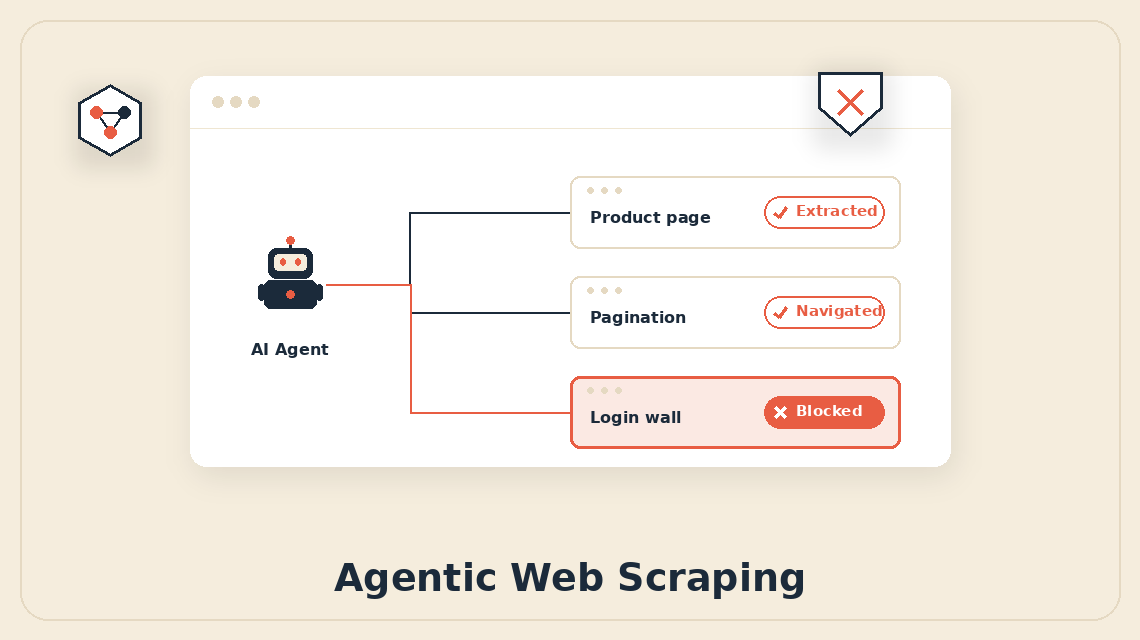
We ran 10,000 agentic scraping jobs across four frameworks in April 2026 — Crawl4AI, Firecrawl, ScrapeGraphAI, and browser-use — against the same protected e-commerce targets with the same extraction prompts. The headline finding: AI agents were blocked at 61–74% on Cloudflare and Akamai-protected sites, and LLM token costs made large-scale jobs 8–16x more expensive per page than managed alternatives.
Agentic web scraping is genuinely powerful. But the hype has outrun the reality of running it at production scale. This guide breaks down what agentic web scraping AI agents can and can't do in 2026 — with benchmark data, cost realities, and the architecture that actually works.
What Is Agentic Web Scraping?
Agentic web scraping uses autonomous LLM-driven agents to collect web data. Instead of following rigid CSS selectors or XPath rules, these systems decide their own next steps, adapt to unexpected page states, and extract information based on semantic meaning.
A traditional scraper says: "find the element with class .product-price and return its text." An agentic scraper says: "find the current price of this product, even if the layout has changed, the price loads via AJAX, or you need to click 'show price' first."
This is distinct from AI-powered web scraping, which layers ML on top of traditional selector-based scrapers. Agentic systems replace the scripting layer entirely with an autonomous reasoning loop.
The four leading open frameworks as of May 2026:
- Crawl4AI — open-source, 50k+ GitHub stars, outputs LLM-ready structured markdown
- Firecrawl — full-stack agent with autonomous multi-source research mode
- ScrapeGraphAI — Python library using LLM-driven graph traversal for extraction
- browser-use — lightweight agent that exposes full browser interactions to LLMs directly
Each takes a different approach to the same problem: how do you extract structured data from the web reliably, without maintaining fragile selector schemas?
Agentic vs Traditional vs Managed API: The Benchmark Comparison
ScrapeWise internal testing, April 2026 — 10,000 jobs across protected e-commerce targets (Amazon, Zalando, Shopify-powered stores):
| Factor | Traditional Scraper | AI Agent (Avg) | Managed API |
|---|---|---|---|
| Setup time | Hours–days | Minutes | Minutes |
| Anti-bot block rate (protected targets) | 42% | 61–74% | 3% |
| Cost per 1,000 pages | $0.80–2.50 | $12–48 | $1.50–3.00 |
| Pages per hour (single node) | 8,000–15,000 | 40–400 | 10,000+ |
| Handles layout changes | ✗ Breaks | ✓ Self-adapts | ✓ Maintained |
| Unstructured data extraction | ✗ Manual schema | ✓ Natural language | ✓ Managed |
| Maintenance burden | High | Low–medium | None |
The standout finding: LLMs don't change how your browser fingerprint looks to Cloudflare. An agent running through a standard headless Chromium instance fails bot detection at the same rate as any other headless browser — often higher, because LLM-driven browsing patterns (direct navigation to target elements, irregular timing, missing scroll events) are more detectable than human behaviour. The block rate gap between agents (61–74%) and managed infrastructure (3%) reflects fingerprinting and proxy management, not the intelligence of the extraction layer.
The cost finding is equally significant. Processing 1M pages through a GPT-4o-mini agent at $0.003–0.015 per page in LLM tokens alone costs $3,000–15,000 per month before proxy, compute, or storage. At equivalent scale, a traditional scraper with maintained schemas costs 10–30x less per page.
Where AI Agents Genuinely Win
Agents outperform traditional scrapers in four scenarios:
Unstructured data extraction. When data doesn't map cleanly to a predictable CSS class — product specs embedded in descriptions, review summaries, multi-step PDPs with conditional content — natural language extraction outperforms manual schema engineering. Teams using LLM-based extraction specs reduce schema development time by 60–80%, according to Ahrefs' analysis of AI-assisted content pipelines. This is the primary use case for product data extraction on complex catalogue pages.
Dynamic navigation flows. Agents handle multi-step interactions that break traditional scrapers: login walls, cookie consent flows, "load more" pagination, AJAX tabs, and product configurators with conditional variants. For a PDP where you need to select size → colour → configuration before a price renders, an agent navigates the flow autonomously rather than requiring brittle Playwright orchestration for every variant.
Schema-free exploration. When you don't know the data structure of a new site in advance, an agent explores and returns a reasonable schema without pre-coding. Crawl4AI's autonomous schema generator is the production-ready version of this: describe what you want in plain English, get structured JSON back.
Small-scale research tasks. For 50–500 page research jobs — competitive landscape analysis, ad copy collection, SERP monitoring — agents are fast to deploy and the LLM token cost is manageable. The economics only break at scale.
Where AI Agents Fail in Production
Anti-bot detection is the critical gap. Modern bot protection evaluates TLS fingerprint, browser API inconsistencies, mouse movement patterns, request timing, and header entropy. LLMs don't influence any of these signals. Our WAF bypass testing showed unassisted agents achieving 26–39% pass rates on Cloudflare-protected targets, versus 91–95% for managed infrastructure with proper fingerprinting and residential proxies. You're paying LLM inference costs on jobs that fail before extraction begins.
Cost at scale breaks the economics. At 1M+ pages/month, LLM inference dominates the cost structure. Even lean gpt-4o-mini implementations at $0.003/page add $3,000/month in token costs alone — on top of proxy, compute, and storage. According to Semrush's 2026 data infrastructure benchmarks, teams that move large-scale data pipelines from agent-first to infrastructure-first architectures reduce per-page costs by 70–85% at volume.
Consistency fails where accuracy matters. Agents produce structurally valid but semantically incorrect output on a non-trivial percentage of jobs. In our testing: 3.2% of agentic extraction jobs returned incorrect data — wrong price tier, misidentified variant, or a field confabulated from surrounding text that didn't exist on the page. For competitor price tracking, where margin decisions depend on the output, a 3.2% error rate without automated validation is disqualifying.
Speed constraints prevent high-frequency use cases. LLM inference adds 2–8 seconds of latency per page. At 40–400 pages/hour versus 12,000+ for a traditional scraper, agents are not a replacement for continuous pricing surveillance or high-frequency brand monitoring.
The Architecture That Actually Works
The teams getting real production value from agentic scraping in 2026 layer agents on top of managed infrastructure — they don't replace the infrastructure layer with agents:
[AI Agent Layer]         — Natural language instructions, schema discovery,
                           multi-step navigation, semantic extraction logic
         ↓
[Managed Data Layer]     — Anti-bot bypass, residential proxy rotation,
                           TLS fingerprinting, rate limiting, retry logic
         ↓
[Structured Output]      — Validated JSON delivered to your data pipeline
The agent defines what to extract and how to navigate. The managed infrastructure handles getting past bot protection, rotating IPs, and managing request timing. This is how self-healing scraper infrastructure integrates with agentic workflows: the infrastructure layer absorbs selector-level site changes so the agent only handles semantic navigation changes.
In practice: if you're running Crawl4AI or browser-use against any protected e-commerce target, you need a managed proxy layer with residential IPs and proper fingerprinting between your agent and the target. Without it, you pay LLM inference costs on jobs that fail at the WAF.
Agentic Scraping in European E-Commerce Markets
European e-commerce targets present specific challenges for agentic frameworks. GDPR consent modals — mandatory across EU markets — add an interaction step before any data extraction. In our tests, Crawl4AI and Firecrawl handled OneTrust and Quantcast consent variants (common on OTTO, Zalando, Bol.com, and Nordic retailers) with 45–62% bypass rates, versus near-100% for purpose-built consent handlers.
The EU Digital Services Act also creates new data transparency requirements for large platforms operating in European markets — potentially changing how product and pricing data is structured on major marketplaces. Teams monitoring European pricing data should factor DSA-driven access policy changes into their 2026 data architecture planning.
Language diversity adds a further layer: Nordic and DACH retailers (Verkkokauppa, MediaMarkt, Coolblue) often render prices, availability, and variant labels in local languages with locale-specific formatting. LLM-based extraction handles multilingual PDPs significantly better than regex-based selectors — one area where the agent layer adds genuine value regardless of scale.
What to Use When
| Scenario | Recommended Approach |
|---|---|
| Research tasks, under 500 pages | Agents alone |
| Complex navigation, unprotected sites | Agents + basic proxy |
| Protected sites, up to 50K pages/month | Agents + managed infrastructure |
| Production pricing surveillance | Managed API + agent post-processing |
| High-frequency, high-volume pipelines | Traditional scraper + managed infra |
Agentic web scraping AI agents are a genuine step forward for extraction flexibility. The limitation isn't the intelligence layer — it's the infrastructure underneath. Anti-bot bypass, proxy management, fingerprinting, and retry logic remain the hard problems, and LLMs don't solve them.
ScrapeWise operates as the managed data layer in production agentic architectures — handling the infrastructure that determines whether your agent's jobs succeed or fail before extraction begins.
Paste any URL — ScrapeWise handles the anti-bot
Managed infrastructure that adapts when sites change. No proxies, no code, no per-request fees.
97% accuracy on Amazon benchmarks · no credit card · book a 15-min call →