

If you're choosing between Playwright and Puppeteer for ecommerce scraping in 2026, there's something most comparison articles won't tell you: the stealth plugin that made Puppeteer the default "safe" choice for anti-bot evasion was deprecated in February 2025. The conventional wisdom is already out of date — and building your stack on it has real consequences when you're trying to scrape product data at scale from sites running Cloudflare Enterprise or DataDome.
This guide is built for e-commerce teams and data engineers who need to make a concrete infrastructure decision, not developers building a hobby scraper. We'll compare Playwright vs Puppeteer ecommerce scraping performance, dissect the 2026 anti-bot landscape, and explain when neither tool is actually the right answer.
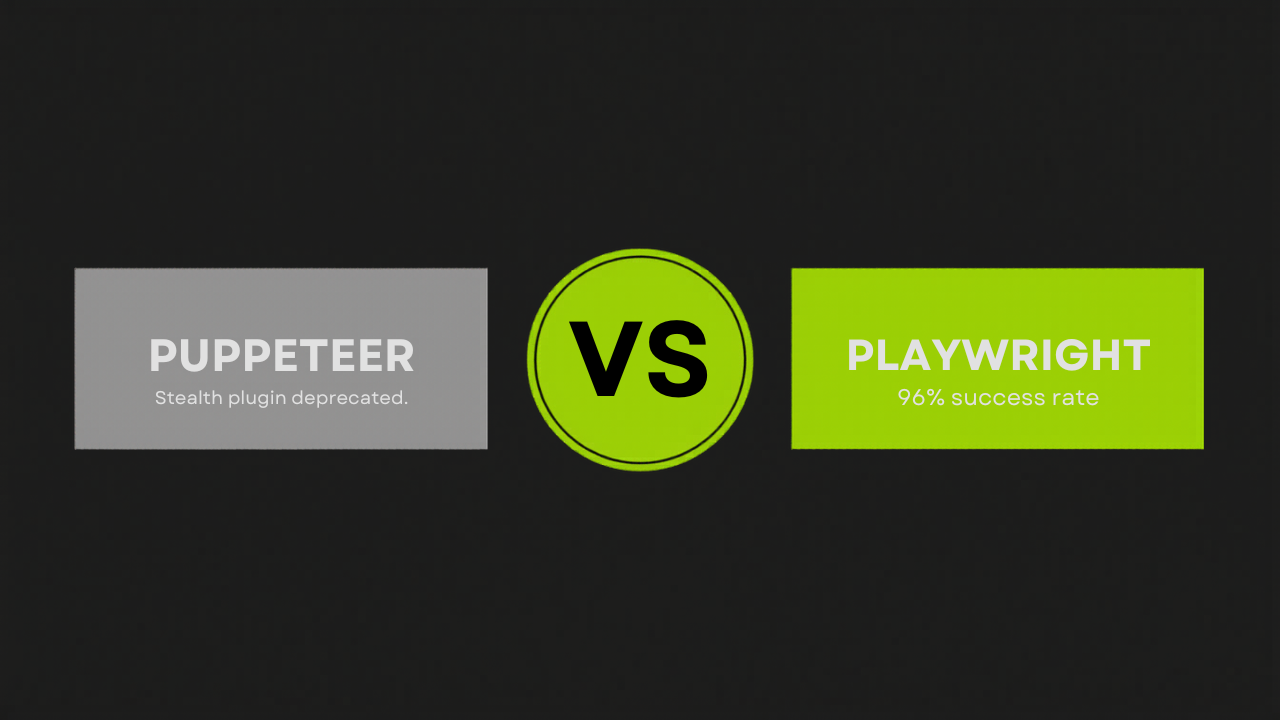
The Stealth Plugin Deprecation Changes the Playwright vs Puppeteer Ecommerce Scraping Calculus
For years, the standard recommendation was: use Puppeteer with puppeteer-extra-plugin-stealth if you need to avoid bot detection. The plugin patched about 10 common detection vectors — navigator.webdriver, Chrome runtime signatures, permission APIs — and it worked well enough against simpler detection systems.
In February 2025, the maintainer deprecated it. The plugin still installs and runs, but it's no longer receiving updates against new detection methods. Meanwhile, DataDome, Cloudflare, and Akamai Bot Manager ship detection model updates continuously. A static patch set from a deprecated plugin is already behind.
The Playwright port (playwright-extra with stealth) continues to be maintained, but it inherits the same architectural limitation: it's a layer of patches on top of the automation framework, not a fundamental change to how the browser presents itself to servers.
What this means for your stack:
- Puppeteer + deprecated stealth plugin: rising failure rate against modern WAFs
- Playwright + playwright-extra stealth: currently maintained, but same detection surface
- 2026 alternatives gaining traction: Nodriver (Python, Chrome-based, maintained by the original undetected-chromedriver author), Camoufox (Firefox-based, patches 40+ detection vectors at the binary level)
If your scraping targets are mid-tier e-commerce sites with basic detection, either tool with stealth plugins still works fine in 2026. If you're targeting Shopify Plus storefronts, ASOS, Fnac, Grailed, or any European retailer running DataDome, the stealth plugin is no longer a reliable foundation.
How Ecommerce Anti-Bot Systems Actually Detect Headless Browsers in 2026
Most comparison articles describe detection evasion as a patching exercise: change the user-agent, hide navigator.webdriver, add mouse movement. This framing understates what modern enterprise WAFs actually do.
The detection stack on major ecommerce sites in 2026 has three layers:
Layer 1 — Static fingerprint checks
These are the signals that stealth plugins patch: navigator.webdriver, headless User-Agent strings (HeadlessChrome), software-rendered WebGL (SwiftShader/LLVMpipe instead of a real GPU), deterministic canvas hashes, and TLS/JA3 fingerprint anomalies from the Node.js HTTP client.
Cloudflare is deployed on approximately 35% of the top 1 million websites globally. At the basic tier, it relies heavily on static fingerprints — and well-configured stealth plugins can still pass these checks.
Layer 2 — Behavioral entropy analysis DataDome — deployed on ASOS, Fnac, Grailed, and dozens of European fashion and electronics retailers — operates primarily at this layer. It analyzes scroll cadence, click coordinates relative to viewport, mouse movement entropy, inter-keystroke timing, and session flow patterns. No stealth plugin patches behavioral signals because they're not transmitted through JavaScript APIs — they're analyzed server-side from the event stream your browser sends.
According to Akamai's 2025 State of the Internet report, bot traffic targeting retail and e-commerce represents the fastest-growing attack vector by volume — which is why DataDome and similar providers have invested heavily in behavioral ML models.
Layer 3 — IP reputation and network-level signals Even a perfectly spoofed browser fingerprint fails if the IP address is on a datacenter ASN blocklist or has been flagged by prior scraping activity. This layer is independent of which automation framework you use.
Understanding these three layers clarifies why "Playwright vs Puppeteer" is genuinely the wrong frame for most enterprise ecommerce scraping problems. The browser choice matters for Layer 1. It's largely irrelevant for Layers 2 and 3.
Playwright's Genuine Advantages for Ecommerce Scraping in 2026
That said, Playwright does have meaningful technical advantages over Puppeteer — especially for the specific patterns that dominate modern ecommerce sites.
Firefox Engine Support Reduces Fingerprint Detection Scores
Playwright supports Chromium, Firefox, and WebKit. Puppeteer is Chromium-only (with limited Firefox support that lags significantly behind).
The relevance for ecommerce scraping: most anti-bot ML models are trained primarily on Chrome headless traffic patterns. Firefox's HTTP/2 fingerprint, TLS cipher suite ordering, and header structure differ from Chrome in ways that can produce lower detection scores — not because Firefox is inherently "stealthier," but because it's a genuinely less common browser in automation, so detection models have less training data on Firefox headless patterns.
Apify's engineering team has documented this in their Playwright vs Puppeteer comparison: using Playwright's Firefox engine on targets with aggressive Chromium-fingerprint detection can meaningfully improve success rates without any additional stealth configuration.
Browser Context Isolation Changes the Scale Economics
Playwright's browser.newContext() creates a fully isolated session — separate cookies, localStorage, and browser state — within a single browser process. You can run 10 isolated sessions at roughly 800MB total RAM sharing one Playwright browser instance.
Puppeteer's contexts are less isolated by design. For truly isolated sessions (separate user profiles, no shared state), you typically need one browser process per session, which scales RAM linearly.
For an ecommerce pricing team running 10,000 product page scrapes per hour across multiple retailers, this difference is significant. ZenRows' performance benchmarks show Playwright maintaining a 96% success rate at 500+ concurrent pages versus approximately 75% for Puppeteer at the same concurrency level. At scale, that's thousands of failed requests per hour that need to be retried.
page.route() for Shopify and Next.js Storefront Scraping
This is the most underrated Playwright advantage for ecommerce teams in 2026: page.route() lets you intercept, inspect, and respond to network requests at the browser level.
Modern ecommerce storefronts — particularly Shopify Plus and headless Next.js builds — expose their product data through internal GraphQL or REST API calls that the React frontend makes when rendering. Instead of scraping rendered DOM (which requires waiting for JavaScript execution, handling dynamic class names, and navigating infinite scroll), you can load the page, intercept the underlying API call that fetches product data, and extract the clean JSON payload directly.
This produces cleaner data with less detection surface because you're not simulating user interaction patterns — you're just observing a network request the site makes to itself. For a deeper look at when this approach beats traditional DOM scraping, see our guide to web scraping vs API for retail data.
Puppeteer can intercept requests using the CDP (Chrome DevTools Protocol) directly, but the API is more verbose and less stable across Chrome versions. Playwright's page.route() is the cleaner abstraction for production ecommerce scraping.
Playwright vs Puppeteer: Ecommerce Scraping Performance Compared
Here's the practical comparison for ecommerce scraping use cases:
| Factor | Playwright | Puppeteer |
|---|---|---|
| Anti-bot stealth (basic) | playwright-extra (maintained) | puppeteer-extra-stealth (deprecated Feb 2025) |
| Firefox/WebKit support | Yes | No (Chromium only) |
| Concurrent session isolation | 10+ sessions per process | 1 process per isolated session |
| Success rate at 500+ pages | ~96% | ~75% |
| SPA/GraphQL interception | page.route() — clean API |
CDP — verbose, version-sensitive |
| Learning curve | Moderate (multi-browser API) | Lower (Chromium-only, simpler API) |
| Speed (single page, short script) | Slightly slower | ~30% faster |
| Active ecosystem (2026) | Growing (Crawlee, Playwright Test) | Mature but declining relative investment |
Verdict for ecommerce teams: Playwright is the better foundation for new projects targeting modern ecommerce sites in 2026. The stealth plugin deprecation, superior context isolation, and page.route() API all favor Playwright for the specific patterns that matter in production ecommerce scraping. Puppeteer remains reasonable for existing codebases and simpler sites where the speed advantage matters.
Playwright vs Puppeteer Ecommerce Scraping: Where Both Tools Hit a Wall
Even with Playwright and all the right configuration, there are ecommerce targets where browser automation alone isn't enough.
Cloudflare Enterprise — used by major European fashion and electronics retailers including Zalando, Bol.com, and Cdiscount — runs bot detection at the edge network level, before your browser even renders a page. Behavioral entropy analysis from DataDome evaluates signals that no browser automation framework patches. And IP reputation blocklists don't care which framework generated the request.
The honest 2026 picture: sophisticated ecommerce scraping at scale requires a managed infrastructure layer on top of whichever browser framework you choose. The effective stack looks like:
- Playwright (or Crawlee/Puppeteer)
- Residential proxy rotation (IP reputation layer)
- Commercial browser API with real browser fingerprints
- Session management and retry logic
Building and maintaining this stack — staying current with Cloudflare detection updates, managing proxy pools, handling session rotation — is significant engineering work. For e-commerce teams whose core job is pricing intelligence or competitive data, this infrastructure is overhead, not value.
With ScrapeWise's price monitoring, you configure which competitors to monitor and what data to extract — without managing proxy pools, stealth plugin deprecations, or anti-bot bypasses. The platform handles the browser infrastructure so your team gets clean product data on a schedule.
For teams that need live competitor data without the engineering overhead, turning competitor sites into structured APIs removes the Playwright-vs-Puppeteer question entirely.
What's Coming After Playwright and Puppeteer
The comparison that matters most in the next 12–18 months isn't Playwright vs Puppeteer — it's the rise of browser automation tools built from the ground up for anti-detection.
Nodriver: Python-based, maintained by the original author of undetected-chromedriver. Patches Chrome at a lower level than a browser plugin can. Bright Data has documented it as a viable next-generation option in their Nodriver web scraping guide.
Camoufox: Firefox-based, patches 40+ detection vectors at the binary level — TLS fingerprint, canvas entropy, WebGL signatures, and behavioral timing noise. Not yet mainstream but gaining adoption in the anti-detect community.
AI-driven anti-detection: WAFs and scraper-side tools are both incorporating ML. This is an arms race with no stable equilibrium — which is a strong argument for using managed infrastructure that can update independently of your application code. Our analysis of the anti-bot arms race and what it means for e-commerce data teams covers this trajectory in more depth.
For JavaScript-heavy ecommerce sites specifically, the interaction between browser automation choice and page rendering strategy matters as much as anti-bot handling. See our guide on scraping JavaScript-heavy ecommerce websites in 2026 for the full rendering decision tree.
Choosing Between Playwright and Puppeteer for Ecommerce Scraping in 2026
Use Playwright if:
- You're starting a new ecommerce scraping project
- Your targets include modern Shopify Plus or Next.js storefronts
- You need concurrent session isolation for high-volume scraping
- Your targets include sites with advanced fingerprint detection (use Firefox engine)
Use Puppeteer if:
- You have an existing codebase and migration cost isn't justified
- Your targets are simpler sites where single-page speed matters
- Your team has deep Puppeteer expertise and requirements are stable
Use managed infrastructure if:
- Your targets include Cloudflare Enterprise, DataDome, or Akamai Bot Manager
- You need 10,000+ pages per day reliably
- Your team's time is better spent on analysis than infrastructure maintenance
- You need data on a consistent schedule without engineering intervention
The Playwright vs Puppeteer ecommerce scraping decision is a starting point, not an ending point. The real question is how much of the stack you want to own.
Paste any URL — ScrapeWise handles the anti-bot
Managed infrastructure that adapts when sites change. No proxies, no code, no per-request fees.
97% accuracy on Amazon benchmarks · no credit card · book a 15-min call →