

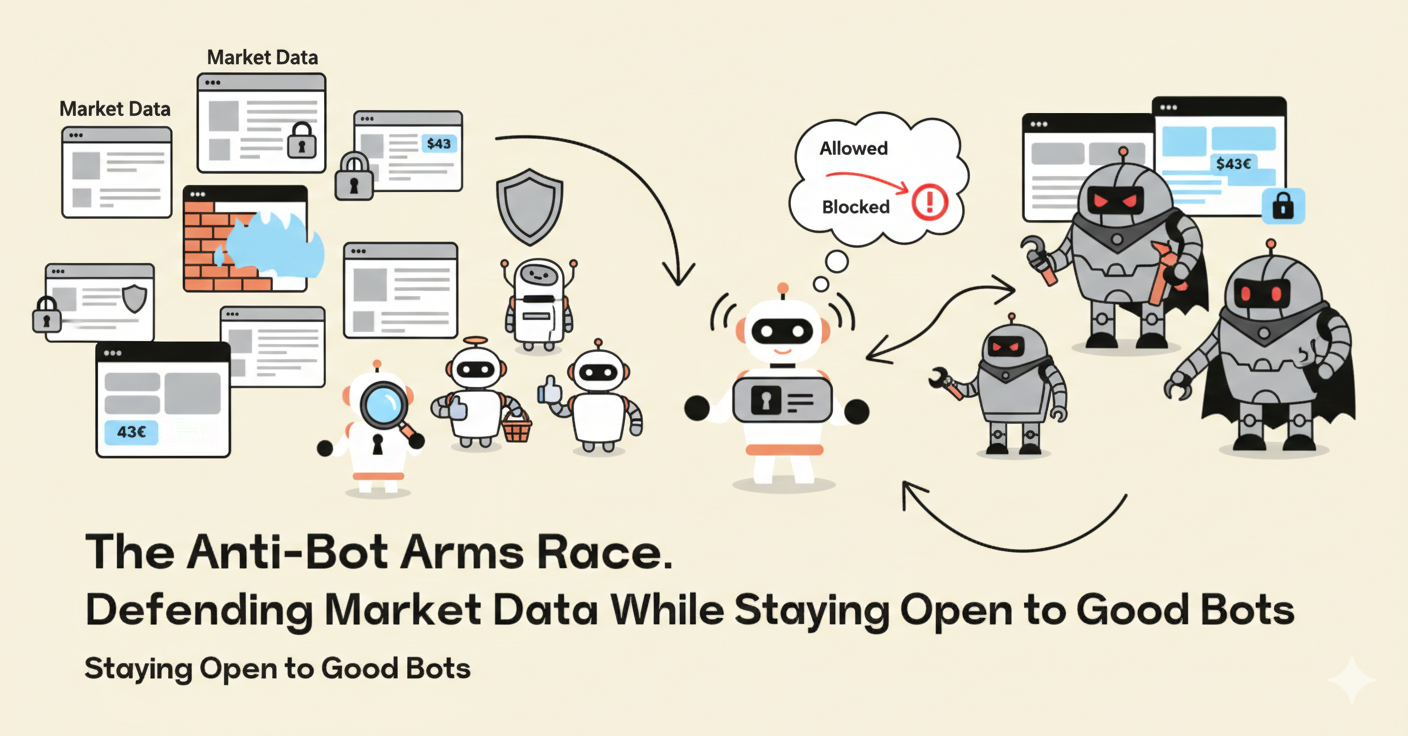
Market Intelligence Has Become Adversarial
For the past twenty years, market intelligence was treated as a technical exercise. Teams built scripts to fetch pages, parse HTML, and record prices. Errors were fixed manually, and as long as the data kept flowing, the business was satisfied.
By 2026, this is no longer the case. Modern e-commerce platforms are intentionally adversarial. Every page may render differently depending on the visitor, device, or interaction history.
The numbers tell a sobering story. According to Imperva's 2025 Bad Bot Report, automated bots now make up over 51% of all web traffic, with malicious bots accounting for 37% of all internet traffic. During Cyber Week 2025, one major retailer reported that 72% of their Black Friday traffic came from malicious bots—not 7%, not 17%, but seventy-two percent.
This evolution has created an anti-bot arms race. The challenge is no longer whether you can collect data—it's whether you can collect it reliably, ethically, and in a way that reflects the true market.
Why Retailers Fight Back
Retailers have strong incentives to restrict automated access.
Profit Protection: Dynamic pricing and promotions can be manipulated if competitors scrape data in real-time. Amazon alone changes prices 2.5 million times daily—exposing this intelligence to scrapers undermines competitive advantage.
Brand Control: Showing inconsistent information to bots can protect brand perception and prevent price-matching that erodes margins.
Data Integrity: Automated scraping may produce skewed insights that drive poor decisions. If your competitor's scraper sees different prices than real customers, their response will be based on false intelligence.
To enforce these goals, platforms implement increasingly sophisticated measures. Cloudflare, Akamai, and AWS Shield now block scrapers based on TLS fingerprinting, behavioral signals, and bot reputation—not just IPs. In July 2025, Cloudflare began blocking AI-based scraping by default, labeling it a violation of trust.
These defenses are subtle. A naive scraper may collect prices but miss key promotional or visual cues, producing inaccurate intelligence that leads to flawed pricing decisions.
Balancing Security and Accessibility
Not all bots are malicious. Many are good bots—trusted partners, analytics tools, affiliate systems, or search engines.
Organizations must distinguish between harmful scraping and legitimate automated access. AI traffic to retail sites grew 770% year-over-year in 2025. People used ChatGPT and Perplexity to research products, then clicked through to buy. That traffic looked automated because it was—but it represented high-intent human shoppers.
Adobe found that AI-referred traffic had 23% lower bounce rates, 12% more page views, and 41% longer sessions than other traffic. Block it indiscriminately, and you've told search engines and AI assistants that your site is hostile to crawlers.
Techniques that enable the balance between protection and accessibility include:
Behavioral Biometrics: Tracking mouse movements, scrolling patterns, and typing cadence to differentiate humans from scripts. Research shows behavioral biometrics achieve 87% accuracy versus 69% for Google reCAPTCHA.
Intent Tokens: Cryptographically signed tokens that allow approved agents to access structured data while blocking unauthorized bots.
Proof-of-Humanity Systems: Verification mechanisms that confirm real human interactions without the friction of traditional CAPTCHAs.
The Decline of CAPTCHAs and IP Blocking
Historically, CAPTCHAs and IP blacklists were sufficient. Today, attackers use distributed bot networks that rotate thousands of IP addresses, AI-powered bots that mimic human behavior, and credentialed automation leveraging account-level access.
The sophistication has reached an inflection point. According to industry reports, advanced AI-driven bots now account for nearly 60% of bot traffic, and they've learned to mimic mouse movements, vary their browsing patterns, and adjust timing to appear human.
Static barriers are no longer reliable. In September 2024, researchers from ETH Zurich announced they had built an AI model capable of defeating visual reCAPTCHAs 100% of the time. This fundamentally breaks the CAPTCHA paradigm.
Modern anti-bot systems rely on continuous behavioral assessment, evaluating trust in real-time rather than through a static checkpoint. The key insight is that bots tend to exhibit linear, predictable movement patterns. A human user might move their mouse in a slightly wavy line with small hesitations and course corrections. A bot typically moves in perfectly straight lines or follows mathematically precise curves.
AI as the Frontline
Artificial intelligence transforms anti-bot defense. Modern AI can detect novel bot behaviors in real-time, predict likely attack vectors before they occur, and adapt defenses dynamically without human intervention.
F5's 2025 Advanced Persistent Bots Report found that bot traffic varied dramatically across industries. For web services, the highest levels of automation targeted Hospitality firms—a staggering 44% of all transactions were bot traffic. Healthcare followed at 32.6%, with eCommerce at 22.7%.
AI turns anti-bot systems from reactive barriers into proactive shields, learning from each interaction and reducing false positives for legitimate users. AI-powered behavioral detection identifies bots by analyzing intent and interaction patterns, using self-learning algorithms that identify emerging bot strategies ahead of time.
The integration of deep learning—including LSTM networks and CNNs—has improved behavioral analysis accuracy by up to 47.3% when combined with traditional methods, reducing error rates in continuous verification.
Operational Implications for Market Intelligence
Companies gathering competitive data must design resilient architectures that account for the adversarial environment.
Flexible Data Pipelines: Able to handle blocking events and dynamic content. Implementing version-aware selectors has reduced downtime by 73% in high-frequency scraping operations, even as target sites deployed multiple hotfixes.
Contextual Analysis: Validate data against behavioral signals to ensure it reflects human-facing content, not bot-specific traps or honeypots.
API Partnerships: Collaborate with platforms via authorized, tokenized access when possible. The era of "scraping as identity game" has arrived—reputation and compliance matter more than proxy rotation.
Compliance isn't just technical, either — for European teams, is price scraping legal in the EU? breaks down the database rights, robots.txt opt-outs, and GDPR rules that shape what "authorized access" actually means.
Ignoring these realities leads to incomplete datasets, AI model drift, and flawed pricing or campaign decisions. Between 2022 and 2026, the number of commercial bot-management and anti-scraping services jumped from 36 to 60, reflecting the escalating arms race.
Good Bots vs. Bad Bots
Bad Bots: Scrapers designed to manipulate pricing, extract sensitive intelligence, or spam digital channels. These include credential stuffing attacks, carding bots, and inventory denial tools that deplete stock before human customers can purchase.
Good Bots: Analytics, affiliate, search engine, and internal automation tools that deliver strategic value. Also includes legitimate competitive intelligence platforms that respect rate limits and robots.txt guidelines.
The key is signal separation: keeping intelligence pipelines open for good bots while neutralizing threats. DataDome's edge-first architecture enables rapid bot detection with low performance impact, distinguishing scraping, scanning, fraud, and other intents.
Platforms that master this balance gain information asymmetry—seeing what competitors cannot while protecting their own intelligence from extraction.
Strategic Advantage of Anti-Bot Measures
Organizations that deploy advanced anti-bot strategies gain more than protection—they shape the rules of engagement.
Control over who sees pricing and promotions: Dynamic defenses can show different content to suspected bots, protecting genuine promotional strategies while feeding misleading data to competitors.
Reduced risk of manipulation: Price Trap attacks—where competitors briefly drop prices to trigger your automated rules—become ineffective when your intelligence systems can distinguish real offers from traps.
Cleaner, human-relevant datasets: When your own scraping infrastructure uses Browser Realism and behavioral mimicry, you collect the same data real customers see. This is the foundation for accurate dynamic pricing and inventory optimization.
By 2026, the companies that survive are those that understand their digital storefront as a strategic battlefield, not just a data source. Akamai processed 11.8 billion bot-related requests on Black Friday 2025 alone—up 79% from the previous year. This is the new baseline reality of e-commerce.
The Future of Market Intelligence in the Anti-Bot Era
The anti-bot arms race is ongoing. Every defensive measure will eventually be tested by new techniques.
Intelligence platforms must evolve with AI-driven detection loops for continuous adaptation, tokenized access frameworks to permit legitimate automation, and integration with behavioral biometrics for accurate human verification.
Multimodal biometrics integrating behavioral data with facial recognition and voice patterns are gaining traction in high-security applications for superior spoof resistance. The behavioral biometrics market itself reached USD 2.92 billion, reflecting enterprise investment in these capabilities.
Success depends on treating intelligence as a living, adversarial system, rather than a static pipeline. The winners will be those who adapt faster than their adversaries—both in defense and in legitimate data collection.
Conclusion
Market intelligence is no longer passive. In 2026, the difference between competitive advantage and blind spots is how effectively you manage the adversarial environment.
Platforms that balance protection and accessibility, leverage AI for detection, and distinguish good bots from bad, secure a Sovereign Data Moat of trustable intelligence—giving them a strategic edge that competitors cannot replicate.
The honest reality? There's no perfect solution. But understanding the problem, investing proportionally to your risk, and accepting that you're sharing your site with automated traffic allows you to make peace with imperfect defenses while still winning the intelligence war.
Frequently Asked Questions
What is the Anti-Bot Arms Race?
The Anti-Bot Arms Race describes the ongoing battle between organizations protecting their data and attackers attempting to scrape it. In 2026, it includes AI-powered detection, behavioral analysis, and dynamic defenses. With bots now comprising over 51% of web traffic and malicious bots accounting for 37%, this has become a board-level strategic concern.
How do behavioral biometrics help detect bots?
Behavioral biometrics analyze interaction patterns such as mouse movements, scrolling speed, and typing cadence to differentiate human users from automated scripts. Research shows behavioral biometrics achieve 87% detection accuracy—significantly outperforming traditional CAPTCHAs at 69%. Bots tend to exhibit linear, predictable movements while humans show natural irregularities.
What are intent tokens and how do they work?
Intent tokens are cryptographically signed identifiers issued to trusted agents, such as approved good bots or internal automation. They allow controlled access to data streams while blocking unauthorized bots, creating a permissioned layer that distinguishes legitimate automation from malicious scraping.
What is proof-of-humanity?
Proof-of-humanity mechanisms verify that an interaction originates from a real human without relying on traditional CAPTCHAs. Combined with AI analysis of behavioral signals, they allow platforms to distinguish between good bots, malicious bots, and genuine users—all while maintaining low friction for legitimate visitors.
Why are traditional CAPTCHAs and IP blocks insufficient?
Modern bots can rotate IPs through distributed networks, mimic human behavior using AI, and exploit account-level automation. Researchers have demonstrated AI models that defeat visual CAPTCHAs with 100% accuracy. Static defenses are easily bypassed, making dynamic AI-driven behavioral assessment essential.
How do anti-bot measures affect market intelligence?
Effective anti-bot measures ensure that data collected reflects what real human customers see. This prevents manipulation, reduces noise, and ensures AI-driven pricing insights are accurate and actionable. For intelligence collectors, this means investing in Browser Realism and behavioral mimicry to see the same prices customers do.
Can organizations block all bots?
Blocking all bots is counterproductive. Good bots like search engine crawlers, analytics tools, and affiliate partners are essential for operations. AI-referred traffic shows 23% lower bounce rates and 41% longer sessions—blocking it means losing high-intent customers. Tiered access and token-based systems allow safe differentiation.
What role does AI play in modern anti-bot systems?
AI continuously monitors user behavior, identifies new bot patterns, predicts potential attacks, and dynamically adapts defenses. Deep learning models like LSTM networks and CNNs have improved behavioral analysis accuracy by up to 47.3%. AI transforms anti-bot strategies from reactive barriers into proactive, intelligent shields.
How can market intelligence teams adapt to the adversarial environment?
Teams should build flexible data pipelines that handle blocking events, implement version-aware selectors that adapt to site changes, validate data contextually to ensure it reflects human-facing content, and pursue API partnerships for authorized access when available. Treating robots.txt as a compliance signal is increasingly important.
What is a "Sovereign Data Moat"?
A Sovereign Data Moat refers to the strategic advantage gained when an organization protects its own intelligence while maintaining superior collection capabilities. By deploying advanced anti-bot defenses and legitimate scraping infrastructure, companies see what competitors cannot—creating information asymmetry that drives better pricing, inventory, and campaign decisions.
Paste any URL — ScrapeWise handles the anti-bot
Managed infrastructure that adapts when sites change. No proxies, no code, no per-request fees.
Not ready to sign up? See 12 real Amazon rows, 972 columns →
97% accuracy on Amazon benchmarks · no credit card · book a 15-min call →