
Sephora Scraper
We do not have a dedicated Sephora data API. What we do have is an AI scraper that reads a sephora.com page you point it at, turns it into the columns you asked for and hands them back by REST, CSV or Excel — on a schedule, priced per page.
- sephora.com
- sephora.fr
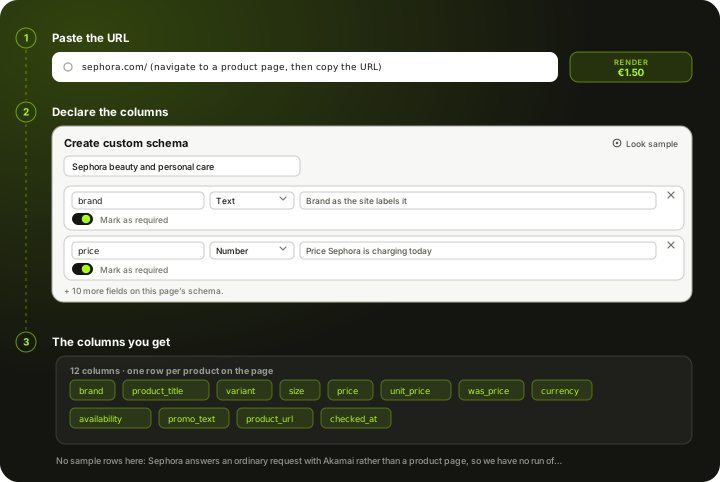
How to scrape Sephora
Sephora publishes no read API for its catalogue. There is no key to apply for and no endpoint to call, which is why the page is the interface. Sephora sets the prestige beauty price in the US and much of Europe, so it is the ceiling in nearly every fragrance and cosmetics comparison. The way to get the data is to read the page the way a customer sees it: point the AI scraper at a sephora.com URL, declare the columns you want in plain English, and schedule it. Beauty prices are set per size and per shade, and a gift-with-purchase or a sampling offer can be worth more than a discount without touching the price at all.
What the AI scraper does with a sephora.com link
The same three steps as any other page you point it at. Nothing about Sephora is pre-built, which is exactly why it works on pages nobody wrote a connector for.
Paste the link
Give it a sephora.com product or listing URL. Market, currency and assortment all come from the page itself, so there is no region setting to get wrong — the URL decides.
Declare the columns
Name each field, give it a type and write a line telling the AI what to look for. “brand” and “product_title” are the two most people start with. The schema is yours and you can change it between runs.
Schedule it and collect
Run it hourly, daily or on demand. Every run returns the same columns in the same order with a timestamp on each row, so the history builds itself.
Set it up once. The data keeps coming.
Save your search once and it runs by itself. Every run lands in your own Scrapewise database, and you pick how to read it.
Set it up once
Add your ASINs, keywords, places or apps to a scraper in the web app. New accounts get 5 free requests.
Runs on your schedule
Pick daily, weekly on the days you choose, every few days, or the first or last day of the month. Scheduled runs start at night, European time. Need it more often? Start runs from your own code.
Saved in your database
Each run adds dated rows, so this week sits next to last week. Rows are kept for 90 days.
Use it your way
Open the table in the web app and download the latest run as an Excel file. Ask your own AI assistant about it. Or pull the rows into your code with an API key.
Ask your AI assistant about your own data
Connect Claude Desktop or Claude Code with a read-only key. The assistant reads the rows you've already collected, at no extra cost on Scrapewise. With a full-access key it can start a run for you too.
- Which of my ASINs lost the Buy Box this week?
- Which competitor cut prices the most since Monday?
- Show the keywords where I dropped out of the top 10.
What you send and what you get
You send a link and a column list. Everything else — market, currency, which products are on the page — comes from the page, so there is nothing to configure twice.
- Link to a Sephora pagerequired
Open the product or category page in your browser and copy the address. Any Sephora country domain works the same way.
https://www.sephora.com/ - Your column listrequired
Field name, type and one line of plain English per column. Written once, reused on every run.
brand, product_title, variant, size - How often it runsoptional
Hourly, daily, weekly or on demand through the API. Daily is what most price monitoring uses.
Daily at 06:00 UTC
One row per product on the page, 6 columns each
- product_title
- price
- currency
- availability
- brand
- source_url
REST API, CSV or Excel. The column set stays the same between runs, so downstream jobs do not re-map fields.
What a run on Sephora actually returned
This is real output, not a mock-up. 2 rows, collected on 3 October 2026 from live sephora.com product pages through our own engine, the same way one of your runs would. Prices move, so treat the numbers as a sample of shape rather than a current price list.
All 6 columns
- product_title
- price
- currency
- availability
- brand
- source_url
product_titleproduct_titleProduct title as the retailer writes it | pricepricePrice the page is charging today | currencycurrencyCurrency the page quoted | availabilityavailabilityStock state the page published | brandbrandBrand as the retailer labels it | source_urlsource_urlThe exact page this row was read from |
|---|---|---|---|---|---|
| FutureIQ™ Hair Longevity Serum for Graying, Thinning, & Scalp Aging | 120 | USD | InStock | K18 Biomimetic Hairscience | https://www.sephora.com/product/futureiq-hair-longevity-serum-for-graying-thinning-scalp-aging-P525639?icid2=homepage_slideshow_hair_program_k18biomimetichairscience_fy265441_broadcast_us_rwd_banner_081026_fallback |
| BOUJEE KITTY CARAMEL MILK 22 | Eau de Parfum | 105 | USD | InStock | KAYALI | https://www.sephora.com/product/P525521?icid2=homepage_slideshow_fragrance_brand-sku-launch_program_kayali_fy265392_broadcast_us_ca_rwd_banner_080326_boujeekittycaramel |
Column names are ones we chose when declaring the schema for this run. Yours can be named whatever your downstream job already expects. Columns not shown here — sku — are ones these pages did not publish. An empty cell would have been the honest answer on every row, so we left them out rather than pad the table.
What a Sephora page costs
Pay-as-you-go from your wallet. No plan, no monthly fee, no seat count.
Measured on 3 October 2026, not assumed. A plain request for a sephora.com page returns a document rather than a refusal, but Akamai is in front of it, and the parts of the page that carry price are filled in by JavaScript after load, so a browser is what makes the run reliable.
500 Sephora pages checked once a day for a month is 15,000 pages.
about EUR 22.50 for the month
You are charged for what a run actually used, not what it was expected to need, and your balance never expires.
See the full price list →What this page is not promising
We would rather say this here than in a support ticket.
No dedicated Sephora endpoint
There is no Sephora API in our catalogue and no pre-built Sephora schema. The AI scraper reads the page you point it at — that is the whole mechanism, and it is why it works on pages nobody built a connector for.
Nothing behind a login
It reads what a visitor can see. Account pricing, contract pricing and anything behind a sign-in are out of scope.
No field the page does not show
If the page does not print it, the scraper cannot return it. Identifiers like EAN or GTIN only come back where the retailer publishes them.
A price is a point in time
Every row carries the timestamp of the run that collected it. A price without one is not evidence, which is why the column is in the default schema.
Sephora has one specific trap
Shade and size variants carry different prices under one product page and the default shade is not always the cheapest.
Not a bulk dump of the catalogue
You give it the URLs you care about. It does not crawl sephora.com end to end, and a schedule that tried to would cost more than the answer is worth.
Typical fields the AI scraper extracts from a Sephora page
Treat this as a starting point rather than a fixed schema. What comes back is whatever the page actually shows on the day of the run.
Size and shade set the price
Beauty is the category where one product page is many prices, and where a size scrape without a size column is unusable.
- Price for the size the page is showing
- Size exactly as printed
- Price per 100 ml or 100 g where printed
- Shade or formulation the page is showing
- Which sizes and shades are listed at all
Offers that are not discounts
A gift with purchase, a sampling offer or a bundle moves perceived value without moving the price, and it is text on the page.
- Gift-with-purchase or offer wording as printed
- Strike-through or was-price where shown
- Bundle or set composition, where the page lists it
- Loyalty or member price where shown
- Promotion end date, where printed
Product identity
Beauty catalogues are brand-dense, so brand and variant are the join keys rather than a part number.
- Brand as labelled
- Site's own product code
- EAN or GTIN, where published
- Category breadcrumb
- Ingredient list, where rendered
- Rating and review count, where shown
The column list is one you write: name each field, give it a type and a line telling the AI what to look for. The schema belongs to your run, not to us. How Custom Schema works →
What it cannot give you If a field is not visible on the page, the scraper cannot invent it. Identifiers such as EAN or GTIN only come back when Sephora publishes them.
What people use Sephora data for
Price per 100 ml comparison
The only honest comparison in beauty, because the same product in two sizes is two different value propositions. Size as a column makes it computable.
Gift-with-purchase tracking
Beauty competes on offers more than on discounts, and the offer is text on the page. Capturing that wording daily reconstructs a competitor's promotional calendar.
Brand price-floor checks
If you own a beauty brand, this is how you see what your products are actually listed at across the retailers that carry them, per size, with the date attached.
Shade and range availability
Which shades a retailer actually stocks, and which have quietly gone out of stock, is a range signal that price data alone misses.
Assortment research before a launch
What a category carries, at what price points and sizes, from which brands, rather than what a category report says it carries.
Feeding your own pricing rules
The export is a normal REST API or CSV, so size, price and per-unit price land in whatever pricing model you already run.
What makes Sephora harder than an ordinary storefront
Here is what the scraper is actually up against on sephora.com, measured rather than assumed.
Access
- Plain HTTP requests are answered, but the answer is the shell of the page rather than the priced version of it
- Named protection on the response: Akamai
- robots.txt publishes sitemaps, which is the cheapest way to build the URL list a run works through
Sizes and shades multiply the page
- Each size usually carries its own price, so a single price column is ambiguous without a size column
- Shades are frequently separate variants with their own stock state and sometimes their own price
- Offers are free text rather than a percentage, so they have to be captured as written rather than parsed into a number
- Brand and category pages are lazily loaded, so a sweep is a list of URLs rather than one request
What the page publishes
- No product-level structured data is published, so every field is read off the rendered page
- Shade and size variants carry different prices under one product page and the default shade is not always the cheapest.
- Price is one of the last things the page settles on, so a read taken too early records the placeholder rather than the number
Keeping a history
- A single read is a snapshot; the value is in the series, which means the run has to be scheduled and the rows kept
- Every row carries the timestamp of the run that produced it, so two days can be compared without guesswork
- Columns stay stable between runs, so a dashboard written once does not break when the site redesigns
Sephora scraping — questions
What people ask before pointing the scraper at sephora.com.
Sephora publishes no read API for its catalogue. There is no key to apply for and no endpoint to call, which is why the page is the interface.
Ready to pull Sephora data into your stack?
Start free — or talk to our team about your exact fields, refresh cadence and volume.