
Market Intelligence Has Become Adversarial
For the past twenty years, market intelligence was treated as a technical exercise. Teams built scripts to fetch pages, parse HTML, and record prices. Errors were fixed manually, and as long as the data kept flowing, the business was satisfied.
By 2026, this is no longer the case. Modern e-commerce platforms are intentionally adversarial. Every page may render differently depending on the visitor, device, or interaction history.
Competitors are no longer passive; they deploy dynamic defenses designed to frustrate scraping, mislead automated agents, and protect sensitive signals.
This evolution has created an anti-bot arms race. The challenge is no longer whether you can collect data—it’s whether you can collect it reliably, ethically, and in a way that reflects the true market.
Why Retailers Fight Back
Retailers have strong incentives to restrict automated access:
- Profit Protection: Dynamic pricing and promotions can be manipulated if competitors scrape data in real-time.
- Brand Control: Showing inconsistent information to bots can protect brand perception.
- Data Integrity: Automated scraping may produce skewed insights that drive poor decisions.
To enforce these goals, platforms implement measures such as:
- Behavioral gating: Detecting and challenging non-human interaction patterns.
- Dynamic content rendering: Showing different data to suspected bots.
- Intent-based masking: Only allowing certain content to appear for verified humans.
These defenses are subtle. A naive scraper may collect prices but miss key promotional or visual cues, producing inaccurate intelligence.
Balancing Security and Accessibility
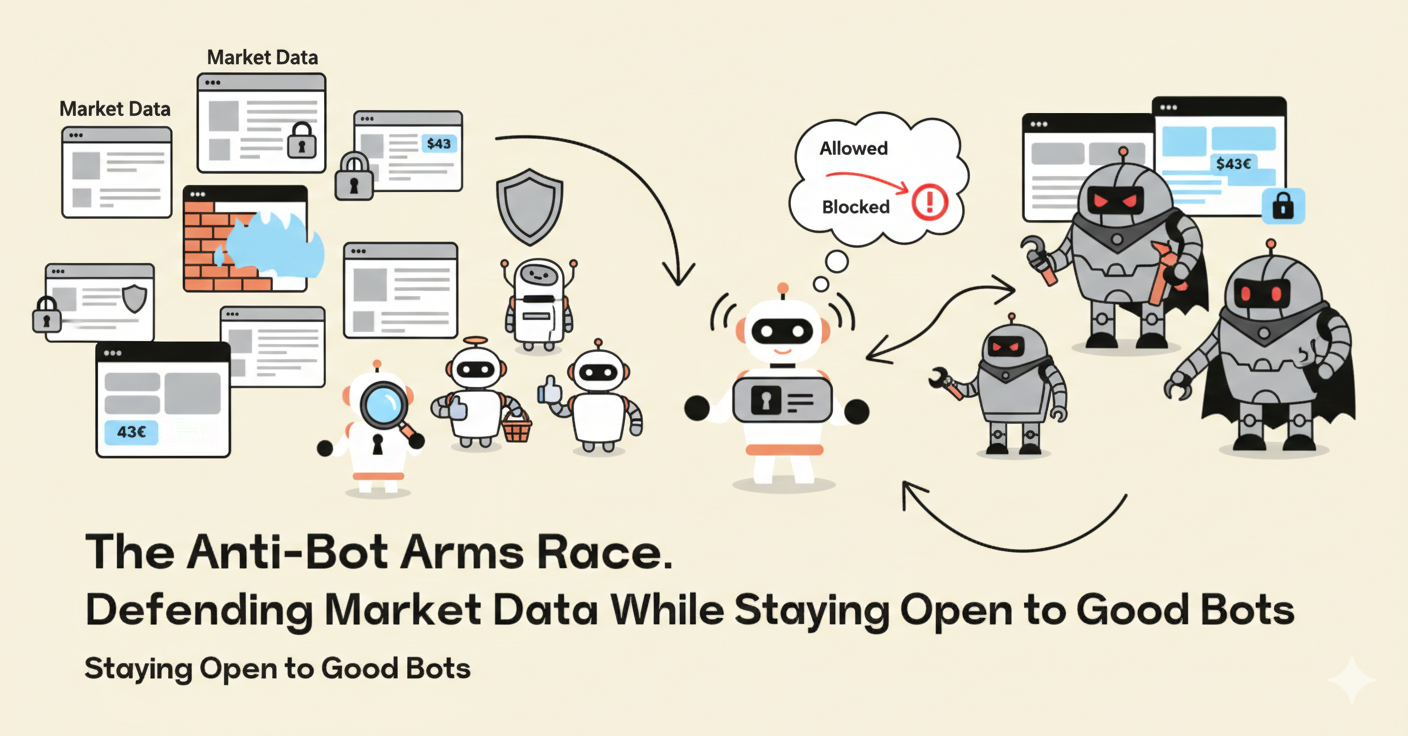
Not all bots are malicious. Many are good bots—trusted partners, analytics tools, affiliate systems, or search engines.
Organizations must distinguish between harmful scraping and legitimate automated access.
Techniques that enable this balance include:
- Behavioral Biometrics: Tracking mouse movements, scrolling patterns, and typing cadence to differentiate humans from scripts.
- Intent Tokens: Cryptographically signed tokens that allow approved agents to access structured data.
- Proof-of-Humanity Systems: Verification mechanisms to confirm real human interactions.
Implementing these systems allows platforms to protect their data without obstructing valuable automation.
The Decline of CAPTCHAs and IP Blocking
Historically, CAPTCHAs and IP blacklists were sufficient. Today, attackers use:
- Distributed bot networks that rotate thousands of IP addresses.
- AI-powered bots that mimic human behavior.
- Credentialed automation leveraging account-level access.
Static barriers are no longer reliable. Modern anti-bot systems rely on continuous behavioral assessment, evaluating trust in real-time rather than through a static checkpoint.
AI as the Frontline
Artificial intelligence transforms anti-bot defense. Modern AI can:
- Detect novel bot behaviors in real-time.
- Predict likely attack vectors before they occur.
- Adapt defenses dynamically without human intervention.
AI turns anti-bot systems from reactive barriers into proactive shields, learning from each interaction and reducing false positives for legitimate users.
Operational Implications for Market Intelligence
Companies gathering competitive data must design resilient architectures:
- Flexible Data Pipelines: Able to handle blocking events and dynamic content.
- Contextual Analysis: Validate data against behavioral signals to ensure it reflects human-facing content.
- API Partnerships: Collaborate with platforms via authorized, tokenized access when possible.
Ignoring these realities leads to incomplete datasets, AI model drift, and flawed pricing or campaign decisions.
Good Bots vs. Bad Bots
- Bad Bots: Scrapers designed to manipulate pricing, extract sensitive intelligence, or spam digital channels.
- Good Bots: Analytics, affiliate, search engine, and internal automation tools that deliver strategic value.
The key is signal separation: keeping intelligence pipelines open for good bots while neutralizing threats.
Platforms that master this balance gain information asymmetry, seeing what competitors cannot.
Strategic Advantage of Anti-Bot Measures
Organizations that deploy advanced anti-bot strategies gain more than protection—they shape the rules of engagement:
- Control over who sees pricing and promotions
- Reduced risk of manipulation by competitors
- Cleaner, human-relevant datasets feeding AI models
By 2026, the companies that survive are those that understand their digital storefront as a strategic battlefield, not just a data source.
The Future of Market Intelligence in the Anti-Bot Era
The anti-bot arms race is ongoing. Every defensive measure will eventually be tested by new techniques.
Intelligence platforms must evolve:
- AI-driven detection loops for continuous adaptation
- Tokenized access frameworks to permit legitimate automation
- Integration with behavioral biometrics for accurate human verification
Success depends on treating intelligence as a living, adversarial system, rather than a static pipeline.
Conclusion
Market intelligence is no longer passive. In 2026, the difference between competitive advantage and blind spots is how effectively you manage the adversarial environment.
Platforms that balance protection and accessibility, leverage AI for detection, and distinguish good bots from bad, secure a Sovereign Data Moat of trustable intelligence, giving them a strategic edge that competitors cannot replicate.